Zen Sand Garden
Rake calm grooves into fine sand around mossy stones.
How to play
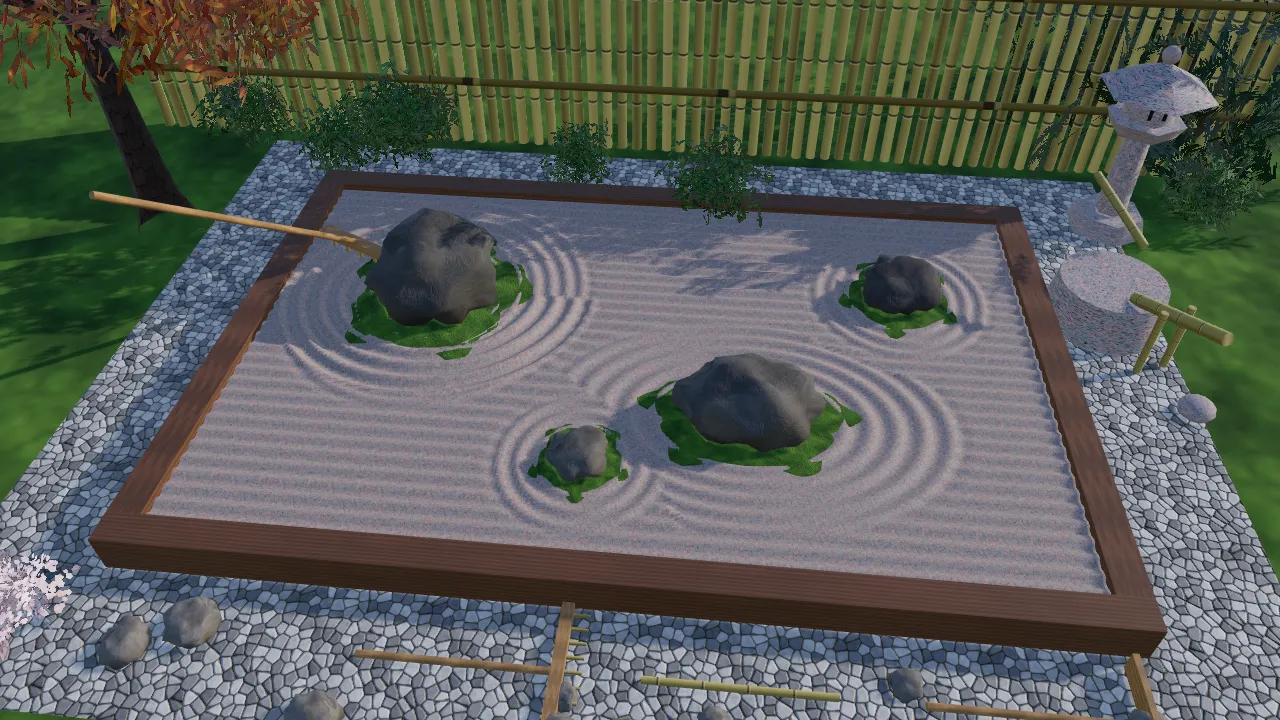
- Drag across the sand to rake grooves. The rake turns to follow your stroke.
- Circle a stone to draw ripples around it. Drag a stone itself to move it somewhere new.
- Tap a tool lying on the pebbles in front of the frame to pick it up: a wide rake, a single bamboo tine or a smoothing board.
- Tap the bamboo deer-scarer to tip it early, or wait for it to fill and knock. Try the three Challenges, or open Lab for the sand settings.
Challenges
- Rake one straight line from one side of the garden to the other
- Rake a complete ring around one of the stones
- Rake a ring around every stone, like a temple garden
Try this
- Set the angle of repose to 22° and rake: the ridges slump into soft waves. At 45° they stay sharp, more like damp sand.
- Rake straight across some ripples. The sand you cut through is pushed into the ridges beside your tines, because the sand you move has to go somewhere.
- Turn the water into the bamboo up and down and time the tocks. The tube tips as soon as the turning effect of the water beats the tube’s own weight.
Fun facts
- Japanese dry landscape gardens, called karesansui, use raked gravel or sand to suggest water, with stones standing for islands or mountains.
- The rock garden of Ryōan-ji in Kyoto has fifteen stones, arranged so that from any spot on its viewing veranda at least one of them is hidden.
- Dry sand piles up to about 30–35°. Damp sand can stand much steeper, because tiny bridges of water between the grains hold them together.
- A shishi-odoshi, or deer-scarer, was first used by farmers to scare deer and boar away from crops with its regular knock.
Sand, grooves and the angle of repose
Karesansui, the dry landscape garden, is one of Japan’s best-known garden styles. Many of the finest examples were made at Zen Buddhist temples, where raking the gravel each morning is part of the daily routine. The raked lines suggest flowing water, ripples spread out around stones like waves around islands, and the whole garden is meant to be looked at quietly rather than walked through. This little garden lets you try the raking, and the physics of sand turns out to be just as interesting as the patterns.
Sand is a strange material
A heap of sand is neither a solid nor a liquid. Each grain is hard, but the grains can slide past one another. They only do so when the slope is steep enough for gravity to beat the friction between them. The steepest slope a heap can hold is called the angle of repose. For dry, rounded sand it is about 30–35°. Angular grains lock together and stand a little steeper, and a touch of water makes sand much stronger still, which is why sandcastles need damp sand.
How the simulation rakes
The sand is stored as a grid of heights, one every two centimetres or so. Each tine of the rake carves a rounded groove and pushes the sand it removes to either side of its path, so no sand is created or destroyed and ridges grow between the tines. Then an avalanche rule runs over the disturbed area: wherever two neighbouring heights differ by more than the angle of repose allows, part of the excess slides from the higher cell to the lower one. Repeating this lets small landslides spread until every slope is stable. This kind of “sandpile model” is a classic tool in physics for studying how avalanches of all sizes arise.
The bamboo deer-scarer
The shishi-odoshi is a seesaw. Water trickles into the open end of a bamboo tube. Empty, the tube rests on its heavy closed end. As water collects, the turning effect (torque) of its weight about the pivot grows, until it beats the torque of the tube’s own weight. The tube tips, pours out the water, swings back and knocks on its stone. More water flow means the tipping point arrives sooner, so the knocks come faster.
For the curious
Two neighbouring cells a distance Δx apart are stable while |h₁ − h₂| ≤ Δx·tan θr. If the difference is bigger, the simulation moves 45% of the excess downhill and repeats several times per frame. For the deer-scarer, water mass m at lever arm a tips the tube when m·g·a > M·g·b, where M is the tube’s mass and b the distance from the pivot to its centre of mass. Here the tube tips at about 120 millilitres.
Questions people ask
What is a zen garden?
A zen garden, or karesansui, is a Japanese dry landscape garden made of raked gravel or sand, carefully placed stones and sometimes moss. The gravel suggests water and the stones suggest islands or mountains. Many were created at Zen Buddhist temples as places for quiet contemplation.
Why is the sand in a zen garden raked into lines?
The lines and ripples represent flowing water and waves spreading around islands. Raking the pattern is also a calm, focused activity in its own right, and in many temples it is done regularly to keep the garden fresh.
What is the angle of repose?
It is the steepest angle at which a pile of loose grains, such as sand or gravel, can rest without sliding. Dry sand settles at about 30 to 35 degrees. Steeper slopes collapse in small avalanches until they reach that angle again.