Bubble Sheet Popping
Squeeze, pop and swipe endless sheets of 3D packing bubbles.
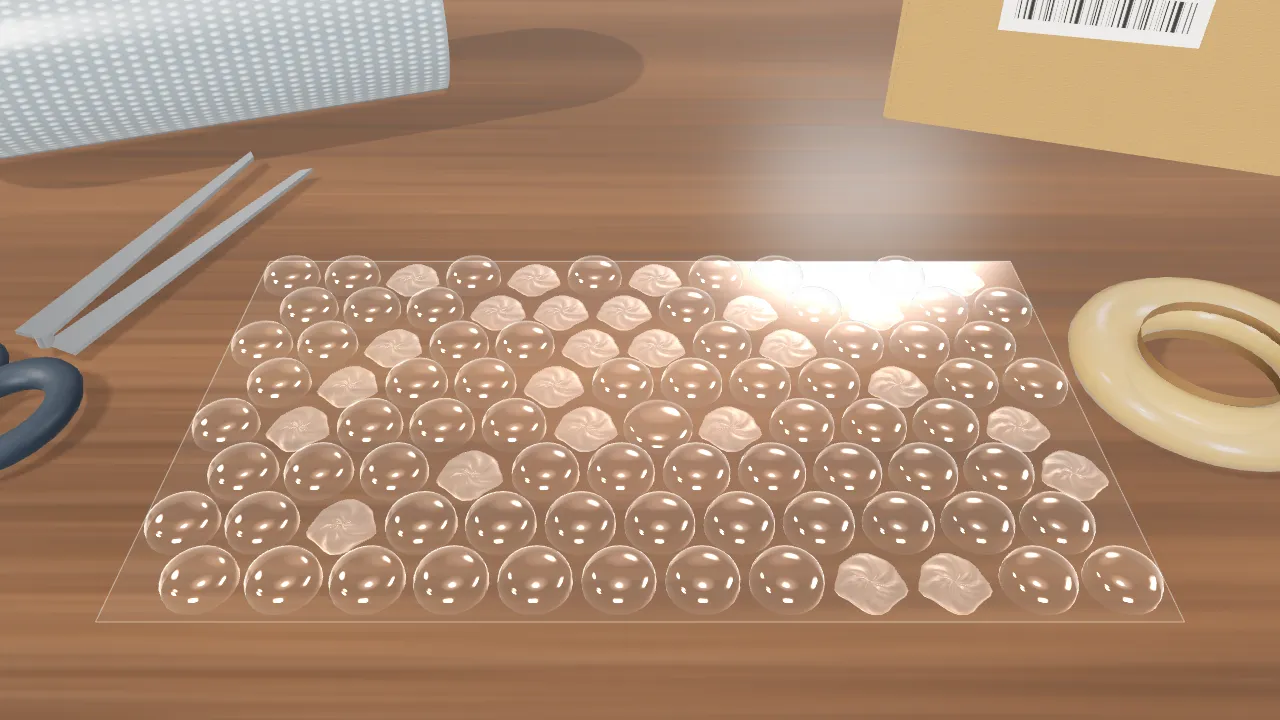
How to play
- Press a bubble and hold until it pops. Some are more stubborn than others.
- Swipe along a row to pop a whole line. Slow down a little over the stubborn ones.
- Tap the bubble roll at the back of the desk for a fresh sheet. Pop every bubble and a new sheet comes off the roll by itself.
- Try the three Challenges, or open Lab for small bubbles, tinted plastic and a musical mode where every bubble plays a note.
Challenges
- Pop a whole row of bubbles in one swipe
- Find a dud: a bubble that sighs flat instead of popping
- Pop every single bubble on one sheet
Try this
- Switch to small bubbles and notice they need a firmer squeeze, just like the real thing.
- Watch the pressure readout while you hold a bubble, and see how high it climbs before the pop.
- Turn on musical mode and swipe slowly along a row to play a scale.
Fun facts
- Bubble packaging was invented in 1957 by engineers Alfred Fielding and Marc Chavannes, who were originally trying to make textured wallpaper.
- An appreciation day for bubble packaging is celebrated on the last Monday of January.
- Squeezing a bubble to half its volume doubles the pressure of the air inside, if the temperature stays the same.
- Every so often a bubble has a tiny leak and sighs instead of popping. This simulation has a few of those too.
Why a bubble pops
Each bubble is a sealed pocket of air. When you press down, you shrink the space the air can occupy, and the air pushes back harder. This is Boyle’s law: at a steady temperature, pressure and volume are inversely proportional, so P₁ × V₁ = P₂ × V₂. Squeeze a bubble to three-quarters of its volume and the pressure inside rises by a third.
The plastic film around the air has to hold that pressure in, and the higher the pressure, the harder the film is stretched. Eventually the stretch is more than the plastic can take, a weak point tears, and the compressed air rushes out all at once. That sudden burst of escaping air sends a pressure wave through the room: the pop you hear. In this simulation every bubble has its own slightly different breaking point, which is why some burst at the lightest touch and others need a firm press. Now and then a bubble has a weak seal instead: the air seeps out with a sigh and the bubble slowly goes flat.
Why small bubbles are harder to pop
It feels backwards, but it is real. For a thin curved skin, the stress in the film is proportional to the pressure multiplied by the bubble’s radius. A small bubble with the same film thickness has to reach a higher pressure before its skin is stretched to breaking point. That is why the small-bubble sheet in the Lab needs more squeeze, and why tiny bubbles on real packaging can be so stubborn.
Why it feels so good
Popping combines a little effort, a clear moment of success and a satisfying sound, over and over, with nothing at stake. Psychologists have even studied it: a small study in 1992 reported that people felt calmer after popping packing bubbles. Here the roll never runs out, so you can pop for as long as you like.
For the curious
The pressure readout uses P = P₀ × V₀ / V, starting from normal air pressure, P₀ ≈ 101 kPa. Most bubbles here burst somewhere between about 130 and 240 kPa, depending on their size. For a thin spherical shell the film stress is σ = P r / 2t, where r is the radius and t the film thickness, which is why a smaller r needs a larger P to reach the same breaking stress. (Strictly, σ uses the extra pressure above the outside air, but the idea is the same.)
Questions people ask
Is popping packing bubbles really relaxing?
Many people find it soothing: it is repetitive, gives instant feedback and has a satisfying sound. A small 1992 psychology study reported that participants felt calmer after popping packing bubbles.
Why do packing bubbles make a popping sound?
Squeezing raises the air pressure inside the bubble until the plastic tears. The compressed air escapes in a sudden rush, creating a pressure wave in the air that we hear as a pop.
Why are small bubbles harder to pop?
The stretch in a curved film is proportional to pressure times radius. A smaller bubble therefore needs a higher pressure before its film is stretched enough to tear.