Domino Rally
Lay wooden dominoes on the floor, tip the first and hear the run fall.
How to play
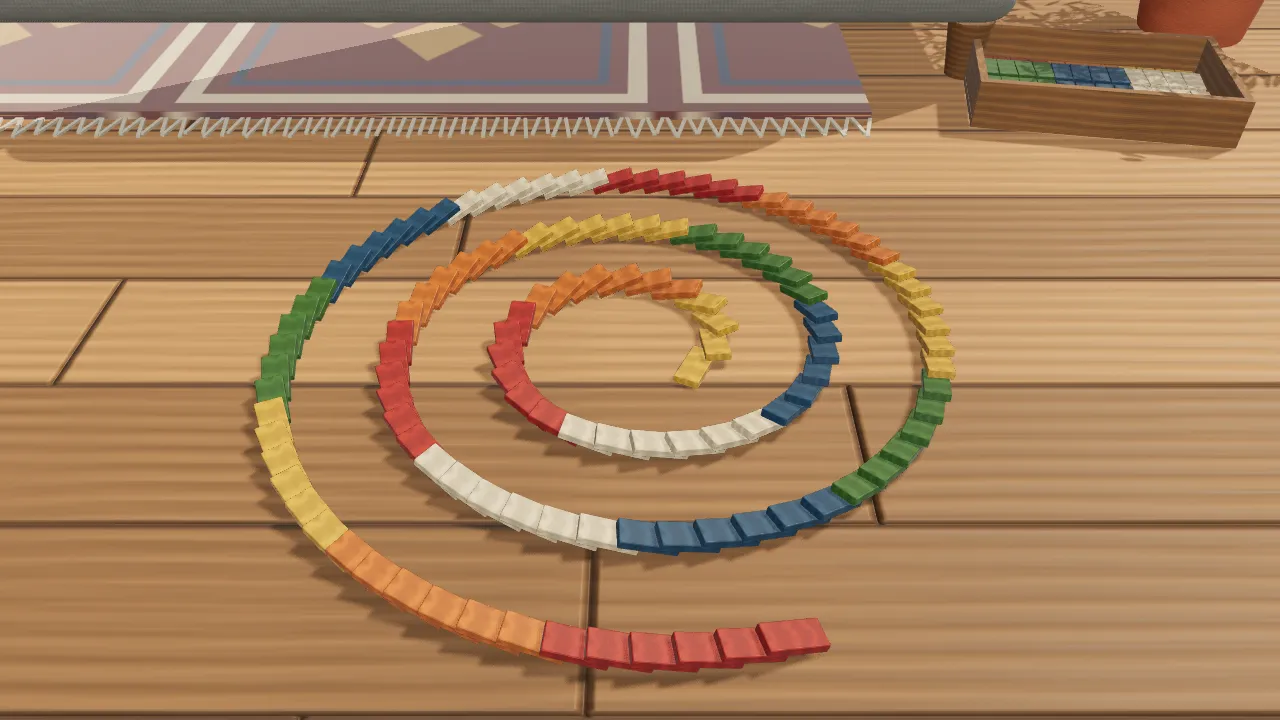
- Drag on the floor to lay a line of dominoes. Start from the last domino of a line to keep it going.
- Tap a domino to tip it over. Tap a fallen domino to stand the whole layout back up.
- To split a line, press beside a domino in the middle of it and draw away. The next domino slides aside to make room for your branch.
- Try the three Challenges, or open Lab for ready-made layouts, spacing, gravity and slow motion. Choose Look around to turn the view.
Challenges
- Topple a run of 50 dominoes with a single tap
- Split a line into two branches and topple both of them
- Draw your own spiral, a full turn or more, and topple all of it
Try this
- Lay two runs with different spacings and compare the wave speed readout for each.
- Switch gravity to the Moon. The same run takes about two and a half times longer to fall.
- Turn on slow motion and watch each domino lean on the next as it passes the push along.
Fun facts
- In 1983 the physicist Lorne Whitehead showed that a falling domino can knock over another about one and a half times its size.
- The record for the most dominoes toppled was set at Domino Day 2009 in the Netherlands, when 4,491,863 dominoes fell.
- Bigger dominoes fall more slowly. A garden domino ten times the height of these would topple about three times more slowly, because the time grows with the square root of the height.
- Every collision here plays the next note of a five-note scale, so every run you build plays its own little melody.
How a tiny push becomes a chain reaction
A standing domino is balanced, but only just. Tilt it a few degrees and nothing happens: it rocks back. Tilt it past its tipping point, where its centre of mass passes over the front edge, and gravity takes over. For these wooden dominoes, which are 4.8 cm tall and 8 mm thick, that point is only about 9.5 degrees.
More energy out than in
Here is the secret of the domino effect. Pushing a domino past its tipping point lifts its centre of mass by a fraction of a millimetre, so it takes almost no energy. As it falls, its centre of mass drops by more than a centimetre, releasing far more energy than you put in. Some of that energy goes into knocking the next domino past its tipping point, and the rest is left over. Each domino delivers more than enough to the next, so the wave never runs out of push, which is why a domino can even topple one bigger than itself.
Why small dominoes fall so fast
The time a block takes to topple grows with the square root of its height divided by gravity. Make a domino ten times taller and it falls about three times more slowly, the same way a tall tree seems to topple in slow motion while a pencil drops in a blink. Lower gravity slows the whole wave too: on a straight run with 3 cm spacing, the wave in this simulation travels about 1.2 m/s on Earth, 0.5 m/s on the Moon and 1.7 m/s on Jupiter.
Spacing, splits and spirals
A domino can only reach the next one if they are closer than its height. Within that limit, spacing changes how far each domino falls before it strikes and how fast it is moving when it does. Builders split a line by standing two dominoes side by side, each overlapping half of the one behind, so a single falling domino pushes both. Curves work as long as each domino still faces roughly toward the next, which is why a spiral tightens gently instead of turning sharp corners.
For the curious: the model
Each domino is a rigid block rotating about its front-bottom edge: I θ″ = m g (½H sin θ − ½T cos θ), with moment of inertia I = m(H² + T²)/3. The bracket is negative when the domino is upright (it rocks back) and turns positive beyond the tipping angle tan θ = T/H. When a domino’s top corner meets the back face of a domino in front of it, an impulse transfers angular momentum using the exact lever arms, and the pair then stays in contact while the fallen one leans on the next. Every domino keeps a list of the dominoes within its reach, which is how one domino can knock over two at a split. That is why a finished run lies in a neat row of leaning tiles.
Questions people ask
Why do dominoes fall one after another?
Each domino needs only a tiny push to pass its tipping point, but releases much more energy as it falls. That surplus is enough to tip the next one, so the wave keeps itself going all the way down the line.
How far apart should dominoes be?
Closer than their own height, so a falling domino can reach the next. Around half to two-thirds of the height is a reliable spacing. Very close spacing can work too, but needs a firmer first push.
Do bigger dominoes fall faster?
No, they fall more slowly. Toppling time grows with the square root of the domino’s height, which is why tabletop dominoes topple in a blink and giant garden dominoes fall gracefully.