Wave Pool and Rubber Ducks
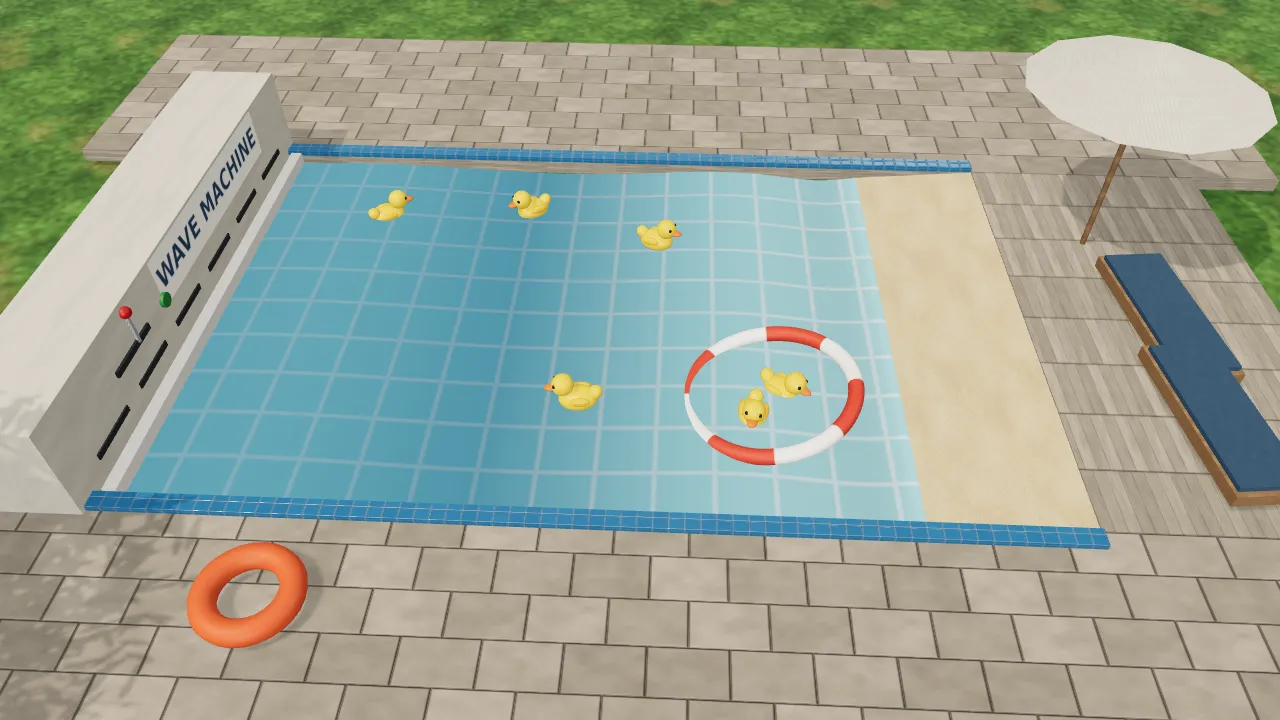
Splash the water to herd bobbing rubber ducks into the striped ring.
How to play
- Tap the water near a duck to make a splash. The surge pushes nearby ducks away from it.
- Herd every duck into the striped ring. Once a duck is inside, it stays.
- Push the red lever on the wave machine for bigger waves, or tap its round button to stop and start it.
- There is no timer. Try the Challenges, or open Lab for the wave period and free duck grabbing.
Challenges
- Splash a duck into the striped ring
- Herd every duck into the ring
- Turn the wave machine up and lift a duck 8 cm on a passing crest
Try this
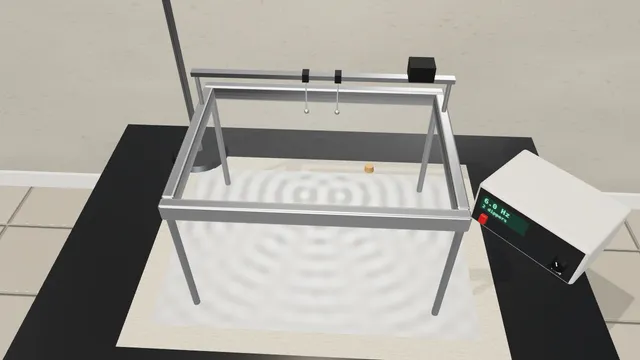
- Turn off the wave machine and watch a single splash. The ripples race outward while the ducks mostly bob in place.
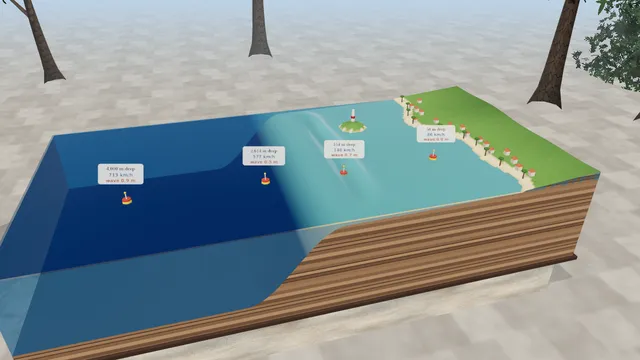
- Compare the two wave speed readouts: waves slow from about 3.4 m/s in the deep end to about 1.4 m/s near the beach.
- Watch the waves as they approach the sand. They bunch up and grow taller as the water gets shallower.
Fun facts
- In water that is shallow compared with the wavelength, waves travel at about √(g·h): roughly 3.4 m/s in 1.2 m of water.
- As waves slow down in shallower water they bunch up and grow taller. This is called shoaling, and it is why waves rise before they break on a beach.
- A floating duck mostly bobs and sways as a wave passes. The wave carries energy forward far faster than it carries the water itself.
- Wave pools make their waves by pushing water at the deep end, with paddles, plungers or bursts of air.
What waves do to a floating duck
A wave pool is a neat physics machine. At the deep end, a paddle pushes the water back and forth, sending a steady train of waves towards the beach. Watch a rubber duck as the waves pass and you will notice something surprising: it rises and falls and rocks to and fro, but it hardly travels along with the waves at all.
Waves carry energy, not water
As a crest arrives, the water under the duck moves forward a little; as the trough follows, it moves back. Each bit of water traces a small loop and returns almost to where it started. The wave pattern, and the energy it carries, rushes on to the beach while the water itself mostly stays put. That is why herding the ducks needs splashes: the outward surge of water from a splash gives nearby ducks a real push. In this scene each splash also gives nearby ducks a small extra shove away from it, standing in for that surge.
Slowing down and growing up
When water is shallow compared with the length of its waves, the waves travel at a speed set only by gravity and depth: c = √(g·h). In the 1.2 m deep end that is about 3.4 m/s; on the gentle slope near the beach, in 20 cm of water, it is closer to 1.4 m/s. The waves behind keep arriving at the same rate, so as the front of the train slows, the crests crowd together and the wavelength shortens. The energy squeezes into less water, so the waves also grow taller. This is called shoaling. On real beaches it is what makes waves steepen until they topple over and break.
A gentle game with real physics
Every duck in the pool feels the true slope of the water surface under it, which tilts it and nudges it downhill, and the real water velocity, which drags it to and fro. Ducks bump softly into each other and the walls. There are no lives, scores or timers: when every duck is home, a new round begins with one more duck.
For the curious
The pool is modelled with the linear shallow-water equations on a grid of cells about 6 cm across: the surface height η rises or falls with the flow of water into each cell, ∂η/∂t = −∇·(hu), and the water accelerates down the surface slope, ∂u/∂t = −g∇η. The depth h varies along the pool, which produces the slowing and shoaling automatically. Energy conservation predicts that a wave’s height grows roughly as h−1/4 as it moves into shallower water, a rule known as Green’s law. Near the beach a sponge layer absorbs the waves, standing in for breaking.
Questions people ask
How do wave pools make waves?
By pushing water back and forth at the deep end, using a moving wall or paddle, plungers or bursts of air. Each push sends a wave travelling down the pool towards the shallow end.
Why do waves get bigger near the beach?
In shallower water waves travel more slowly. The waves behind keep arriving, so they bunch together, and the same energy is packed into less water, making them taller. This is called shoaling.
Do floating objects travel with the waves?
Mostly not. A floating object bobs up and down and sways back and forth as each wave passes, ending up nearly where it started. Waves carry energy much faster than they move the water, although there is a slow drift in the direction of the waves.