Rain on a Pond
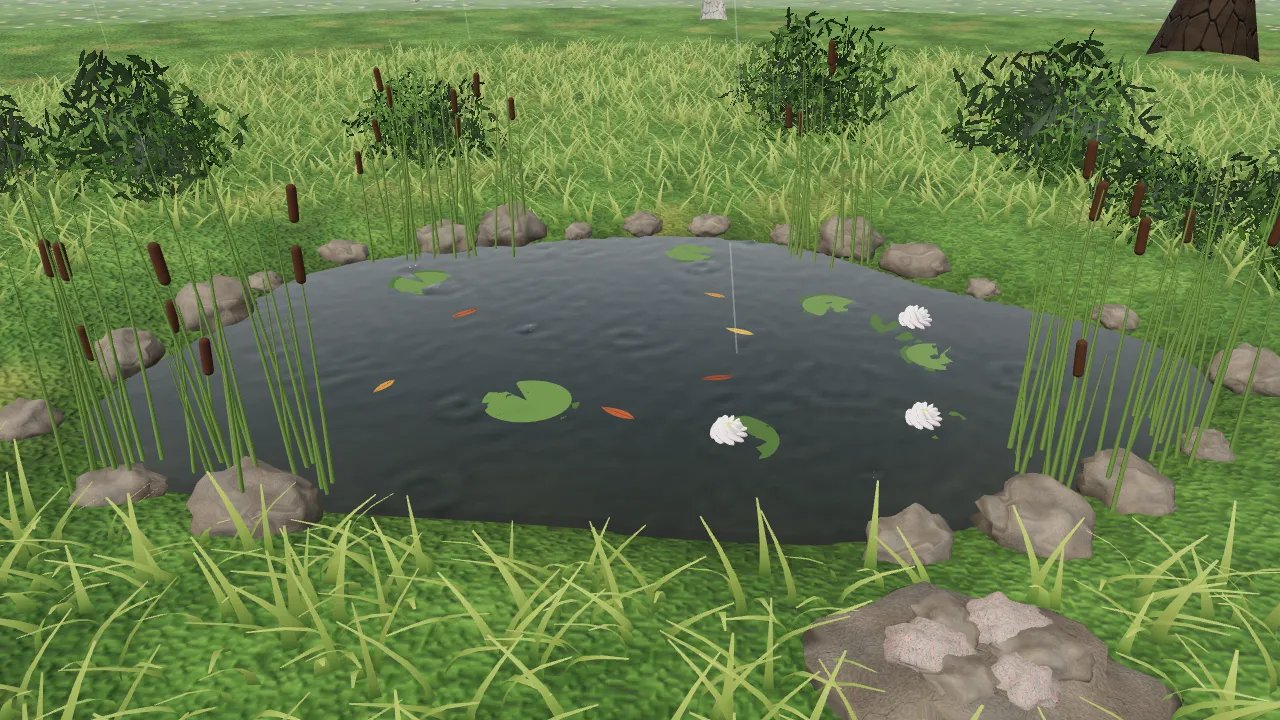
Tap raindrops onto a garden pond, fling pebbles and trail a finger.
How to play
- Tap the pond to drop in a raindrop. Each one starts a ring of ripples that passes straight through the others.
- Drag a pebble from the flat stone on the near bank and fling it towards the water for a big splash.
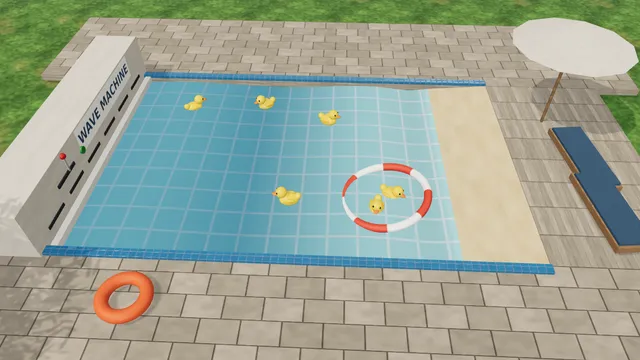
- Drag a finger through the water. Move faster than the ripples spread and a V-shaped wake trails behind it.
- Drag a lily pad or a leaf to move it, or open Lab to change the rain, the drop size and the wind.
Challenges
- Fling a pebble from the bank into the pond
- Set a lily pad bobbing with a pebble splash at least a metre away
- Trail your finger faster than the ripples to draw a V-shaped wake
Try this
- Press Let it stop and tap twice, close together. Watch the two rings cross: they pass straight through each other and carry on.
- Make the drops bigger. Each drop now carries more energy, so its rings are stronger and its splashes jump higher.
- Drag slowly through the water, then quickly. Only the fast stroke leaves a V of ripples behind it, like the wake of a duck.
Fun facts
- Small raindrops are almost perfectly round. Larger ones flatten into a shape like a hamburger bun as they fall.
- Raindrops larger than about 5 millimetres across usually break apart before they reach the ground.
- A 2 mm raindrop falls at about 6.5 metres per second once it reaches its steady, terminal speed.
- Much of the gentle sound of rain on water comes from tiny air bubbles trapped under the surface by each drop, which ring like little bells.
Why every raindrop draws a circle
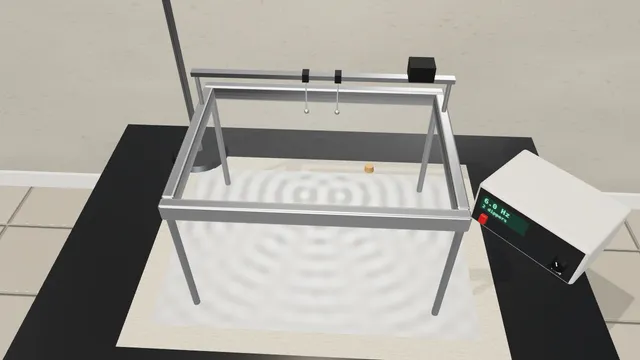
Watch rain falling on a still pond and the surface fills with expanding circles that cross and overlap but never seem to get in each other’s way. Each raindrop is a tiny impact that pushes the water down and outward. The water springs back, and the disturbance spreads away in every direction at the same speed, so it traces a perfect ring.
Rings that pass through each other
When two rings meet, the water simply adds their heights together, crest on crest or crest on trough, and then each ring carries on as before. This is called superposition, and it is why a pond in the rain looks like a lace of circles rather than a muddle. Waves can share the same patch of water without changing one another.
Fading as they grow
Each ring carries a fixed amount of energy from its drop. As the ring grows, that energy spreads around an ever longer circle, so the ripple gets lower: in two dimensions, its height falls roughly with the square root of the distance travelled. Friction in the water and with the air drains energy too, so rings fade completely after a short journey. At the banks, what is left reflects gently back into the pond.
How raindrops fall
A raindrop speeds up as it falls until air resistance balances its weight. From then on it falls at a steady terminal speed, which depends on its size: about 4 m/s for a 1 mm drop and around 9 m/s for the largest drops. Drops aren’t tear-shaped: small ones are spheres, and bigger ones are flattened underneath by the air rushing past them. The scene drops each raindrop at the terminal speed for its size, and bigger drops make stronger rings.
For the curious
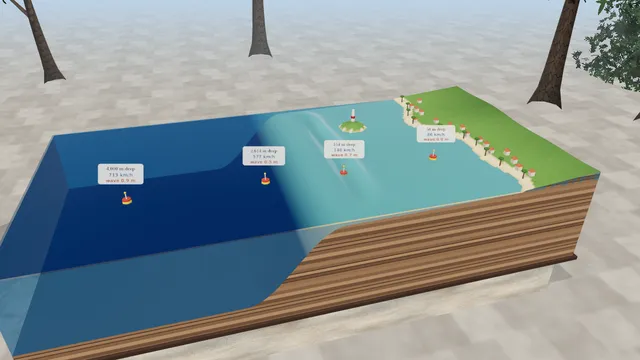
Real ripples just a few centimetres long are shaped by both gravity and surface tension. Their speed depends on their wavelength, with a minimum of about 23 cm/s for ripples around 1.7 cm long, which is why a ring from a single drop slowly sorts itself into a pattern of slightly different wavelengths. To stay smooth on any device, the scene uses a simpler model in which all ripples travel at one speed, about 30 cm/s, set through the shallow-water speed √(g·h). The pond is a grid of about 11,000 cells, each drop adds a small crater-shaped dip, and the terminal speeds come from a standard fit to measured raindrop speeds.
Questions people ask
Why do raindrops make rings on water?
A raindrop pushes the surface down where it lands. The water springs back and the disturbance spreads outward at the same speed in every direction, so it forms a growing circle.
Do ripples bounce off each other?
No. When two ripples meet, their heights add together for a moment and then each carries on unchanged. This is called superposition, and it is why rings on a rainy pond pass through one another.
How fast do raindrops fall?
It depends on their size. Drizzle drops fall at only a few metres per second, a typical 2 mm drop at about 6.5 m/s, and the largest drops at around 9 m/s, where air resistance balances their weight.