How a Tsunami Grows
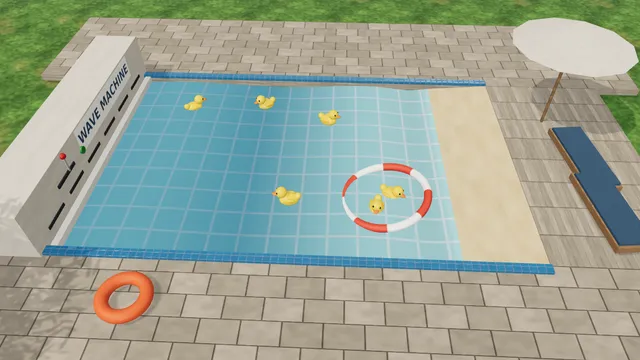
Raise the sea floor in a 3D diorama and see the wave grow at the coast.
How to play
- Press on the open sea and drag upwards to raise the sea floor, then let go to release the wave. A quick tap sets off a standard quake.
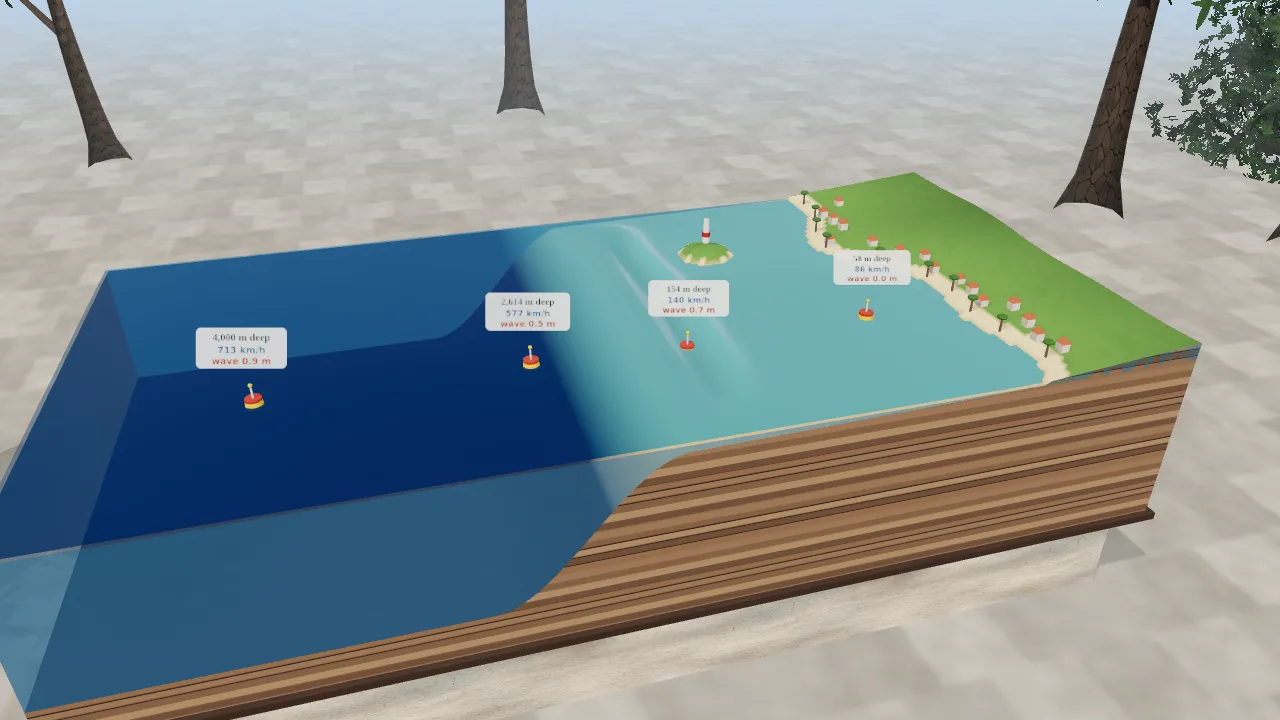
- Follow the wave with the buoys: each label shows the water depth, the wave speed there and the biggest wave it has felt.
- Drag a buoy anywhere on the sea to measure the depth and wave speed at that spot.
- Heights and depths are exaggerated so you can see them. Open Lab to change the uplift or speed up the time-lapse.
Challenges
- Raise the sea floor and set off a tsunami
- Move a buoy to where the wave travels faster than 700 km/h
- Send a wave more than 4 m high to a buoy near the coast
Try this
- Read the speed on the deep-ocean buoy, then on the buoy near the coast. The same wave slows from around 700 km/h to a few tens of km/h.
- Watch the wave height on the buoys. It is lowest over the deep ocean and grows as the wave moves onto the shallow shelf.
- Look at the island. The wave bends around it and the two halves meet behind it, which is why sheltered-looking coasts can still be hit.
Fun facts
- Over the deep ocean, about 4,000 m down, a tsunami travels at roughly 700 km/h, as fast as a jet airliner.
- Far out at sea a tsunami may be less than a metre high and pass under ships almost unnoticed.
- Tsunami warning systems use sensors on the deep sea floor, such as the DART buoy network, to detect passing waves.
- If the sea suddenly draws back from the shore, it can be a natural warning of a tsunami. Head for high ground straight away.
From a ripple at sea to a wall of water
Most ocean waves are made by wind and stir only the top few metres of the sea. A tsunami is different. It starts when an earthquake suddenly lifts or drops a large patch of the sea floor, raising the whole column of water above it by a metre or so over an area that can be a hundred kilometres across. Gravity pulls the bulge back down, and the disturbance spreads out as a wave that moves the entire depth of the ocean.
Fast in the deep, slow in the shallows
A tsunami’s wavelength can be well over a hundred kilometres, far longer than the ocean is deep. Waves like that behave as shallow-water waves, even in the middle of the ocean, and their speed depends only on gravity and depth: c = √(g·h). Over 4,000 m of water that is about 713 km/h. Over a 200 m deep continental shelf it is about 160 km/h, and in 10 m of water near the coast only about 36 km/h.
Why it grows
As the front of the wave reaches shallower water and slows down, the rest of the wave keeps arriving behind it. The wave bunches up: its length shortens and its energy, which hardly leaks away on the journey, is squeezed into a smaller volume of water. The only way to fit is upwards, so the wave grows taller. This is called shoaling. A wave that was barely noticeable at sea can arrive at the coast many metres high, flooding far inland as a fast, powerful surge rather than a breaking surf wave.
Bending around islands and into bays
Because the wave travels more slowly in shallow water, the part of a wavefront over the shelf lags behind the part still in deep water. The front swings round to follow the shape of the sea floor, an effect called refraction. Waves wrap around islands and can focus into bays, which is why the danger along a coastline is not even.
For the curious
The diorama solves the linear shallow-water equations, ∂η/∂t = −∇·(hu) and ∂u/∂t = −g∇η, on a grid with cells 1.25 km across, with the real depths of a typical ocean, slope and shelf. Conservation of energy predicts that the height of a wave moving slowly into shallower water grows roughly as h−1/4 (Green’s law): from 4,000 m to 40 m deep, that is about three times taller. The scene runs as a time-lapse, and heights are exaggerated so you can see them. Real tsunamis are deadly and fast: if you are near a coast and feel a strong earthquake or see the sea retreat, move to high ground at once.
Questions people ask
Why does a tsunami get bigger near the coast?
In shallower water it travels more slowly. The back of the wave catches up with the front, so the wave shortens and its energy is squeezed into less water, which makes it grow taller. This is called shoaling.
How fast does a tsunami travel?
Its speed depends on the water depth, roughly the square root of gravity times depth. Over the deep ocean that is around 700 km/h; near the coast, in water a few metres deep, it slows to a few tens of kilometres per hour.
Why is a tsunami so dangerous if it is small at sea?
Because it moves the whole depth of the ocean and has an enormous wavelength. When it reaches shallow water that energy builds a tall, fast surge that keeps flowing inland for minutes, unlike an ordinary wave that breaks and runs back.