Doppler Effect Ripples
Drag a buzzing dipper through a ripple tank and see its ripples bunch.
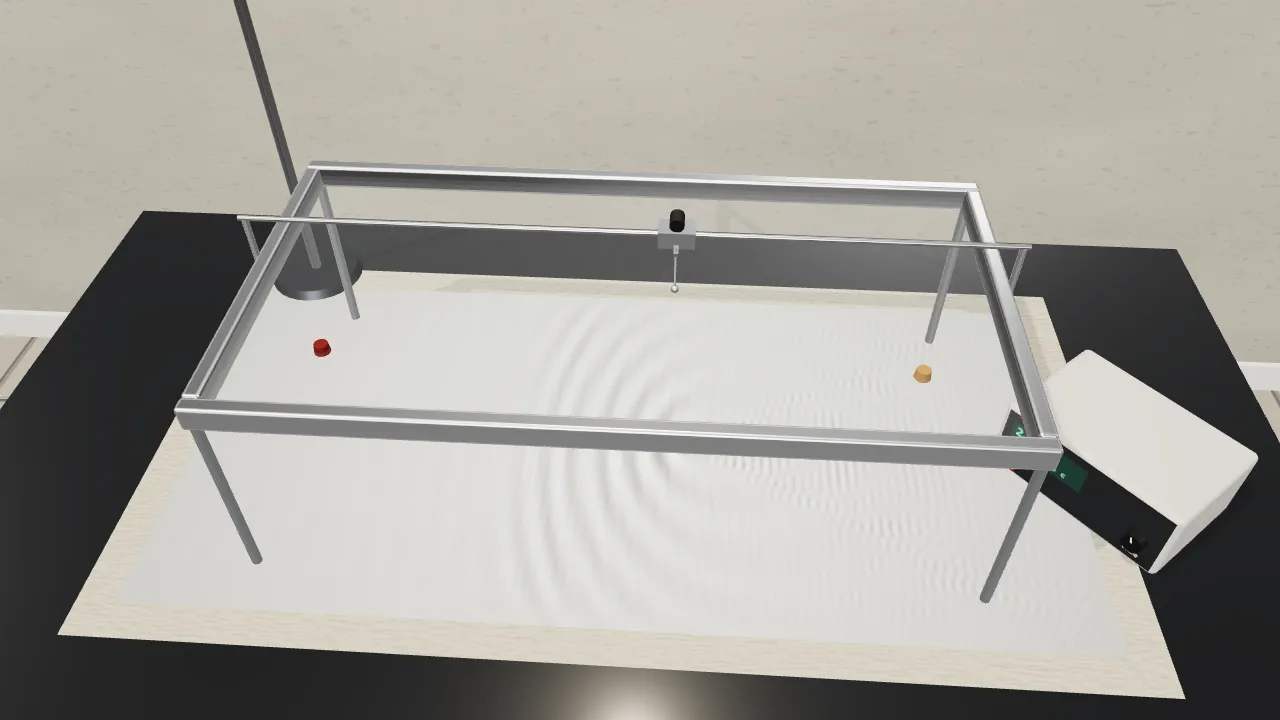
How to play
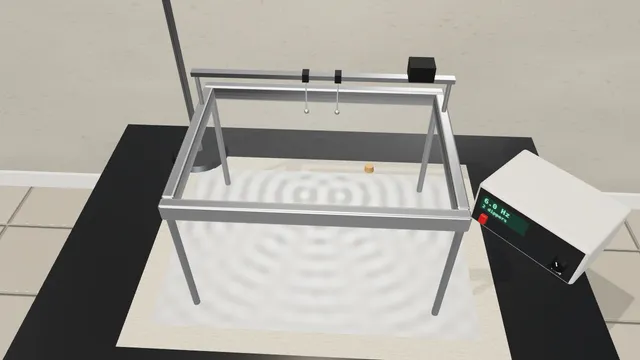
- Grab the carriage on the rail and drag the vibrating dipper through the water. Let go and its motor runs it to and fro again.
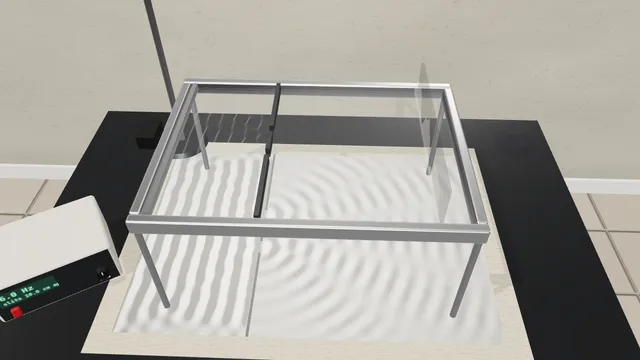
- Compare the ripples in front of the dipper, squeezed close together, with the stretched ones behind it.
- Move faster than the ripples themselves and they pile into a V-shaped shock wave trailing behind.
- Try the Challenges, or open Lab for the motor speed, the dipper frequency and Hear the difference.
Challenges
- Hold the dipper still and see its ripples spread in perfect circles
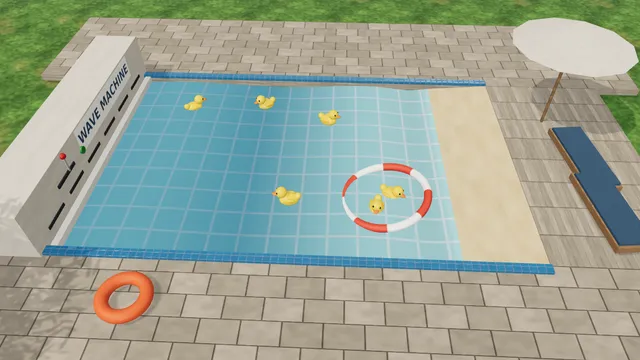
- Move the dipper towards a float fast enough that it receives double the frequency
- Drag the dipper faster than the ripples to make a V-shaped shock wave
Try this
- Hold the carriage still. The ripples form perfect circles, equally spaced in every direction.
- Drag the carriage faster and faster. The ripples ahead get closer and closer until they pile up on top of each other.
- Set the motor speed past 1.2 in Lab. The dipper outruns its own waves, and they form a V-shaped shock wave trailing behind it.
Fun facts
- Christian Doppler proposed the effect in 1842. In 1845 Christophorus Buys Ballot tested it with musicians playing a steady note on a moving train.
- Police speed guns and weather radar measure speeds from the Doppler shift of radio waves bouncing off cars or raindrops.
- Astronomers work out how fast stars and galaxies move towards or away from us from the Doppler shift of their light.
- A sonic boom is the shock wave made by an aircraft flying faster than sound, the same V-shape this boat makes when it outruns its ripples.
Why moving sources sound different
Stand by a road as an ambulance passes and you hear its siren drop in pitch the moment it goes by. The siren itself never changes. What changes is how its sound waves reach you. This is the Doppler effect, and in a shallow tray of water you can see it directly.
Crowded waves ahead, stretched waves behind
The dipper on the boat’s bow taps the water at a steady rate, and each tap starts a circular ripple that spreads at the same speed in every direction. If the dipper stands still, the circles are evenly spaced. When it moves, each new ripple starts a little farther along than the last. In front of the dipper the crests are squeezed together, so a listener there meets them more often: a higher frequency. Behind, the crests are spread apart and arrive less often: a lower frequency. The readouts show both, and Hear the difference plays them as notes.
Breaking the wave barrier
As the boat’s speed approaches the wave speed, the crests ahead of it bunch up into a wall, because the dipper almost keeps pace with them. Faster still, the boat outruns its own ripples. Nothing can arrive ahead of it, and the ripples it leaves behind overlap along two lines that form a V. This is a shock wave, the water version of a sonic boom. The V gets narrower as the boat goes faster.
Where the effect turns up
The same reasoning applies to sound, light and radio. Radar speed guns, weather radar and medical ultrasound all measure motion through Doppler shifts. Astronomers use the shift of starlight to find planets tugging their stars and to measure how fast distant galaxies are receding.
For the curious
For a source moving at speed v through still water whose waves travel at c, a listener directly ahead receives f′ = f / (1 − v/c) and one directly behind f′ = f / (1 + v/c). When v exceeds c, the shock forms a V whose half-angle α obeys sin α = c / v. These neat formulas hold here because shallow-water waves all travel at the same speed, √(g·h), about 24 cm/s at 6 mm deep. Waves on deep water behave differently: long waves outrun short ones, and real boat wakes on deep water keep an angle of about 19.5° whatever the boat’s speed, a result Lord Kelvin worked out in the 1880s.
Questions people ask
What is the Doppler effect?
The change in frequency you detect when a source of waves moves relative to you. Waves from an approaching source are squeezed together and arrive more often; waves from a receding source are stretched and arrive less often.
Why does a siren sound higher as it comes towards you?
Each sound wave is sent out a little closer to you than the previous one, so the crests reach your ear more frequently. Your ear hears a higher frequency, which is a higher pitch, until the vehicle passes and the pitch drops.
What happens when something moves faster than its own waves?
It outruns them, so the waves pile up along a V-shaped front called a shock wave. For sound this is a sonic boom; for a boat in shallow water it is a sharp V of ripples.