Double-Slit Water Waves
Slide two slits in a ripple tank and find bright and still fringes.
How to play
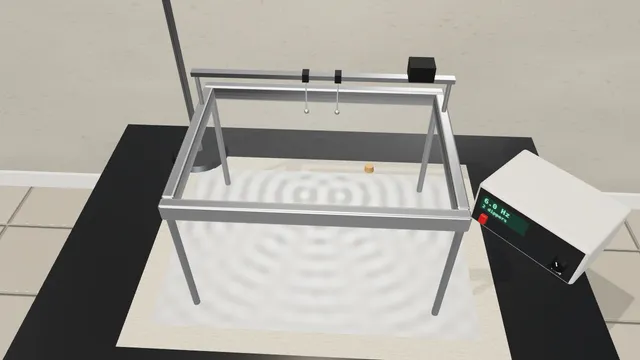
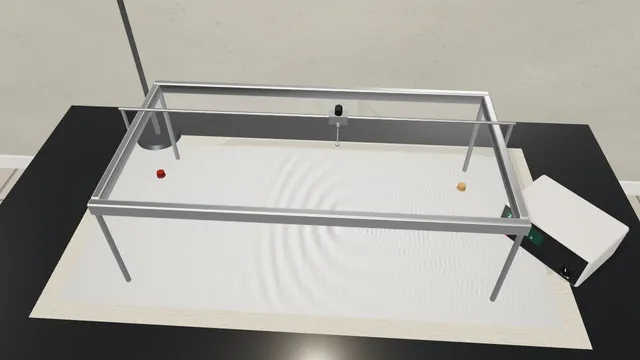
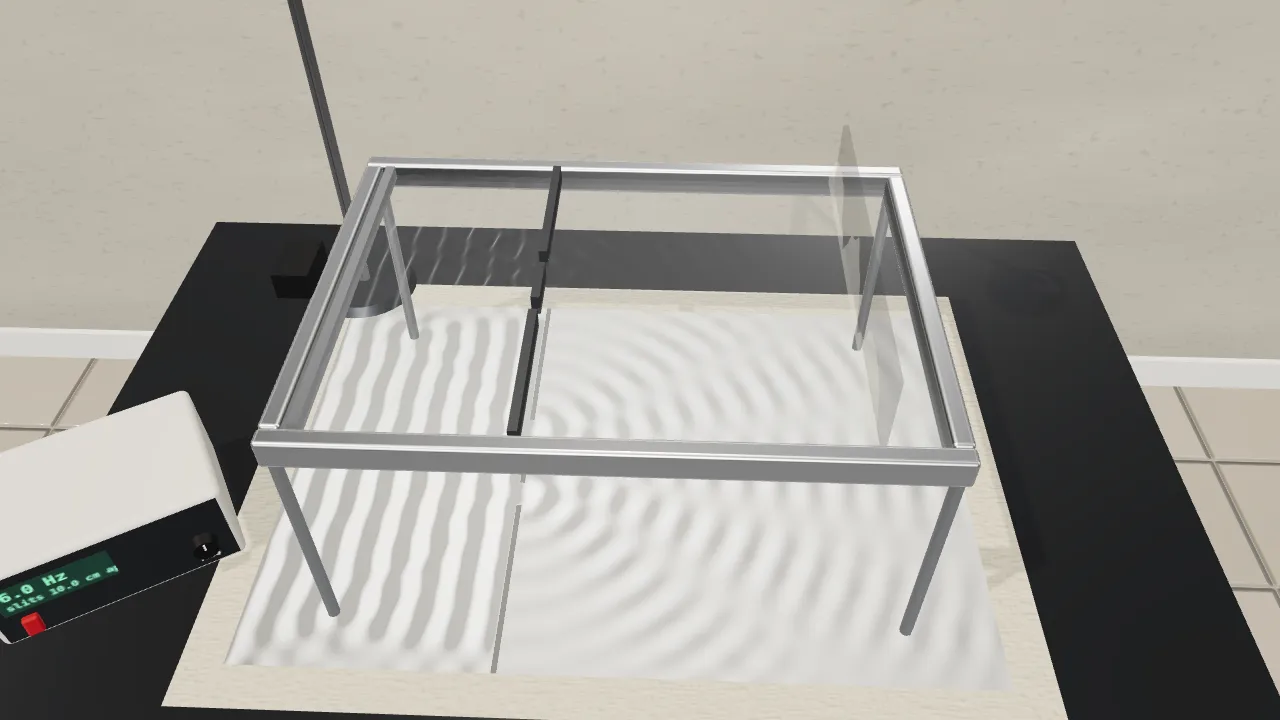
- The paddle on the left sends straight waves towards the wall with two gaps. The lamp above projects them onto the paper under the tank.
- Drag the outer part of the wall to slide the slits apart or together, and see the fringes on the far curtain spread out or crowd in.
- Tap a gap to plug it with a rubber bung, and tap it again to free it. Drag the FREQ knob to change the wavelength.
- Try the Challenges, or open Lab for the slit width and a map of the wave energy.
Challenges
- Plug one slit and see the fringes merge into a single broad band
- Slide the slits apart until five bright fringes reach the far curtain
- Find a spacing and frequency that give seven bright fringes
Try this
- Raise the paddle frequency. The wavelength shrinks and the bright fringes on the curtain move closer together.
- Switch to One slit. The curtain shows one wide bright band instead of a row of fringes.
- Turn on Show predicted bright directions and check that the gold peaks line up with the lines from d·sin θ = mλ.
Fun facts
- Thomas Young’s experiments with light passing through two narrow openings, in the early 1800s, were key evidence that light is a wave.
- When electrons are sent through two slits one at a time, they still build up an interference pattern, a famous result of quantum physics.
- A gap that is narrow compared with the wavelength spreads waves into a wide fan. This spreading is called diffraction.
- Bright fringes appear where the distances to the two slits differ by a whole number of wavelengths.
Two gaps, one pattern of light and water
The double-slit experiment is one of the most famous in physics. Shine light through two narrow slits and, instead of two bright lines on the screen behind, you see a whole row of bright and dark stripes. Water waves make the same pattern, and here you can watch it happen wave by wave.
Diffraction: each gap becomes a source
The paddle sends out straight, parallel waves. When they reach the wall, most of the energy is reflected, but a little squeezes through each gap. A gap that is not much wider than the wavelength doesn’t simply let through a narrow beam: the wave spreads out on the other side in curved ripples, as if the gap were a new source. This bending and spreading is called diffraction. The narrower the gap compared with the wavelength, the wider the fan.
Interference: where the ripples meet
Beyond the wall, ripples from the two gaps overlap. At some points a crest from one gap always arrives with a crest from the other, and the water moves strongly. At others a crest always meets a trough, and the water stays almost still. This is interference. The busy directions are those where the distances to the two gaps differ by a whole number of wavelengths; the calm ones are halfway between. Across the far side of the tank they form a row of bright and dim fringes, which the gold curtain records.
From water to light and electrons
Thomas Young used the same reasoning for light in the early 1800s: only waves could make such stripes. Much later, physicists found that electrons, atoms and even large molecules sent through two slits build up interference patterns too, one particle at a time. The pattern you see in this tank sits at the heart of both classical and quantum physics.
For the curious
For slits a distance d apart, bright fringes occur at angles θ where d·sin θ = m·λ, with m = 0, ±1, ±2 and so on. On a screen a distance L away, neighbouring fringes are about λ·L/d apart when the angles are small. A single slit of width a has dark directions where a·sin θ = m·λ (m ≠ 0), which sets the overall envelope of the pattern. The scene solves the shallow-water equations, with the wall as a reflecting barrier, the paddle as a moving boundary and absorbing beaches at the other edges. The curtain shows the time-averaged square of the wave height, which is proportional to the energy the waves carry.
Questions people ask
What does the double-slit experiment show?
That waves passing through two openings overlap and interfere, making a pattern of strong and weak regions. With light it showed that light behaves as a wave, and with electrons it revealed the wave nature of matter.
Why do waves spread out after going through a gap?
This is diffraction. A gap acts like a new source of waves, which spread out in curved fronts on the far side. The effect is strongest when the gap is about as wide as the wavelength or narrower.
How do you calculate where the bright fringes are?
Bright fringes appear at angles where the slit separation times the sine of the angle equals a whole number of wavelengths: d·sin θ = m·λ. Their spacing on a distant screen is roughly the wavelength times the screen distance divided by the slit separation.