Chladni Plate Sand Patterns
Bow a metal plate and watch sand gather into the patterns of sound.
How to play
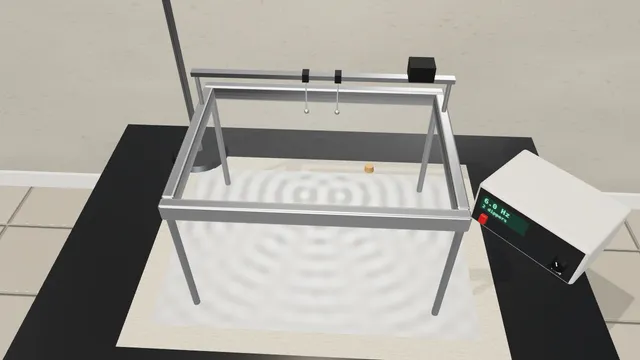
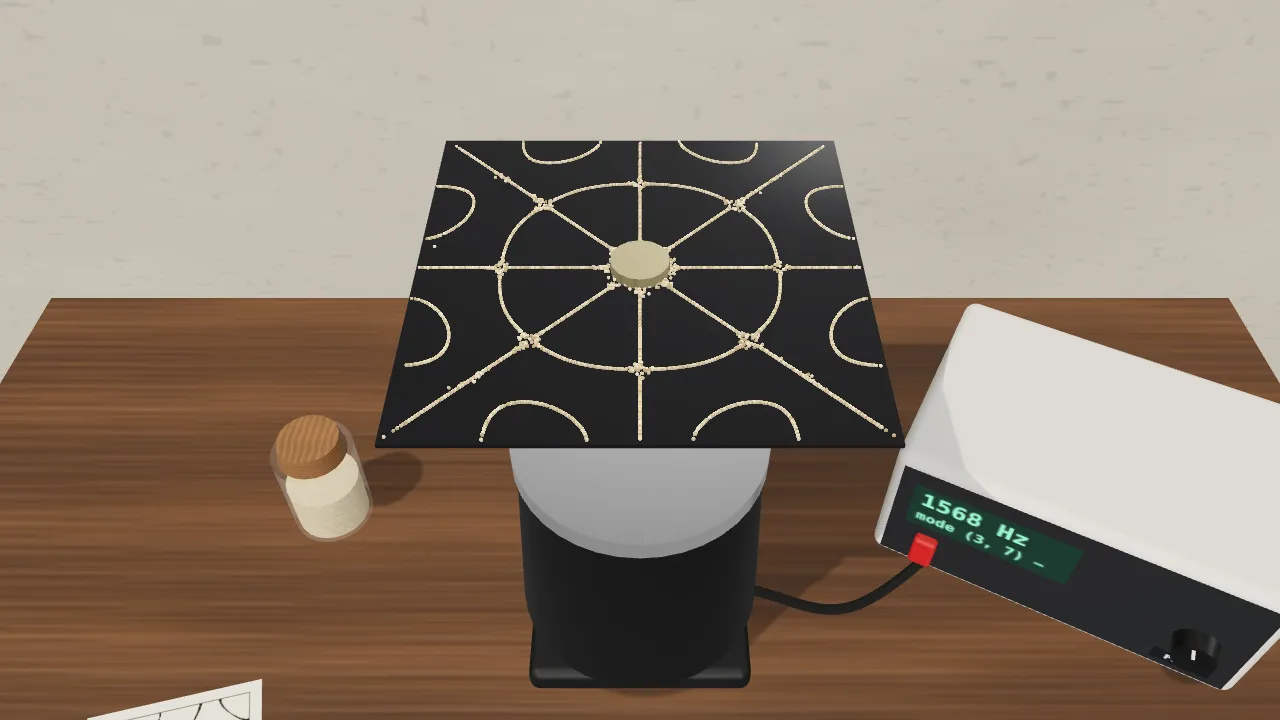
- Drag the violin bow along the edge of the plate. The plate sings in a mode that moves strongly where you bow, and the sand runs to the still lines.
- Tap the edge to rest a fingertip there: that point must stay still, so the next stroke picks a pattern with a node under your finger.
- Drag the FREQ knob on the signal generator to step through the resonances, or tap the jar to sprinkle more sand.
- Try the Challenges, or open Lab to show the plate’s shape or start again with a fresh plate.
Challenges
- Bow the plate’s edge until the sand gathers into a pattern
- Make the sand draw a big X from corner to corner
- Copy the figure printed on the card beside the plate
Try this
- Step up through the modes and count the lines. Higher frequencies make more, closer-spaced nodal lines.
- Turn on the plate’s shape view: the sand lines sit exactly on the boundaries between the red and blue regions.
- Turn the drive strength down to about 0.3. The sand still finds the lines, but more slowly, because it is jostled less hard.
Fun facts
- Ernst Chladni published his sand figures in 1787, in a book on the theory of sound. He made his plates ring with a violin bow.
- After Chladni demonstrated his plates for Napoleon, a prize was offered for the mathematics of vibrating plates. Sophie Germain won it in 1816.
- Very fine powder gathers at the most active spots instead of the still lines, carried by tiny air currents, as Michael Faraday showed in 1831.
- Doubling the number of wiggles across a plate raises its pitch about fourfold, because plate frequencies grow with the square of the mode numbers.
How sound draws pictures in sand
Sprinkle sand on a metal plate, make the plate ring, and the sand leaps into the air and gathers into intricate lines, stars and grids. These are Chladni figures, named after the German physicist Ernst Chladni, who drew hundreds of them in the 1780s. Each picture is a map of how the plate is vibrating.
Standing waves in two dimensions
When the plate is driven at one of its natural frequencies, waves running back and forth across the metal combine into a standing wave: a fixed pattern in which some regions move up while neighbouring regions move down, then swap. Between them run nodal lines, where the plate doesn’t move at all. Sand on a moving region is thrown up and lands somewhere slightly different, again and again. Only on a nodal line is it left in peace, so over a few seconds the sand drifts there and stays. The pattern of lines shows the shape of the vibration.
Only certain notes work
A plate can only hold standing waves that fit its size and shape, so it rings strongly at particular frequencies called resonances or modes. Between them the vibration is weak and the sand barely stirs. This is why the frequency slider jumps from one mode to the next. Each mode is labelled by two numbers, n and m, which count the half-wiggles across the plate in each direction. Higher numbers mean more lines and a higher pitch.
Held at the centre
This plate is clamped to a driver at its centre, the way many modern Chladni demonstrations work. The centre can’t move, so only modes with a still point in the middle appear. Chladni himself held his plates with his fingers and bowed the edge; touching a spot forces it to become part of a nodal line, which was his way of choosing patterns.
For the curious
For a square plate of side L, a classic approximation describes each mode as cos(nπx/L)·cos(mπy/L) ± cos(mπx/L)·cos(nπy/L). The frequencies of a thin plate grow with the square of the wave number, so here f ≈ K·(n² + m²), where K depends on the plate’s stiffness, density, thickness and size. For a 1 mm steel plate 30 cm across, K is about 27 Hz, giving modes from tens of hertz to a few kilohertz. In the scene each grain is jostled randomly in proportion to the local vibration amplitude and slides slowly down the gradient of the amplitude squared, so it naturally comes to rest on the nodal lines.
Questions people ask
What is a Chladni plate?
A flat metal plate, usually held at its centre or edge, that is made to vibrate with a violin bow or a speaker. Sand sprinkled on it collects along the lines that stay still, revealing the pattern of the vibration.
Why does sand collect on the nodal lines?
Everywhere else the plate is moving up and down, which throws the grains about. On the nodal lines the plate is still, so grains that land there stay put, and over time all the sand ends up along those lines.
Why do Chladni patterns change with frequency?
A plate can only form standing waves that fit its shape, each at its own resonant frequency. Higher frequencies fit more wiggles across the plate, so the patterns gain more and more closely spaced lines.