Singing Glass Harp
Rub the rims of water-tuned wine glasses and make them sing.
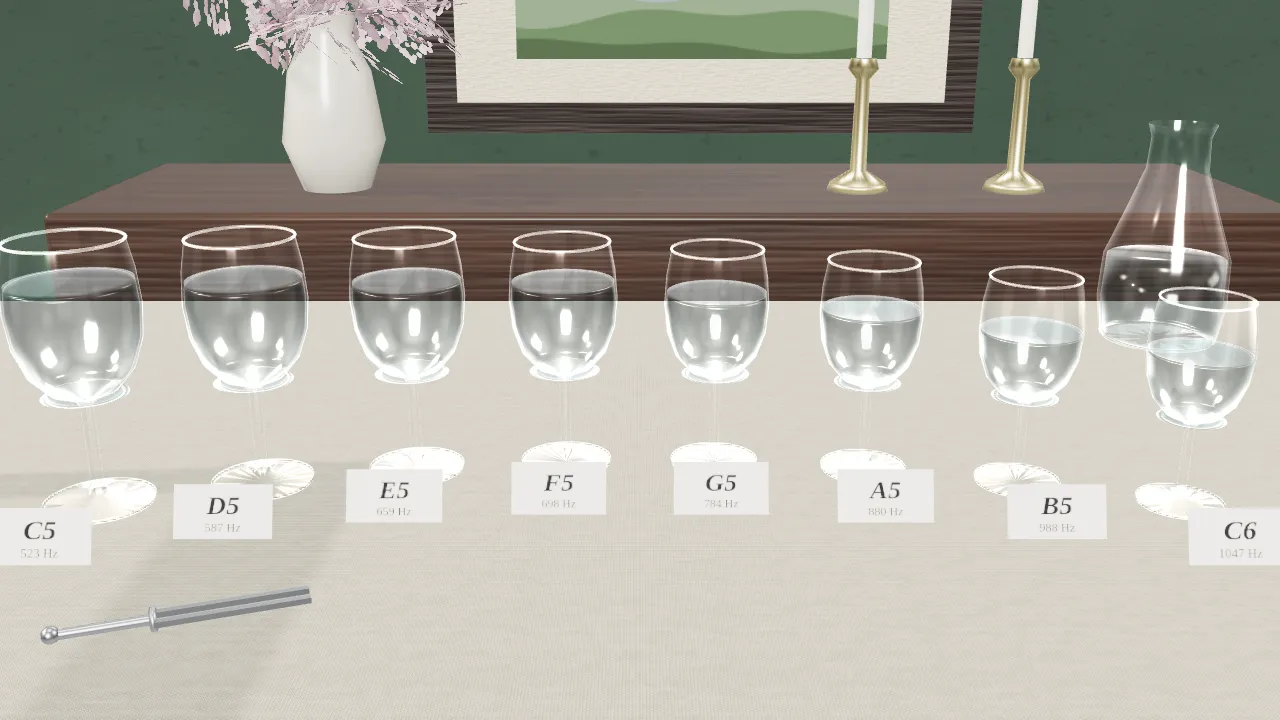
How to play
- Press on a glass’s rim and move in small circles to make it sing. Faster rubbing makes it louder.
- Tap a glass to ring it like a bell. Tap the tuning fork on the cloth to hear a reference A at 440 Hz.
- Press lower down on a glass and drag up or down to add or pour out water, or lift the carafe and hold it over a glass to pour.
- Try the three Challenges, or open Lab to tune all eight glasses to a scale, add food colouring or let them play a gentle tune.
Challenges
- Circle a rim with your finger until the glass sings
- Ring a C major chord: the C, E and G glasses together
- Change the water in a glass until it rings an A, like the tuning fork
Try this
- Empty a glass and ring it, then fill it almost to the top and ring it again. The fuller glass sounds clearly lower.
- Add water a little at a time and watch the note card. The pitch barely changes at first, then drops quickly as the water nears the rim.
- Make a glass sing and look at the water: ripples appear in four patches around the edge, where the glass wall is moving most.
Fun facts
- Benjamin Franklin invented the glass armonica in 1761: a row of nested glass bowls spun by a foot treadle and played with wet fingers.
- Mozart wrote music for the glass armonica, including his Adagio and Rondo, K. 617.
- A singing glass’s rim bends into a slight oval that flips direction every half cycle, with four points between that stay almost still.
- A rubbing finger works like a violin bow: it repeatedly sticks to the glass and slips, hundreds of times a second, in step with the glass’s own vibration.
How a wine glass learns to sing
Run a clean, wet fingertip around the rim of a wine glass and, with a little practice, it begins to sing with a pure, ringing tone. Line up several glasses with different amounts of water and you have a glass harp, an instrument that has been played for centuries. The physics behind it involves vibration, friction and the surprising effect of a little water.
The glass’s favourite way to vibrate
A glass, like a bell, has a few natural ways to vibrate, each with its own frequency. The lowest and loudest is a bending motion in which the rim flexes into a slight oval, then into an oval at right angles, back and forth hundreds of times a second. Between the bulges are four points that hardly move. The higher modes, with more bulges around the rim, add faint overtones that give the glass its shimmering sound. This scene builds the sound from those modes, and shows the oval wobble slowed down so you can see it.
Why rubbing works
Your finger doesn’t slide smoothly over the glass. It grips, drags the rim a tiny distance, then slips back, again and again: a stick–slip motion, like a bow on a violin string. Once the slipping falls into step with the glass’s natural frequency, each grip gives the vibration a small push at just the right moment, and it builds into a steady tone. That is why the finger needs to be clean and wet: grease or dry skin spoils the regular grip-and-slip.
Why water lowers the note
When the glass wall vibrates, any water touching it has to move too. That extra moving mass slows the vibration and lowers the pitch. The wall moves most near the rim, so water high up makes a much bigger difference than water in the bottom of the bowl. Filling a glass a quarter of the way hardly changes its note, while the last few centimetres below the rim can lower it a lot. The vibrating wall also pushes the water near it, which is why ripples appear in four patches around the edge.
For the curious
A widely used approximation, worked out by the physicist A. P. French in 1983, says that a glass whose empty pitch is f₀, filled to a height h out of a bowl height H, sings at about f = f₀ / √(1 + β·(h/H)⁴). The constant β grows with the density of the liquid and the radius of the glass, and shrinks with the thickness of its wall; here it is set to 4, so a brim-full glass sings a little more than an octave below an empty one. The overtones are placed at 2.83 and 5.42 times the main frequency, the ratios predicted for the bending modes of a thin, bell-like shell. Each sound is synthesised from gently enveloped tones whose loudness follows how fast you rub.
Questions people ask
Why does a wine glass sing when you rub the rim?
A clean, wet finger sticks to the rim and slips back repeatedly. When that stick–slip motion falls into step with the glass’s natural vibration, each grip adds a little energy, and the glass rings with a steady tone.
Why does adding water change the pitch of a glass?
The vibrating glass wall has to push the water touching it, which adds moving mass and slows the vibration. Water near the rim, where the wall moves most, has the biggest effect.
Does a fuller glass make a higher or lower note?
A lower note. More water means more mass moving with the glass wall, so it vibrates more slowly. The drop is small when the glass is only partly filled and grows quickly as the water nears the rim.