Harmonograph Drawing Machine
Push a swinging table and let a pen draw spirals, stars and roses.
How to play
- Drag the paper table aside and let go: the pen starts a fresh drawing driven by your push.
- Slide the brass weight on the pen pendulum’s post up or down to change the frequency ratio. It clicks into the simple ratios.
- Tap the stack of blank cards for a fresh card, then watch the pen draw as the pendulums swing and slowly settle.
- Try the Challenges, or open Lab to detune slightly, change the damping or the ink, or press Surprise me.
Challenges
- Push the paper table and let the pen draw until the swing dies away
- Slide the weight to a 1 : 2 ratio and draw that figure
- Draw figures at three different frequency ratios
Try this
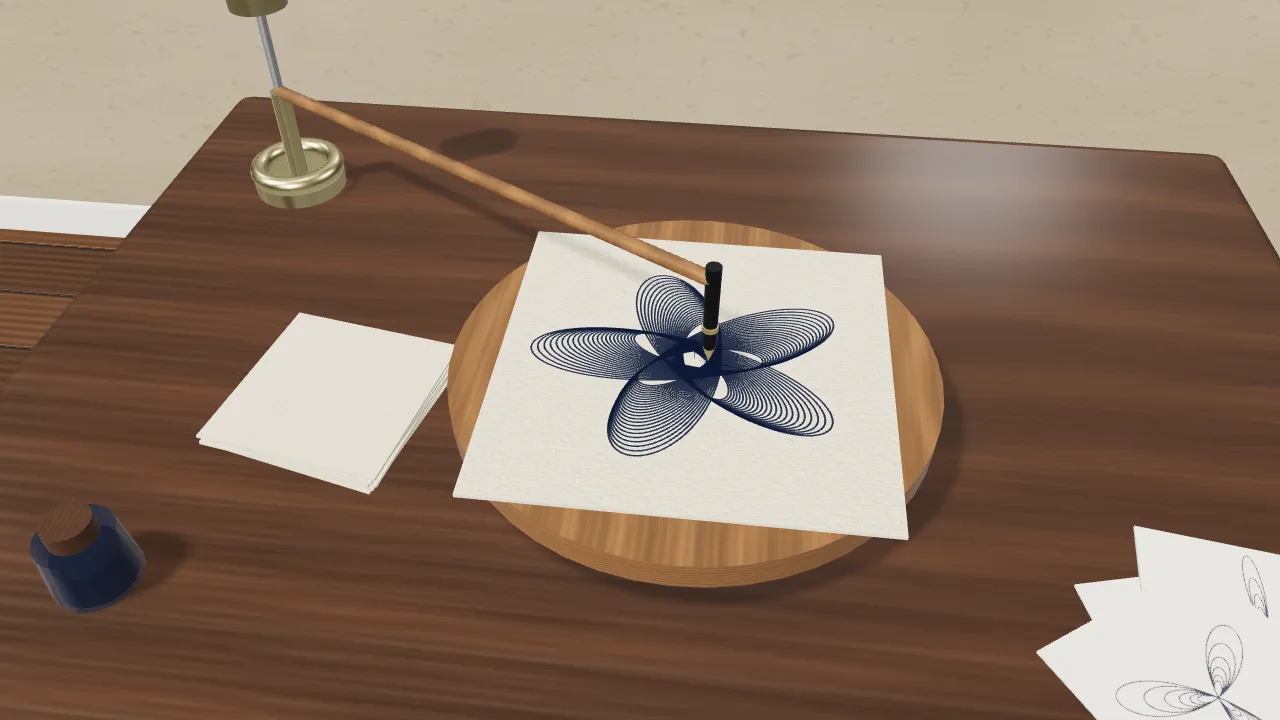
- Choose 1 : 1 with zero detune: you get a single ellipse that shrinks. Add a little detune and it becomes a spiralling rosette.
- Compare 2 : 3 and 3 : 4. Count the lobes of each figure and see how they relate to the ratio.
- Lower the damping for a dense, long-lasting drawing, or raise it for a few bold, quickly shrinking loops.
Fun facts
- Curves made by combining two perpendicular vibrations are called Lissajous figures, after the French physicist Jules Antoine Lissajous, who studied them in 1857.
- The American mathematician Nathaniel Bowditch had already studied the same curves in 1815, so they are sometimes called Bowditch curves.
- Harmonographs were a popular parlour amusement in the Victorian era.
- Each line spirals inward because friction makes every swing a fixed fraction smaller than the one before: exponential decay.
Drawing with pendulums
A harmonograph is a drawing machine powered by pendulums. One pendulum moves a pen, another moves the card underneath it, and as they swing, the pen traces a curve that records both motions at once. Because the pendulums slowly lose energy, the lines spiral gently inward, and the finished drawing has the delicate, layered look that made harmonographs a favourite of Victorian parlours.
Ratios make the shape
Each pendulum swings with its own steady rhythm, set by its length. What matters for the drawing is the ratio of the rhythms. If the pen and the card swing at the same rate, a ratio of 1 : 1, the pen draws an ellipse or a circle. A ratio of 1 : 2 gives figure-of-eight shapes, and 2 : 3 or 3 : 4 give looping stars and knots. These closed curves are called Lissajous figures. The simple whole-number ratios are the musical ones too: as frequency ratios, 1 : 2 is an octave, 2 : 3 a perfect fifth and 3 : 4 a perfect fourth, so a harmonograph drawing is a picture of a musical interval.
Detune and damping
A perfect ratio would draw the same figure over and over. Real pendulums are never perfectly tuned, and that is where the beauty comes from. With a slight detune, the figure slowly rotates or morphs from one shape into another, filling the card with interwoven lines. Meanwhile friction makes every swing a little smaller than the last. The amplitude falls by the same fraction each second, a pattern called exponential decay, so the figure shrinks steadily toward the centre. Raise the damping in the Lab for a few bold loops, or lower it for a dense, lacy drawing.
The machine in this scene
This harmonograph has two pendulums, each hung on a gimbal so that it can swing in two directions at once: one carries the pen, the other carries the card. The pen circles one way, while the card swings in a line or round in an ellipse, set by the swing-shape slider, circling the same way or the opposite way. Every motion is a real damped pendulum swing, so the drawing evolves just as a wooden harmonograph’s would.
For the curious
Each pendulum angle obeys θ″ = −ω²·sin θ − 2γ·θ′, where ω sets its rhythm and γ its damping. For small swings the solution is close to θ(t) = θ₀·e−γt·cos(ωt + φ). The pen’s position on the card is the pen pendulum’s displacement minus the table’s, so the drawing is approximately x = A·e−γt·sin(ω₁t + φ₁) − B·e−γt·sin(ω₂t + φ₂), with a matching formula for y. The scene integrates both pendulums, in both directions, with the fourth-order Runge–Kutta method 240 times per second, and lays down a ribbon of ink as the pen moves.
Questions people ask
What is a harmonograph?
A drawing machine in which swinging pendulums move a pen and the paper beneath it. The combined motions trace intricate curves, and because the pendulums slowly lose energy, the lines spiral gently inward.
How does a harmonograph make its patterns?
The shape depends on the ratio of the pendulums’ swing rates. Simple ratios like 1 : 2 or 2 : 3 give looping figures, a slight detune makes the figure rotate and evolve, and damping makes it shrink toward the centre.
What are Lissajous figures?
The curves traced by a point that vibrates in two perpendicular directions at once. They are named after Jules Antoine Lissajous, who studied them in 1857, and their shape depends on the ratio and phase of the two vibrations.