Spring Pendulum
Bounce a ball on a spring and see the bounce turn into a swing.
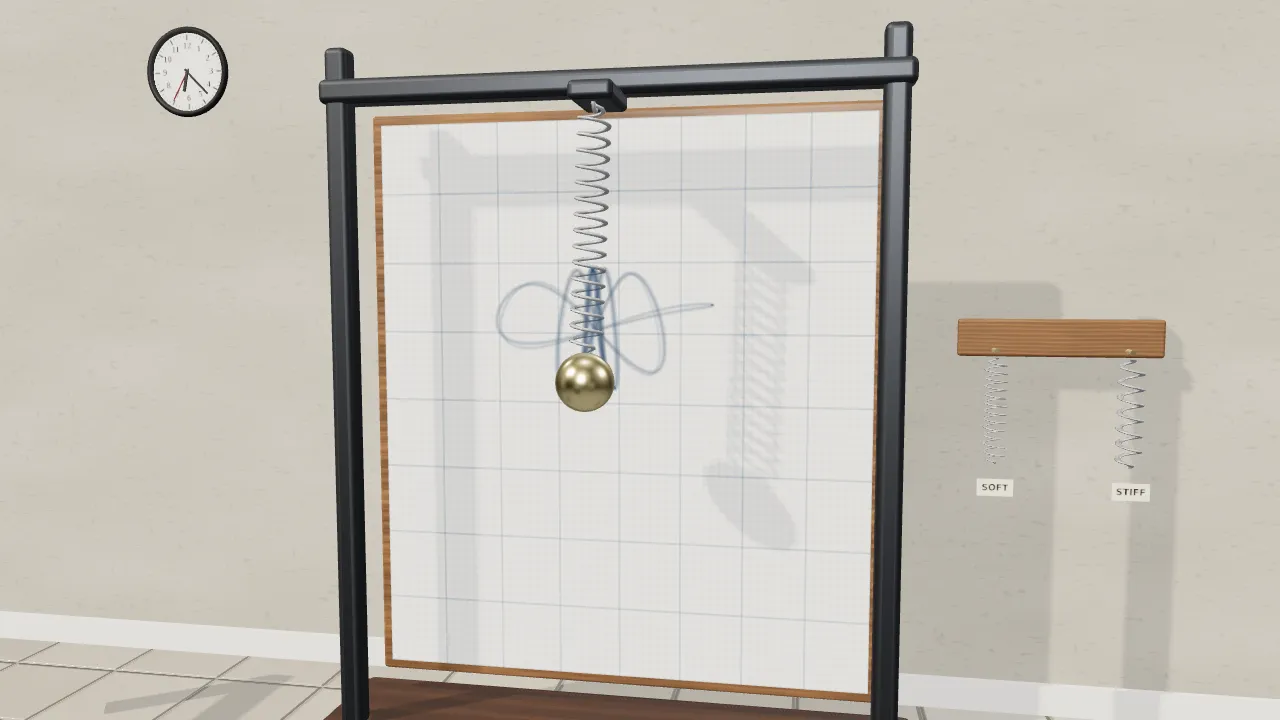
How to play
- Pull the brass ball straight down and let go. With the tagged 2 : 1 spring the bounce slowly turns into a swing, then back again.
- Or drag it out sideways for a swing, and see the swing hand its energy to a bounce.
- Tap a spring on the wall rack to hang it on the rig: the soft and stiff springs are out of tune.
- Try the Challenges, or open Lab for Twirl in 3D, the stiffness, the bob mass and gravity.
Challenges
- Pull the ball straight down, let go and see the bounce turn into a swing
- Swing it sideways and let the swing turn into a bounce
- Hang an out-of-tune spring and keep a straight bounce bouncing for 15 s
Try this
- With the spring tuned to 2 : 1, press Bounce and wait. The pure bounce turns into a swing and back, as the Energy in bouncing readout rises and falls.
- Set the stiffness well away from the tuned value and press Bounce again. Now the ball keeps bouncing straight and hardly swings at all.
- Press Twirl in 3D. With a sideways push, the swing plane wanders round instead of staying fixed.
Fun facts
- Robert Hooke published his law of springs in 1678 as the Latin phrase “ut tensio, sic vis”: as the extension, so the force.
- When a spring pendulum bounces exactly twice as fast as it swings, a pure bounce can turn into a swing all by itself.
- You use a similar 2 : 1 trick on a playground swing: standing up and squatting twice per swing pumps energy in.
- The spring’s stiffness and the bob’s mass set the bounce rhythm, while the stretched length sets the swing rhythm.
When a bounce becomes a swing
A ball hanging from a spring can move in two different ways. It can bounce, stretching and squashing the spring, or it can swing from side to side like an ordinary pendulum. Usually the two motions mind their own business. But when their rhythms are tuned just right, energy starts to flow from one to the other, and a ball that was only bouncing ends up swinging widely, then bouncing again.
Two rhythms
The bouncing rhythm depends on the spring’s stiffness k and the ball’s mass m: a stiffer spring or a lighter ball bounces faster. The swinging rhythm depends on the length of the stretched spring, just like a pendulum on a string. The readout shows the ratio between them. The interesting setting is 2 : 1, with the ball bouncing exactly twice for every complete swing. Press Tune to 2 : 1 in the Lab to set it.
Why 2 : 1 is special
Think of a playground swing. To pump it higher without touching the ground, you stand up as you pass the bottom and crouch at each end, raising and lowering your body twice per swing. That periodic change in effective length feeds energy into the swing. The bouncing spring does the same thing automatically: as it bounces, it lengthens and shortens the pendulum twice per swing. The slightest sideways wobble gets pumped up, while the bounce loses energy, until the motion is mostly a swing. Then the process runs backwards. Physicists call this autoparametric resonance, because the system drives itself.
Patterns in the trail
The glowing trail draws the path of the ball. A pure bounce is a short vertical line. Near 2 : 1 it opens into shapes like a smile, a figure of eight or a fan, and the shape slowly cycles as energy passes back and forth. Away from the resonance the bounce stays a bounce. With a sideways push in three dimensions, the swing plane itself starts to wander, a much-studied twist on the same physics.
For the curious
Writing r for the ball’s position relative to the hook, with unstretched spring length r₀, Newton’s second law gives r″ = g − (k/m)·(|r| − r₀)·r/|r|, where g points straight down. At rest the spring stretches by mg/k (Hooke’s law), so the hanging length is ℓ = r₀ + mg/k. The bounce frequency is √(k/m) and the swing frequency √(g/ℓ). Setting the first to twice the second gives k = 3mg/r₀. The scene integrates the full equation in three dimensions with the fourth-order Runge–Kutta method, 600 times per second, so the energy readout stays steady when friction is off.
Questions people ask
What is an elastic pendulum?
A pendulum whose string is replaced by a spring, so the bob can bounce up and down as well as swing from side to side. It is also called a spring pendulum or swinging spring.
Why does a spring pendulum switch between bouncing and swinging?
When the bounce is about twice as fast as the swing, the bouncing changes the pendulum’s length twice per swing. That pumps energy into any small sideways motion, so the bounce turns into a swing, and then the energy flows back.
What is autoparametric resonance?
A resonance where one motion of a system periodically changes a property, such as length, that controls another motion, so energy flows between them without any outside push. The 2 : 1 spring pendulum is a classic example.