Kapitza’s Upside-Down Pendulum
Shake a pendulum’s pivot fast enough and it balances upside down.
How to play
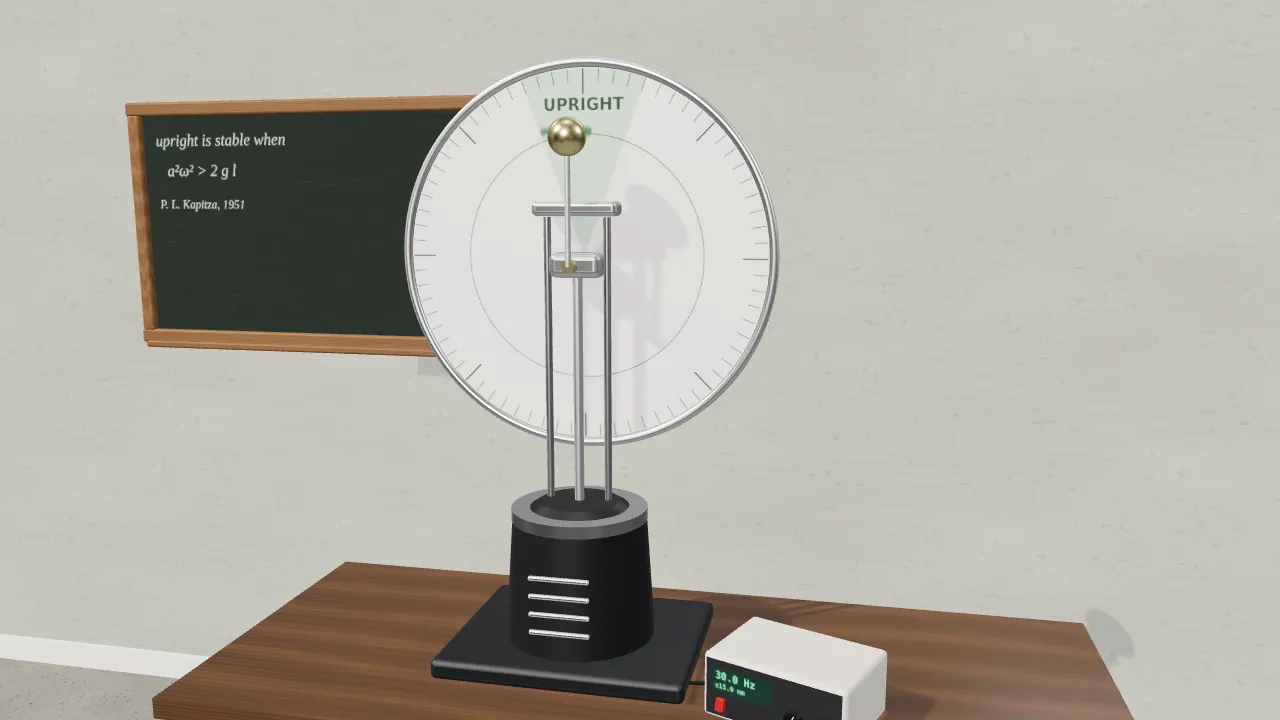
- Drag the brass ball up over the top and let go. With the shaker running fast enough, it wobbles gently but stays standing.
- Drag the FREQ and AMPL knobs on the signal generator up or down to change the shaking. The Stability readout shows when upright can stand.
- Tap the red switch to stop the shaker and see what happens to an upside-down pendulum without it.
- Turn on Slow motion in Lab to see the pivot’s rapid up-and-down movement, or try the Challenges.
Challenges
- Lift the ball over the top and let go so it balances upside down
- Turn the frequency down until the balancing pendulum topples over
- Keep it upright for 10 s with the Stability number below 1.15
Try this
- Slowly lower the shake frequency while the pendulum stands upright. Note the frequency at which it topples, and compare it with the moment the Stability readout passes 1.
- Make the rod longer. A longer pendulum needs faster or bigger shaking to stay up, as the formula below predicts.
- Switch the motor off while it is balancing. Without the shaking, upright is an ordinary unstable balance point and it falls straight away.
Fun facts
- Andrew Stephenson described a pendulum kept upright by a vibrating pivot in 1908; Pyotr Kapitza explained the effect in detail in 1951.
- The same kind of averaged force from a rapidly changing field holds charged particles in a Paul trap. Wolfgang Paul shared the 1989 Nobel Prize in Physics for the ion trap technique.
- For a 30 cm rod shaken 1.5 cm up and down, balance needs about 26 shakes per second or more.
- Pyotr Kapitza won the 1978 Nobel Prize in Physics for his discoveries in low-temperature physics.
How shaking makes upside-down stable
Try balancing a pencil on its tip and it falls at once: the upside-down position is a balance point, but an unstable one. Any tiny tilt lets gravity pull the pencil further over. Surprisingly, there is a way to make an upside-down pendulum stand on its own without any sensors or clever control. Just shake its pivot up and down, quickly enough. This is the Kapitza pendulum.
A tug-of-war, averaged out
When the pivot accelerates upwards, the rod feels heavier, as you do in a lift that starts going up. When the pivot accelerates downwards, the rod feels lighter, or even pulled the other way. If the rod is tilted, these alternating pushes don’t quite cancel. Over each fast cycle, the effect averages out to a small extra push that always tends to line the rod up with the direction of shaking. At low shaking rates gravity wins and the pendulum falls. Above a threshold, the averaged push wins and the upright position becomes stable. The pendulum wobbles slowly around vertical, the gentle motion you see in the scene, while the fast jitter happens underneath.
The magic number
For a pendulum of length l shaken with amplitude a and angular frequency ω, the upright position is stable when a²ω² > 2gl. The Stability readout shows the ratio a²ω²/(2gl): above 1, upright can stand. Because the frequency enters squared, small increases in shaking speed help a lot. Doubling the rod length doubles what’s required, so long pendulums are much harder to keep up.
Where it matters
The same principle, often called dynamic stabilisation, has real uses. In a Paul trap, a rapidly switching electric field creates the same kind of averaged force, holding a single charged atom almost still in empty space. Neither the pendulum nor the ion is pushed in one steady direction: the holding force only exists on average, over many fast cycles.
For the curious
With the pivot at height a·cos ωt and the angle θ measured from straight down, the pendulum obeys θ″ = −((g − aω²·cos ωt)/l)·sin θ. Averaging over the fast shaking gives an effective potential energy U = −mgl·cos θ + (m·a²ω²/4)·sin²θ. This has a minimum at the top, θ = 180°, exactly when a²ω² > 2gl. The scene doesn’t use the averaged formula: it integrates the full equation with the fourth-order Runge–Kutta method 3,000 times per second, so the balance emerges on its own.
Questions people ask
How can a pendulum stand upside down?
By shaking its pivot rapidly up and down. The fast alternating pushes average out to a small force that keeps the rod lined up with the shaking direction, which makes the upright position stable when the shaking is fast and strong enough.
What is the Kapitza pendulum?
A pendulum whose pivot vibrates vertically. It is named after the physicist Pyotr Kapitza, who explained in 1951 why such a pendulum can balance upside down.
How fast do you have to shake a Kapitza pendulum?
Fast enough that the amplitude times the angular frequency, squared, is bigger than twice gravity times the length: a²ω² > 2gl. For a 30 cm pendulum shaken 1.5 cm, that is about 26 shakes per second.