Foucault Pendulum
Swing a museum pendulum and let Earth’s turning topple the pins.
How to play
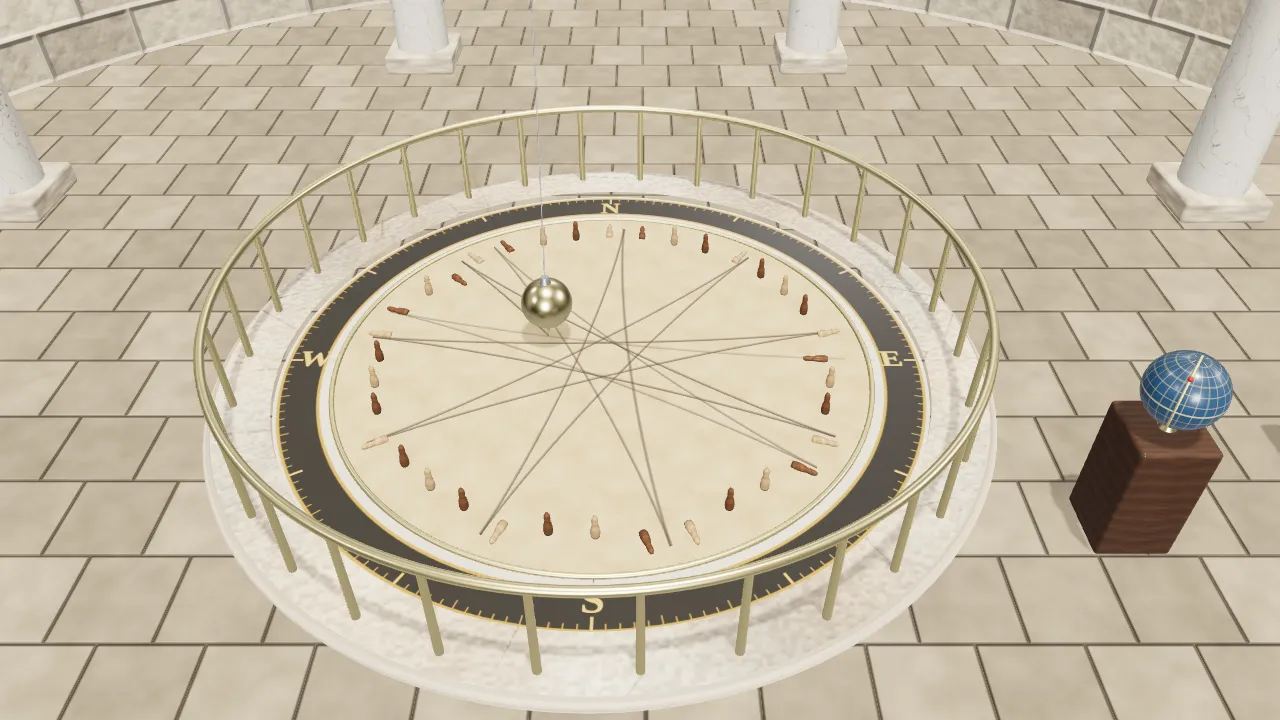
- Drag the brass bob out towards the ring of wooden pins and let go. Its stylus draws the swing in the sand.
- Watch the swing turn slowly clockwise in the north. Each time it lines up with a new pin, down it goes. Tap a fallen pin to stand it up again.
- Drag the globe by the railing up or down to travel north or south: at the equator the swing never turns, and south of it the turn reverses.
- Earth’s spin is sped up so you can see in minutes what takes hours. Try the Challenges, or open Lab for cities and Foucault’s 67 m wire.
Challenges
- Pull the bob out, let it go and knock over your first pin
- Knock down ten pins in a single release
- Turn the globe south of the equator and see the swing turn anticlockwise
Try this
- Set the latitude to 90° (North Pole) and then to 0° (the equator). At the pole the pattern in the sand turns fastest; at the equator it doesn’t turn at all.
- Choose Sydney. The swing plane now turns anticlockwise, because you are in the Southern Hemisphere.
- Switch to the 67 m wire. Each swing takes about twice as long, but the turning rate stays the same: it depends only on latitude.
Fun facts
- Léon Foucault showed his pendulum to the public at the Panthéon in Paris in 1851, using a 67-metre wire and a 28-kilogram bob.
- At the North or South Pole, the swing plane makes a full turn in about 23 hours 56 minutes: one rotation of the Earth relative to the stars.
- On the equator, a Foucault pendulum doesn’t turn at all.
- In the Northern Hemisphere the swing plane turns clockwise seen from above; in the Southern Hemisphere it turns anticlockwise.
The pendulum that showed the Earth turning
In 1851 the French physicist Léon Foucault hung a heavy ball from a very long wire and set it swinging. Over the following hours, the line along which it swung slowly turned. Nothing was pushing it round: it was the floor, and the whole Earth with it, that was turning underneath. It was the first simple, direct demonstration that our planet rotates, and Foucault pendulums still swing in science museums around the world.
Why the swing plane turns
Imagine the pendulum at the North Pole. Once it is swinging, nothing twists its plane, so it keeps swinging in the same direction relative to the distant stars. Meanwhile the Earth turns beneath it once a day. To someone standing on the ice, the swing plane seems to turn the other way, completing a full circle in about 23 hours 56 minutes. At other latitudes only part of the Earth’s spin acts around the local vertical, so the turning is slower. On the equator the floor isn’t twisting under the pendulum at all, and the plane doesn’t turn.
The sine law
The rate of turning is about 15° per hour × sin(latitude). In Paris, at about 48.9° north, that is roughly 11° per hour, so a full turn takes close to 32 hours. The scene speeds up the Earth’s spin so you can see the turning in minutes, while the pendulum itself swings at its true rate. The readouts always show the real figures for the latitude you choose.
Pins and patterns
Many museum pendulums knock over a ring of small pins as the swing plane turns, so visitors returning later can see how far it has gone. The stylus line in the sand shows the same thing in detail: a star-shaped rosette whose points creep round with every swing. Real Foucault pendulums need very long wires, heavy bobs and careful release, because air drag, a sideways nudge or a slightly uneven support can make the swing go elliptical and confuse the effect.
For the curious
Measured on the rotating floor, the bob feels a sideways Coriolis acceleration, −2Ω × v, where Ω is Earth’s rotation (7.29 × 10⁻⁵ radians per second). For small swings only the vertical part, Ω·sin φ at latitude φ, matters, and the motion along east (x) and north (y) obeys x″ = −(g/L)·x + 2Ω·sin φ·y′ and y″ = −(g/L)·y − 2Ω·sin φ·x′. Solving these shows the swing plane turning at exactly Ω·sin φ. The scene integrates them with the fourth-order Runge–Kutta method, with Ω multiplied by the speed-up you choose.
Questions people ask
How does a Foucault pendulum prove the Earth rotates?
Once swinging, the pendulum keeps its swing direction fixed relative to the stars, because nothing twists it. Its swing plane appears to turn slowly relative to the floor, which can only happen if the floor itself, and the Earth with it, is rotating.
How long does a Foucault pendulum take to go full circle?
It depends on latitude. At the poles it takes about 23 hours 56 minutes. Elsewhere you divide that by the sine of the latitude: about 32 hours in Paris and about 31 hours in London. On the equator it never turns.
Which way does a Foucault pendulum turn?
Seen from above, the swing plane turns clockwise in the Northern Hemisphere and anticlockwise in the Southern Hemisphere. The direction comes from the way the Earth spins beneath the pendulum.