Coupled Pendulums
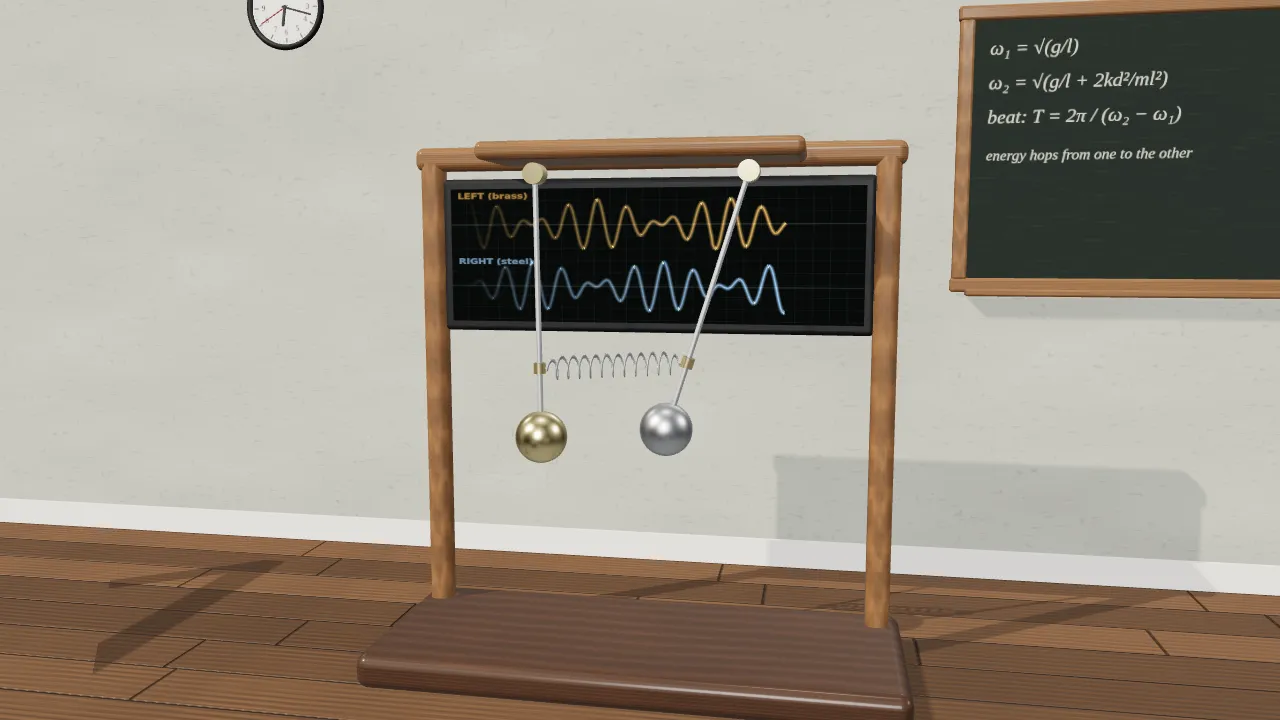
Swing one pendulum by hand and see its energy pass to its neighbour.
How to play
- Drag one bob sideways and let go. Grabbing a bob holds both still, so you can pose both before letting go.
- Watch the screen behind: the amber and blue traces show each pendulum’s swing growing and shrinking in turn.
- Grab the spring and slide it up or down the rods: higher means weaker coupling and a slower hand-over.
- Try the Challenges, or use Lab for Together and Opposite starts, the spring stiffness and the right pendulum’s length.
Challenges
- Swing one pendulum and wait until the other has all the energy
- Set both swinging so their energy stays evenly shared for 10 seconds
- Slide the spring up until one hand-over takes longer than 10 seconds
Try this
- Press Swing one and time how long the left pendulum takes to come to rest. Compare it with half the Beat period readout.
- Press Together, then Opposite. In each case the energy stays put. Which one swings faster?
- Make the right pendulum a few centimetres longer. Now the hand-over is never complete: the left pendulum never quite stops.
Fun facts
- With two identical pendulums, all of the energy can pass from one to the other and back again, however weak the spring is.
- A weaker spring doesn’t stop the transfer, it only slows it down: the beat period gets longer.
- If the two pendulums are not identical, the hand-over is never complete.
- The same mathematics of normal modes describes how the atoms in a molecule vibrate together.
Two pendulums, one shared rhythm
Hang two identical pendulums side by side, link them with a gentle spring and set just one swinging. At first only that one moves. Slowly its swing shrinks while the other pendulum, untouched, begins to swing more and more, until the first is almost still and all the energy has crossed over. Then the process reverses, and the energy flows back. The slow back-and-forth is called a beat.
The two normal modes
The key to understanding the beats is that this pair has two special ways of moving, called normal modes, in which nothing ever changes. Swing both pendulums together, in step, and the spring is never stretched: each pendulum swings at its own natural rate as if the spring were not there. Swing them in opposite directions and the spring is stretched and squashed on every swing, adding an extra push that makes this mode slightly faster. Press Together and Opposite in the Lab to see each one on its own.
Where the beats come from
Starting with just one pendulum swinging is the same as starting both modes at once with equal strength. Because the modes run at slightly different rates, they drift in and out of step. When they agree on the left and cancel on the right, the left pendulum swings fully and the right one is still. Half a beat later the situation is reversed. The time for a full cycle of this hand-over is the beat period, shown in the readout.
Detuning
Make one pendulum longer and the two no longer share the same natural rate. The normal modes become lopsided, and the energy can no longer cross over completely. The bigger the mismatch compared with the strength of the spring, the less energy ever reaches the second pendulum. Tuned and detuned oscillators like these appear everywhere, from vibrating molecules to the strings of a piano.
For the curious
For small swings of pendulums with length L and mass m, joined by a spring of stiffness k fixed a distance d below the pivots, the in-step mode has angular frequency ω₁ = √(g/L) and the opposite mode ω₂ = √(g/L + 2kd²/(mL²)). The beat period is T = 2π/(ω₂ − ω₁), and complete transfer from one pendulum to the other takes half of that. The simulation doesn’t use these small-swing shortcuts: it computes the real spring force from the positions of both attachment points and integrates both pendulums with the fourth-order Runge–Kutta method, 600 times per second.
Questions people ask
What are coupled pendulums?
Two or more pendulums linked so they can exchange energy, for example by a spring or a shared flexible support. Swinging one makes the other start to swing, and the energy moves back and forth between them.
What is a normal mode?
A pattern of motion in which every part of a system moves at the same frequency and the pattern never changes. Two coupled pendulums have two: swinging together in step, and swinging in opposite directions.
Why does the energy move from one pendulum to the other?
Starting one pendulum is the same as starting both normal modes at once. The modes run at slightly different rates, so they drift in and out of step, and the swing moves from one pendulum to the other and back.