Metronome Synchronisation
Start five metronomes out of step and hear them settle on one beat.
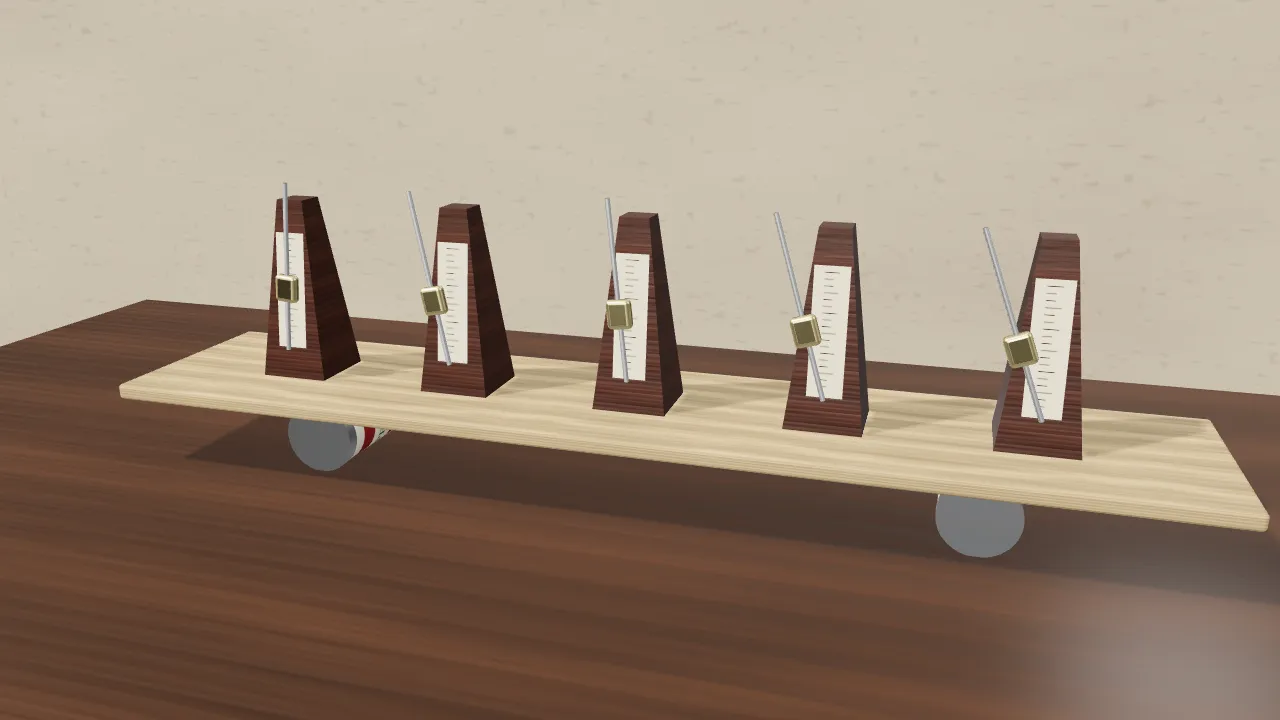
How to play
- Tap a metronome to knock it out of step. Over half a minute or so, all five drift back into one beat.
- Drag a brass weight up the rod to slow that metronome, or down to speed it up. A small change is forgiven; a big one is not.
- Tap one of the cans to roll both out from under the board, so it rests on the table. Tap again to put them back.
- Try the Challenges, or open Lab to change the tempo, board mass, mismatch or number of metronomes.
Challenges
- Knock a metronome out of step and wait until all of them tick as one
- Slide one weight a little and see the others still pull it into step
- Roll the cans away and keep the metronomes out of step for 20 s
Try this
- Scramble the metronomes and watch the In step readout climb towards 100% while the Board sway readout grows.
- Untick Board rolls on cans and scramble again. With the board locked, the metronomes ignore each other for ever.
- Make the board heavier. It moves less with each swing, so the metronomes take longer to agree, or never quite manage.
Fun facts
- In 1665 Christiaan Huygens noticed that two pendulum clocks hanging from the same beam ended up swinging in exact opposition. He called it an “odd kind of sympathy”.
- When London’s Millennium Bridge opened in 2000, it swayed sideways as walkers fell into step with its motion, a similar feedback between a moving platform and many rhythms.
- The board only needs to move a few millimetres for the metronomes to pull each other into step.
- Synchronisation happens across nature, from the pacemaker cells that set the heartbeat to fireflies that flash in unison.
How metronomes agree on a beat
Start five metronomes at the same tempo but at random moments, and their ticks form a clattering jumble. Put them on a light board resting on two cans, and something lovely happens: over half a minute or so the ticks draw together, until all five swing as one. No one adjusts them. They synchronise themselves through the board they share.
The board is the messenger
Every time a metronome’s pendulum swings one way, it pushes its case, and the board, slightly the other way, because momentum must balance. With the board on rollers, those pushes make it sway by a few millimetres. That sway shakes every metronome on the board. A metronome that is running slightly ahead gets nudged back, and one that lags behind gets nudged forward. The nudges are tiny, but they keep coming on every swing, and gradually the metronomes pull each other into the same rhythm and the same phase. Once they agree, their pushes add up and the board sways steadily in time with them.
Why they don’t simply stop
Each metronome has an escapement, the mechanism that ticks. It gives the pendulum a small kick every swing, topping up the energy lost to friction and keeping the swing at a fixed size. Physicists model this as a self-sustained oscillator: small swings get boosted and big ones get damped. Because each metronome keeps its own swing size, the only thing the board can change is timing, and timing is exactly what synchronisation is about.
Lock the board, lose the sync
Untick Board rolls on cans in the Lab and the board is held still. Now there is no messenger, and each metronome keeps its own phase indefinitely. Make the board heavier and the messages get weaker, so syncing takes longer. If the metronomes are too different in tempo, the nudges can’t overcome the mismatch, and the group never fully agrees.
For the curious
Each pendulum obeys I·θ″ = −m·g·r·sin θ − m·r·cos θ·X″ + τ, where X is the board’s position and τ = −I·ε·((θ/θ₀)² − 1)·θ′ is a van der Pol-style escapement that keeps the swing near a fixed size. The board obeys momentum balance, M·X″ + Σ m·r·(cos θ·θ″ − sin θ·θ′²) = −c·X′, with a little rolling friction c. All the equations are solved together with the fourth-order Runge–Kutta method, 600 times per second. The In step readout is the Kuramoto order parameter: the length of the average of each metronome’s phase arrow, which is 0% for random timing and 100% for perfect unison.
Questions people ask
Why do metronomes on a moving board synchronise?
Each swing pushes the board slightly, and the board’s movement pushes back on every metronome. Those small repeated nudges speed up the ones that lag and slow down the ones that lead, until they all swing together.
Why do the metronomes need to sit on cans?
The cans let the board roll freely, so it can carry the tiny pushes from one metronome to the others. On a fixed table nothing passes between them, and they stay out of step.
What did Huygens discover about pendulum clocks?
In 1665 Christiaan Huygens noticed that two pendulum clocks hanging from a common support always ended up swinging in exact opposition, even after being disturbed. It was one of the first recorded observations of synchronisation.