Pendulum Wave
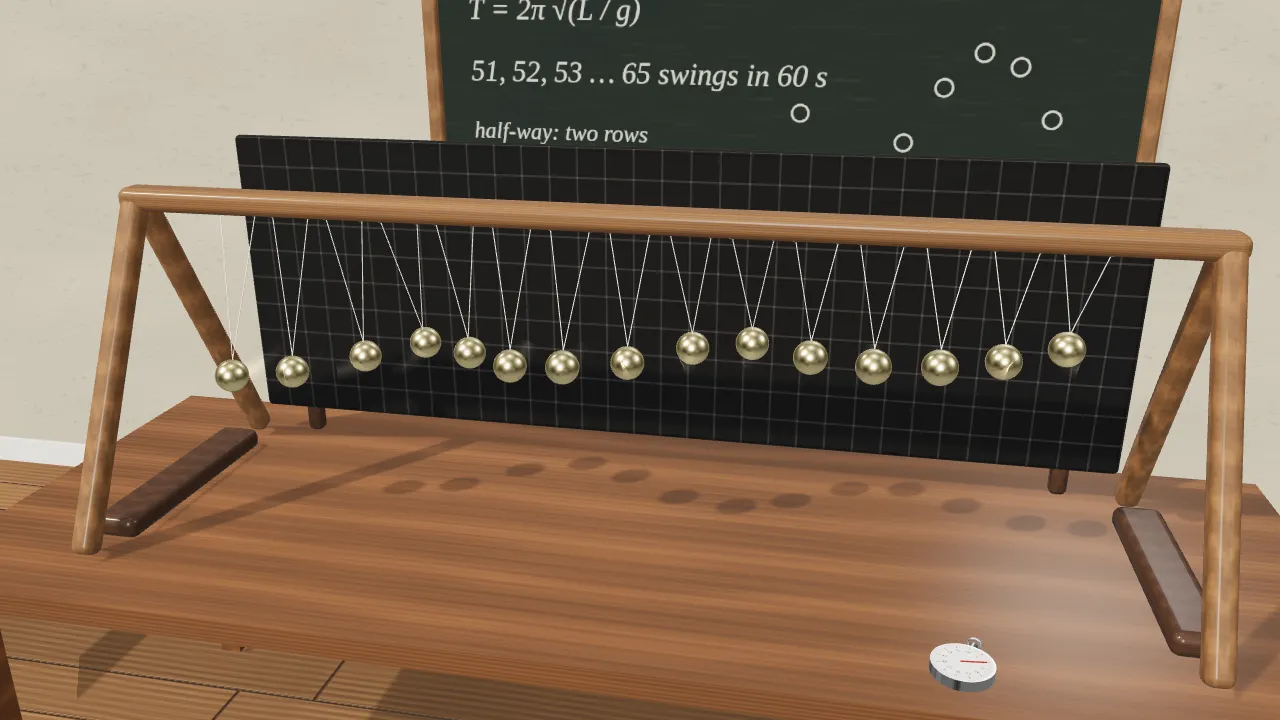
Pull back fifteen pendulums, let go and spot snakes, rows and order.
How to play
- Drag any ball back: like the board in real demos, it pulls the whole row with it. Let go to start.
- See the patterns change: a travelling snake, then three groups, then two alternating rows at the half-way mark. Tap a ball to call the pattern you see.
- The stopwatch on the bench restarts each time you let go. Tap it to stop it when every ball is back in line.
- Open Lab to fast-forward, change gravity or the number of swings, or show a line through the balls.
Challenges
- Tap a ball just as the row splits into two alternating lines
- Tap a ball when the balls gather into three groups
- Stop the stopwatch within a second of the row lining up again
Try this
- Keep watching until the Time in cycle readout reaches 30 s. The row splits into two lines swinging in opposite directions.
- Switch gravity to the Moon. The strings don’t change, so every pendulum slows down and the whole dance takes about 2.5 times longer.
- Fast-forward ×4 and watch the full minute. At 60 s every ball is back in a single straight line.
Fun facts
- The pendulums never touch or push each other. Every pattern comes from timing alone.
- A version shown in Harvard University’s lecture demonstrations uses fifteen pendulums whose longest makes 51 swings a minute and whose shortest makes 65.
- A pendulum’s swing time depends on its length and on gravity, not on the mass of its bob.
- To halve a pendulum’s swing time you need a string only a quarter as long, because the period grows with the square root of the length.
Fifteen pendulums, one minute, endless patterns
Every ball in this row is a separate pendulum, and none of them ever touches another. Yet released together they form a rippling snake, split into rows, scramble into what looks like disorder and then, exactly one minute later, line up again. The secret is in the tuning of the string lengths.
Tuned to the minute
A pendulum’s swing time, its period, depends on its length: longer pendulums swing more slowly. Here the longest pendulum makes 51 complete swings in 60 seconds, the next makes 52, the next 53, and so on up to 65 for the shortest. Each one gains exactly one swing per minute on its neighbour. After 60 seconds every pendulum has made a whole number of swings, so they all arrive back where they started at the same moment.
Where the patterns come from
Between the start and the end of each minute, neighbouring pendulums drift steadily out of step. After 15 seconds each one is a quarter of a swing ahead of the next, and the row forms four interleaved groups. After 20 seconds it is a third of a swing ahead and you see three groups. At 30 seconds each pendulum is half a swing away from its neighbours, so alternate balls swing in opposite directions and the row splits into two lines. In between, the steadily changing offsets look like waves running along the row. These are not real waves, since no energy passes from ball to ball. They are patterns of phase, like the stripes you see when two fences overlap.
Why real demos slowly drift
The simple period formula is exact only for tiny swings. Released from a bigger angle, a pendulum takes slightly longer. This simulation sets each length using the exact period for its release angle. Real demonstrations also fight air drag, which gradually shrinks the swings and changes their timing by a hair. Turn on Air drag in the Lab to see the swings fade.
For the curious
For small swings the period is T = 2π√(L/g). For a release angle θ₀ the exact period is T = 4√(L/g)·K(sin(θ₀/2)), where K is the complete elliptic integral of the first kind. Pendulum k must make 51 + k swings in 60 s, so Tk = 60/(51 + k) seconds and the length follows from solving the formula for L. On Earth that gives about 34 cm for the longest pendulum and about 21 cm for the shortest. Each pendulum’s motion, θ″ = −(g/L)·sin θ, is integrated with the fourth-order Runge–Kutta method, 480 times per second.
Questions people ask
How does a pendulum wave work?
Each pendulum has a slightly different length, chosen so it makes exactly one more swing per minute than its longer neighbour. As they drift in and out of step, the changing timing creates wave-like patterns, and after one minute they all line up again.
Do the pendulums in a pendulum wave affect each other?
No. They hang independently and never touch or pull on each other. The patterns come entirely from their carefully chosen swing times.
How do you work out the string lengths for a pendulum wave?
Pick the cycle time and the number of swings for each pendulum, find each period by dividing the cycle time by its number of swings, then use L = g·T² / (4π²) for small swings. For 51 swings in 60 seconds on Earth that is about 34 cm.