Double Pendulum Chaos
Pose a double pendulum, drop it and see a twin 0.001° away split off.
How to play
- Drag either brass bob to pose the arms, then let go. Higher starts give wilder motion.
- Grab the brass carriage on the rail at the top and slide it to and fro to shake the support and pump in energy.
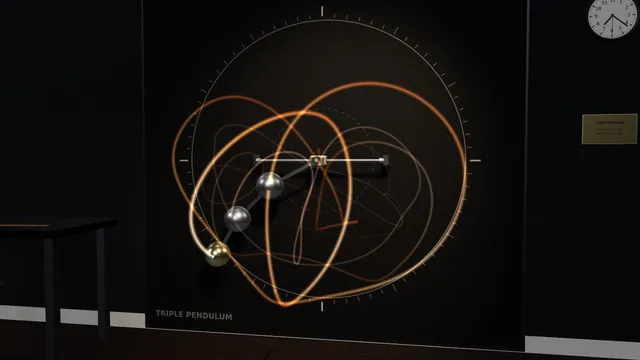
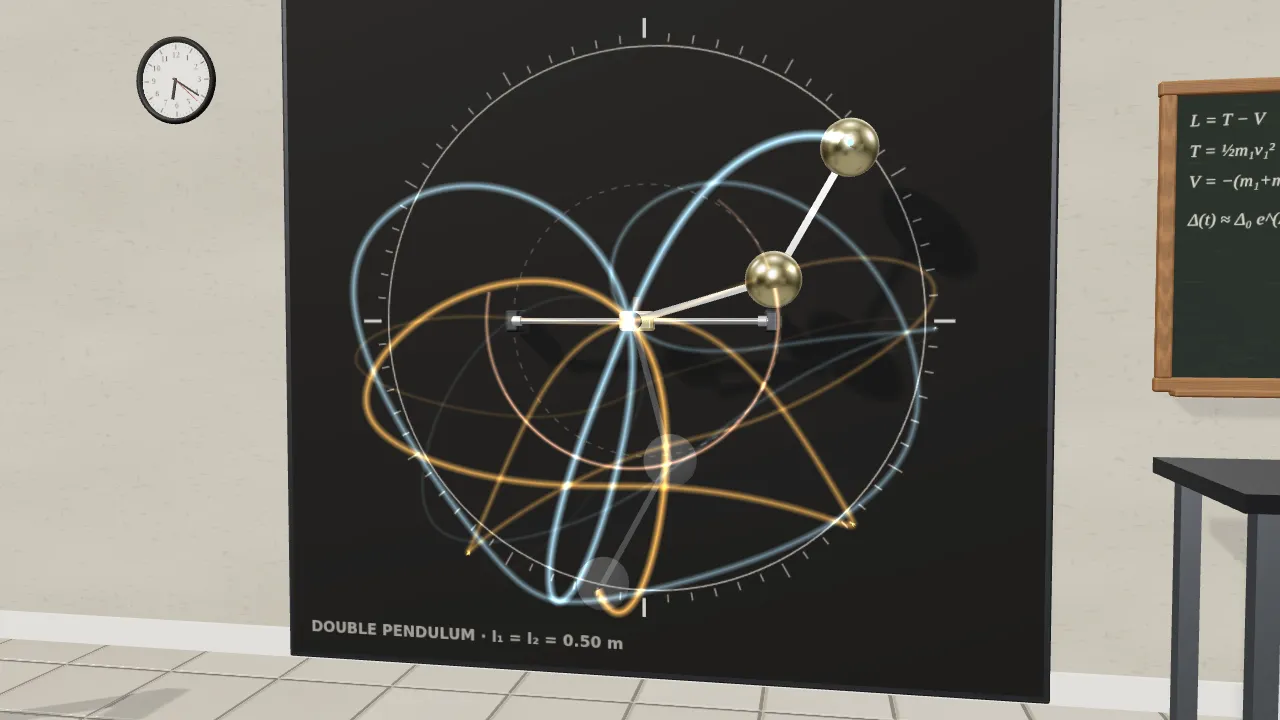
- The gold trail belongs to a ghost twin that started just 0.001° away. Watch how long the two stay together.
- Try the three Challenges, or open Lab to change the rod lengths, the lower mass, gravity or friction.
Challenges
- Drop it from high enough that the lower arm swings right over the top
- Make the lower arm flip over five times in a single drop
- Find a start that keeps the ghost twin within 1 cm for 30 seconds
Try this
- Press Drop from high and count the seconds until the gold twin trail visibly leaves the blue one. Then try Gentle swing: the twins stay together for as long as you care to watch.
- Keep an eye on the Energy readout while the bobs fly around. Without friction it hardly changes, even though the motion looks wild.
- Turn the air friction up a little. The chaos fades as energy drains away, and the pendulum settles into calm, predictable swinging.
Fun facts
- The double pendulum is deterministic: the same start always gives the same motion. It is unpredictable in practice only because no start can be measured perfectly.
- The phrase “butterfly effect” comes from a 1972 talk by the meteorologist Edward Lorenz, who found the same sensitivity in a simple weather model.
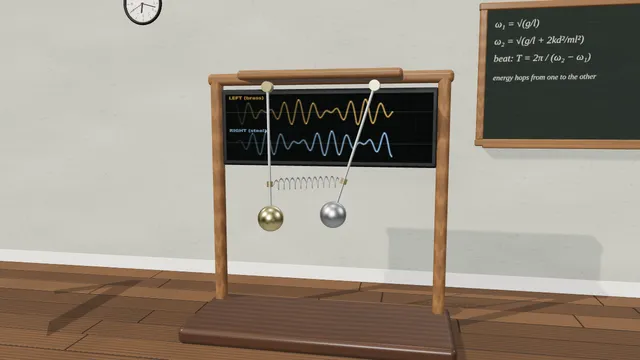
- For small swings a double pendulum is not chaotic at all. It moves as a blend of two steady rhythms, one with the bobs in step and one with them opposed.
- With equal rods and bobs, those two rhythms run at about 0.77 and 1.85 times the swing rate of a single pendulum of the same rod length.
Why two pendulums are wilder than one
A single pendulum is the very picture of regularity: it swings back and forth with the same rhythm for as long as it keeps moving. Hang a second pendulum from the end of the first and everything changes. Released from high up, the lower bob whips over the top, pauses, reverses and loops in a way that never quite repeats. This is chaos, and the double pendulum is one of the simplest machines that shows it.
Sensitive to the tiniest difference
Chaos doesn’t mean randomness. The motion follows Newton’s laws exactly, and the same start always produces the same dance. What makes it chaotic is sensitivity to initial conditions. The gold trail in this scene belongs to a ghost twin that started only 0.001° away, far less than you could ever measure on a real pendulum. For a few seconds the two paths overlap perfectly. Then the tiny gap grows, roughly doubling again and again, until the twins move in completely different ways. Weather forecasting runs into the same limit, which is why the effect became known as the butterfly effect.
Calm at small swings
Chaos needs energy. Press Gentle swing and the double pendulum behaves itself: its motion is a mixture of two steady patterns called normal modes, one with both bobs swinging the same way and a faster one with them swinging opposite ways. The twins then stay together indefinitely. Between these extremes there are starts where calm and wild motion alternate, and the twin is a quick test of which kind you have found.
Energy that never changes
With friction at zero, the total energy, kinetic plus potential, is conserved. Energy flows constantly between the two bobs and between speed and height, but the sum stays fixed. The Energy readout is a check on the simulation itself: a sloppy calculation would let it drift, so the motion is computed in very small, careful steps. Add air friction in the Lab and the readout falls steadily as motion turns into heat, and the pendulum settles down.
For the curious
With angles θ₁ and θ₂ measured from straight down, rod lengths l₁ and l₂ and bob masses m₁ and m₂, Lagrange’s method gives two coupled equations:
(m₁ + m₂)·l₁·θ₁″ + m₂·l₂·θ₂″·cos(θ₁ − θ₂) + m₂·l₂·θ₂′²·sin(θ₁ − θ₂) + (m₁ + m₂)·g·sin θ₁ = 0
l₂·θ₂″ + l₁·θ₁″·cos(θ₁ − θ₂) − l₁·θ₁′²·sin(θ₁ − θ₂) + g·sin θ₂ = 0
There is no neat formula for their solution, so the scene solves them numerically with the fourth-order Runge–Kutta method, 600 times per second, for both the pendulum and its twin. For equal rods of length l and equal masses, the two small-swing rhythms have angular frequencies √((2 − √2)·g/l) and √((2 + √2)·g/l).
Questions people ask
Why is a double pendulum chaotic?
Because its motion is extremely sensitive to how it starts. The two arms keep exchanging energy, and at high energy any tiny difference in the starting angles grows roughly exponentially until the motion becomes completely different.
Is the motion of a double pendulum random?
No. It is fully determined by Newton’s laws, and the same start always gives exactly the same motion. It only looks random because we can never know the starting position precisely enough to predict far ahead.
Does a double pendulum ever repeat itself?
At small swings it moves in regular, nearly repeating patterns. Released from high up, its motion is chaotic and does not settle into a repeating cycle, although it can come close to earlier positions by chance.