Triple Pendulum
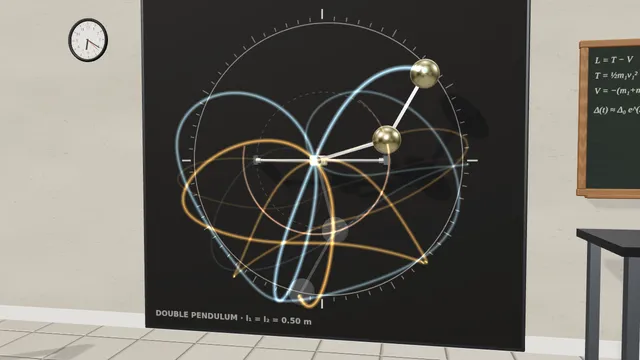
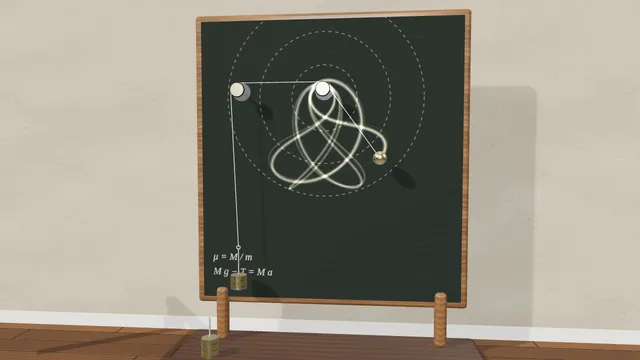
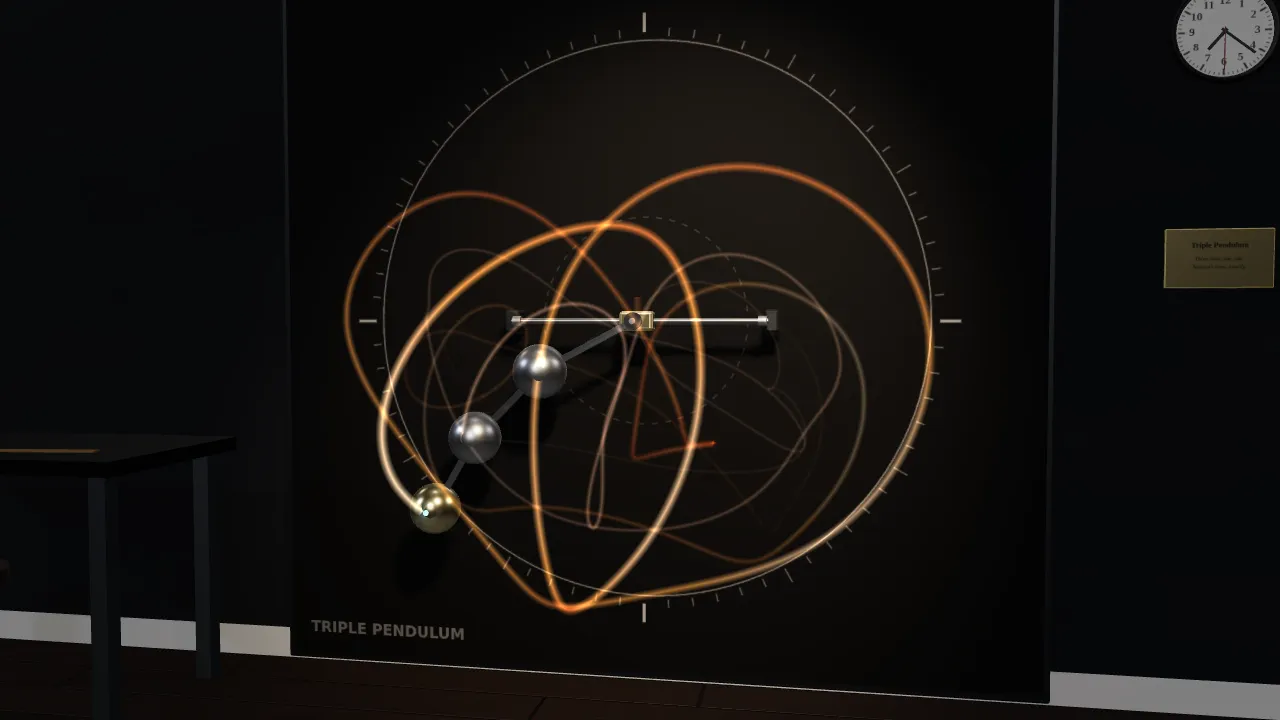
Pose three linked arms, let go and trace the tip’s whip in light.
How to play
- Drag any of the three bobs to pose the arms, then let go.
- Follow the LED trail: ember red where the tip moves slowly, white-hot where it whips round fastest.
- Slide the brass carriage on the top rail to shake the support and feed in energy by hand.
- Try the Challenges, or open Lab for Nearly upright and Gentle swing starts, gravity, friction and a twin pendulum.
Challenges
- Let go so the tip swings up higher than the top pivot
- Make the lowest arm flip over 20 times in one release
- Whip the tip faster than 9 m/s
Try this
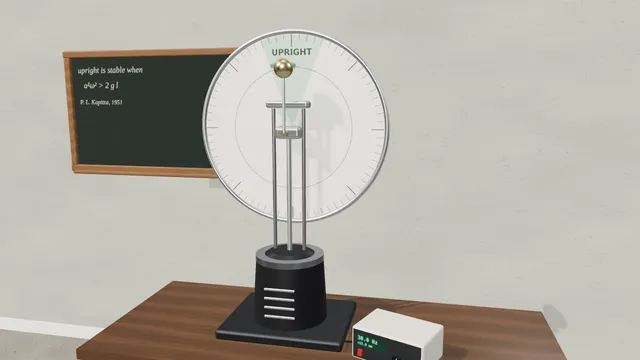
- Press Nearly upright. The pendulum balances for a moment, then collapses in a different way each time you change the start even slightly.
- Turn on the twin pendulum in the Lab and compare how quickly the two copies split apart here and on the double pendulum.
- Lower the Lowest bob mass. A lighter tip gets flung faster, and its trail glows white-hot more often.
Fun facts
- A triple pendulum needs three angles to describe its shape at any instant: it has three degrees of freedom, one more than a double pendulum.
- Balancing an upside-down triple pendulum on a moving cart is a classic test for control engineers, because it is so unstable.
- However wild the motion looks, a frictionless triple pendulum can never rise higher than its starting energy allows.
- Like the end of a cracking whip, the lightest outer arm can end up moving far faster than the heavier arms above it.
Three arms, one tangle of energy
Add a third arm to a double pendulum and the motion gets even richer. The top arm swings, the middle arm flips and the lowest arm is flung around in sudden bursts. Every movement follows Newton’s laws exactly, yet the result is so sensitive to its starting position that predicting it far ahead is hopeless. That is the hallmark of chaos.
More ways to share energy
A triple pendulum has three degrees of freedom: three angles are enough to describe its whole shape. Energy can slosh between all three arms and between speed and height in many more combinations than in a double pendulum. Without friction, the total energy is fixed, so the motion is confined: the tip can only reach places its energy allows. Inside that limit the motion wanders, rarely repeating, and two copies started a hair apart soon go their separate ways. Switch on the twin in the Lab to see it.
The whip effect
The trail here is coloured by the speed of the tip: deep red when it drifts, orange and white-hot when it races. The brightest streaks appear when the upper arms suddenly slow down and hand their energy outward. The lighter lowest bob then has to carry that energy alone, so it moves much faster, in the same way the thin tip of a whip outruns the hand that cracks it. Make the lowest bob lighter in the Lab and the gold bursts become more frequent.
Balancing on top
Every pendulum has an upside-down balance point, but it is unstable. The Nearly upright start places all three arms within a fraction of a degree of vertical. For a moment nothing seems to happen, then the tiny error grows and the stack folds over. Engineers use upside-down pendulums, especially multi-armed ones on carts, as benchmarks for fast control systems, because keeping them up needs constant, precise corrections.
For the curious
For point masses m₁, m₂, m₃ on light rods l₁, l₂, l₃, the kinetic energy can be written as ½·Σ Mij·θ′i·θ′j, with Mij = μk·li·lj·cos(θi − θj), where μk is the total mass at or below the lower of the two arms. Lagrange’s equations then give three coupled equations, M·θ″ = f, where f contains gravity and the centrifugal terms in θ′². The scene solves this 3 × 3 system at every stage of a fourth-order Runge–Kutta step, 600 times per second. The Energy readout is the honest check: with friction off it should barely move.
Questions people ask
Is a triple pendulum more chaotic than a double pendulum?
Both are chaotic when released from high up. The triple pendulum has more ways to share energy between its arms, so its motion usually looks even more erratic and is just as impossible to predict far ahead.
How is a triple pendulum simulated?
Its motion is written as three equations from Lagrangian mechanics, one for each angle. At every small time step a computer solves them together and advances the angles, here using the fourth-order Runge–Kutta method 600 times per second.
Why does the end of a triple pendulum move so fast?
When the upper arms slow down, their energy is passed outward to the lightest arm. Carrying the same energy with less mass means moving faster, so the tip whips round like the end of a cracking whip.