Swinging Atwood’s Machine
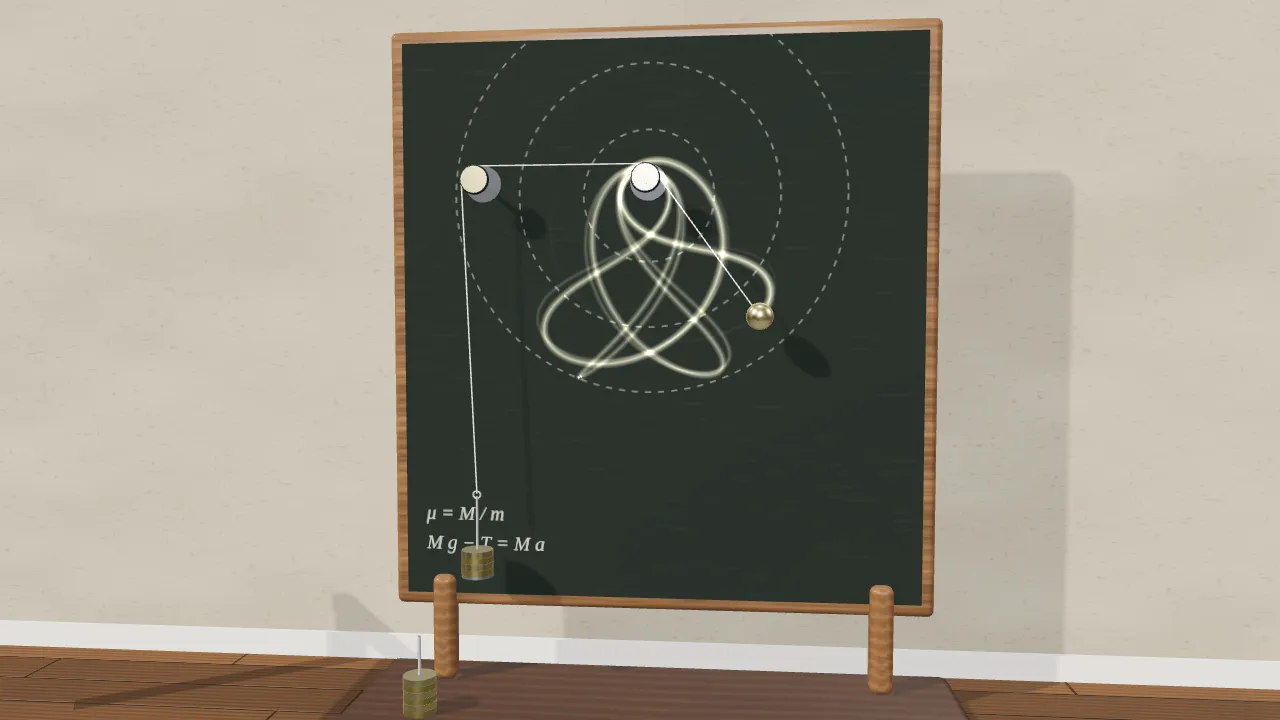
A light swinging ball holds up a heavy weight, tracing wild loops.
How to play
- Drag the brass ball out to the side and let go.
- Watch the heavy weight ride up and down as the ball swings, and follow the trail of the ball.
- Tap the spare slotted masses on the base to add one to the hanger, or tap the hanger to take one off, then release again.
- Try the Challenges, or open Lab for a fine mass-ratio slider, friction and slow motion.
Challenges
- Release the ball so it loops right round its pulley
- Swing the ball so hard that it hauls the heavy weight up by 20 cm
- Take a slotted mass off, then make the ball haul the weight up half a metre
Try this
- With the mass ratio at 3, release sideways and watch the trail. Then try 2.5 and 4: small changes give very different paths.
- Watch the heavy weight while the ball whirls near the pulley. Fast swinging needs so much string tension that the heavier weight is lifted.
- Turn up the friction. As energy drains, the ball spirals in and the weight slowly sinks.
Fun facts
- George Atwood described his original machine in 1784. Two weights on one string over a pulley slowed falling down enough to measure.
- A swinging ball needs extra string tension to follow its curved path. When it whirls fast enough, that tension can lift a heavier weight.
- The motion depends on the ratio of the two masses, not on their actual size.
- With the counterweight exactly three times heavier than the ball, the motion is known to be regular rather than chaotic.
A light ball that lifts a heavy weight
The original Atwood’s machine is a classroom classic: two weights hang from one string over a pulley, and the heavier one sinks while the lighter one rises. Let the lighter weight swing like a pendulum instead of hanging straight, and the machine becomes something completely different. The swinging ball loops, dives toward the pulley and flies out again, while the heavy counterweight bobs up and down in response. This is the swinging Atwood’s machine.
Why the heavy weight doesn’t just win
Hanging still, the heavier weight would simply pull the lighter one up. But a moving ball needs a pull toward the pulley just to follow its curved path: the faster it swings, the stronger that pull must be. When the ball is swinging fast, the string tension it needs can be greater than the counterweight’s weight, so the counterweight is hauled upwards. When the ball slows near the top of its swing, the counterweight drops again. This constant tug-of-war between swinging and lifting couples the two motions together.
Regular and chaotic paths
The machine has two degrees of freedom: the length of string to the ball and its swing angle. With such a coupling, the motion is usually chaotic: tiny changes in the start lead to completely different paths, and the trail fills in a tangled region. Physicists who studied the machine in the 1980s found that some mass ratios behave very differently. When the counterweight is exactly three times heavier, the motion is integrable, following hidden regular rules, and the trail draws smooth, repeating loops. Other ratios give a mixture of regular islands and chaotic seas, which is why exploring the slider is so rewarding.
What the scene adds
If the ball would be pulled right into the pulley, it bounces off with some energy lost, as a real ball would. The Energy kept readout shows this: it stays at 100% for smooth orbits and drops when the ball hits the pulley or when you add friction.
For the curious
With counterweight mass M, ball mass m, string length r to the ball and swing angle θ, the Lagrangian is L = ½(M + m)·r′² + ½·m·r²·θ′² − g·r·(M − m·cos θ). Lagrange’s equations give (M + m)·r″ = m·r·θ′² − g·(M − m·cos θ) and r·θ″ = −2·r′·θ′ − g·sin θ. Dividing by m shows that only the ratio M/m matters. The term m·r·θ′² is the swinging that lifts the counterweight. The scene integrates both equations with the fourth-order Runge–Kutta method, 2,000 times per second.
Questions people ask
What is a swinging Atwood’s machine?
An Atwood’s machine, two weights joined by a string over pulleys, in which the lighter weight is allowed to swing like a pendulum. The swinging and the up-and-down motion of the heavier weight are coupled, which produces rich and often chaotic motion.
How can a lighter swinging weight hold up a heavier one?
A swinging object needs extra pull from the string to follow its curved path. When the light ball swings fast enough, the string tension it needs is larger than the heavier weight, so the heavy weight is lifted.
Is the swinging Atwood’s machine chaotic?
For most mass ratios, yes: small changes in how it starts lead to very different paths. A few special ratios behave regularly; with a counterweight exactly three times heavier than the ball the motion is known to be integrable.