Standing Waves on a String
Shake a cord at just the right pitch and see standing loops appear.
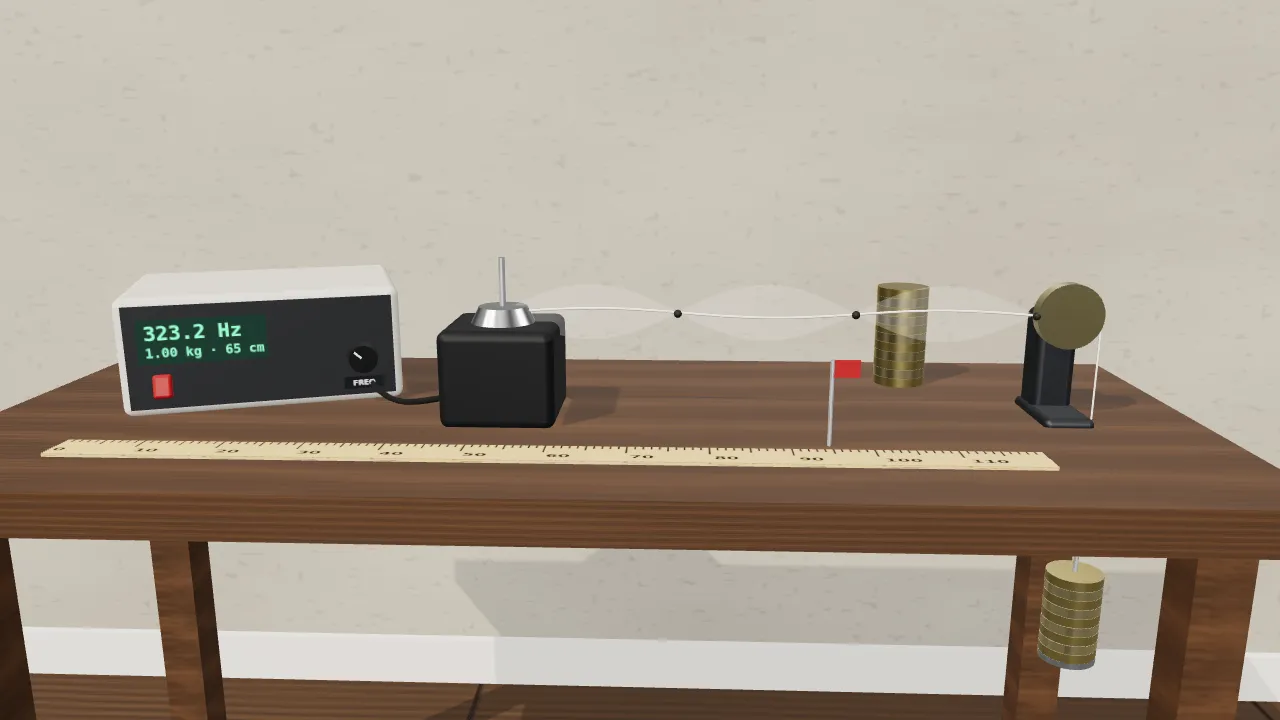
How to play
- Drag the FREQ knob on the signal generator up or down. At each resonance the cord swings in big loops with still nodes between them.
- Drag the black driver along the bench to shorten or lengthen the cord, or tap the spare slotted masses to add tension (tap the hanger to remove some).
- Drag the cord up or down and let go to pluck it, and hear the mix of harmonics your pluck made.
- Try the Challenges, or open Lab to pick a harmonic exactly, change the cord or turn on Slow motion.
Challenges
- Turn the frequency knob until the cord swings in big, steady loops
- Put a node exactly at the red marker flag
- Make four loops at a lower frequency than the three loops you started with
Try this
- Turn the FREQ knob about 5% away from a resonance. The loops shrink to almost nothing: the string only responds strongly at its resonant frequencies.
- Quadruple the hanging mass from 0.5 kg to 2 kg with the slotted masses. The wave speed doubles, and so does every harmonic’s frequency.
- Pluck the string exactly in the middle, then near one end. The middle pluck sounds hollower, because it leaves out the even harmonics.
Fun facts
- In the mid-1800s the German physicist Franz Melde studied standing waves on strings driven by a vibrating tuning fork, a setup still used in classrooms.
- Halving the vibrating length of a string doubles its frequency, raising the note by an octave. That is what a guitarist’s frets do.
- Doubling a string’s tension raises its pitch by a factor of √2, about half an octave.
- The open A string of a guitar in standard tuning vibrates at 110 hertz.
How a string chooses its notes
Shake one end of a stretched string and a wave runs along it, reflects from the far end and runs back. At most shaking rates the outgoing and returning waves jumble together and the string barely moves. But at certain special rates they line up perfectly, and the string swings in a steady pattern of loops with still points between them. This is a standing wave, and the special rates are the string’s harmonics.
Nodes and loops
In a standing wave some points, called nodes, never move: the two waves passing through them always cancel. Halfway between, at the antinodes, they add up and the string swings widely. Because both ends are held still, a whole number of half-wavelengths must fit along the string. One half-wave gives a single loop, the fundamental. Two give two loops, the second harmonic, and so on. Your eye can’t follow the string at a hundred swings a second, so it sees a blurred, shimmering loop, just as in a real experiment. Slow motion shows the string flicking between the top and bottom of each loop.
Tension, length and mass
How fast waves travel along the string sets every harmonic. A tighter string carries waves faster; a heavier string carries them more slowly. Here the tension comes from a hanging mass, so you can change it simply by changing the weight. A shorter string fits its half-waves into less room, so all its harmonics rise. Guitar and violin players use all three: thicker strings for low notes, tuning pegs for tension and fingers or frets for length.
A pluck is a chord
When you pluck the string into a sharp V and let go, it doesn’t vibrate in one harmonic but in many at once. The mix depends on where you pluck: pulling at the centre makes no even harmonics at all, because each of them has a node there. The scene works out the mix from the shape you pulled and plays it, which is why plucking near the end sounds brighter.
For the curious
The wave speed on a string with tension T and mass per metre μ is v = √(T/μ), and the harmonics of a string of length L are fₙ = n·v / (2L). With a 1 kg mass (T ≈ 9.8 N), a 0.5 g/m nylon string and L = 0.65 m, v ≈ 140 m/s and the fundamental is close to 108 Hz. The scene integrates the wave equation ∂²y/∂t² = v²·∂²y/∂x² on 200 points with gentle damping, many hundreds of tiny steps per frame, and draws the pale envelope from the largest recent displacement at each point.
Questions people ask
What is a standing wave?
A wave pattern that stays in place instead of travelling. It forms when two identical waves move in opposite directions, such as a wave and its reflection, giving fixed nodes that never move and antinodes that swing the most.
How do you calculate the frequency of a vibrating string?
Find the wave speed from the tension and the mass per metre, v = √(T/μ), then divide by twice the length for the fundamental: f₁ = v / 2L. The other harmonics are whole-number multiples of f₁.
Why does where you pluck a string change its sound?
A pluck excites many harmonics at once, and the plucking point controls their mix. Harmonics with a node at the plucking point are not excited, so plucking at the centre removes the even harmonics and gives a hollower tone.