Ripple Tank Interference
Set two dippers rippling and find the lines where the waves cancel.
How to play
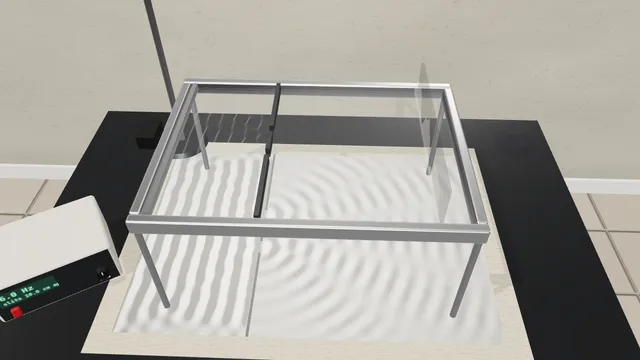
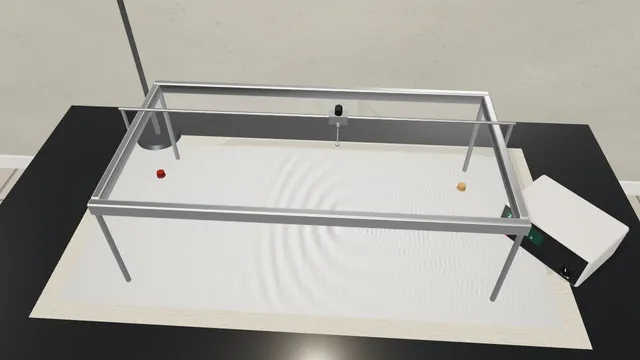
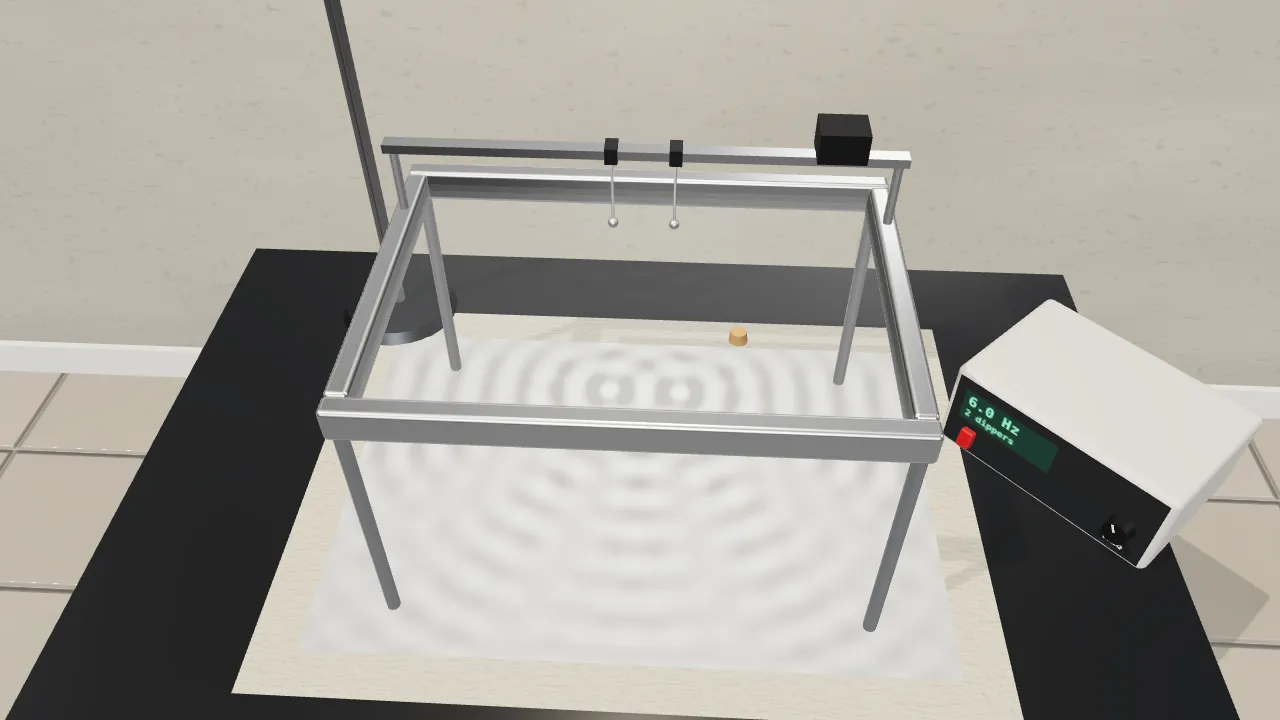
- Drag a dipper along its bar, or grab the little black motor to slide the whole bar. The pattern on the paper below shifts as you go.
- Look for the still lines fanning out between the busy ones. Those are nodal lines, where the two waves cancel.
- Drag the FREQ knob on the signal generator up or down. Tap the water to drop in a single ripple, or drag the cork float about.
- Try the Challenges, or open Lab for one or three dippers, the phase difference and the water depth.
Challenges
- Move the dippers closer until only one still line runs either side of the middle
- Spread the dippers until three still lines fan out on each side
- Park the cork float on a still line so that it stops bobbing
Try this
- Raise the frequency. The wavelength shortens and more nodal lines squeeze into the fan.
- Turn on Show where the waves cancel, then set the phase difference to 180°. The still line that ran straight down the middle becomes a busy one.
- Lower the water depth. The waves slow down, so at the same frequency the ripples crowd closer together.
Fun facts
- In a real ripple tank a lamp shines down through the water: each curved crest acts like a small lens, focusing light into a bright line on the screen below.
- Waves in shallow water travel more slowly than in deep water, which is why the ripples bunch up when you lower the depth.
- Where a crest from one dipper always meets a trough from the other, the water stays almost still. That line of calm is called a nodal line.
- Thomas Young showed in the early 1800s that light makes interference patterns like these, strong evidence that light is a wave.
When two sets of ripples meet
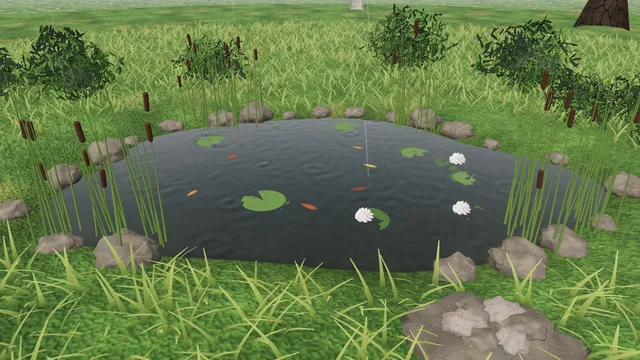
Drop two pebbles into a still pond and their rings spread out, cross and carry on as if the other set were not there. Where they overlap, the water does something simple but powerful: it adds the two waves together. This is called superposition, and it is the key to everything you see in a ripple tank.
Adding crests and troughs
Each dipper taps the surface at a steady rate, sending out circular waves with a fixed wavelength, the distance from one crest to the next. At points where a crest from one dipper arrives together with a crest from the other, the two add up to a double-height crest, and half a cycle later to a double-depth trough. That is constructive interference. At other points a crest from one dipper always meets a trough from the other, and they cancel. The water there barely moves: destructive interference.
Why the calm lines fan out
Whether two waves add or cancel depends on the path difference: how much farther one dipper is than the other. If the difference is a whole number of wavelengths, the waves arrive in step and add. If it is a whole number plus a half, they arrive out of step and cancel. Points with the same path difference lie along curves called hyperbolas, so the calm nodal lines spread out from between the dippers like the ribs of a fan. Moving the dippers apart, or shortening the wavelength, packs in more nodal lines. Turn on Show where the waves cancel in the Lab to see them as dark lanes in a time-averaged map.
Wave speed and depth
Water waves in a shallow tank travel at a speed set by gravity and depth: roughly c = √(g·h), where g is 9.81 m/s² and h the depth. At 6 mm deep that is about 24 cm/s. The wavelength is the speed divided by the frequency, λ = c / f, so a deeper tank or a slower dipper gives longer waves. Real ripple-tank waves also feel surface tension, which nudges the speed of the shortest ripples, but for these settings gravity and depth do most of the work.
For the curious
The scene solves the linear shallow-water equations on a grid of about 11,000 cells: the surface height η changes with the flow of water in and out of each cell, ∂η/∂t = −∇·(hu), while the water accelerates down surface slopes, ∂u/∂t = −g∇η. Each dipper adds and removes a little water in a sinusoidal rhythm. Sponge layers near the walls absorb waves, as the sloping beaches of a real tank do. The bright and dark bands come from the surface curvature ∇²η, the same lensing that makes a real ripple tank’s projected pattern.
Questions people ask
What is a ripple tank?
A shallow glass-bottomed tray of water used to study waves. Vibrating dippers or bars make ripples, and a lamp above projects them onto a screen below, where crests show up as bright lines and troughs as dark ones.
What causes interference patterns in water?
When two sets of waves overlap, their heights add together. Where crests meet crests the water moves strongly, and where crests meet troughs the waves cancel, so a pattern of busy and calm regions appears.
What are nodal lines?
Lines where two overlapping waves always cancel, so the water stays almost still. They occur wherever the distances to the two sources differ by an odd number of half wavelengths.