Loy Krathong River of Lights
Float candlelit krathongs on a moonlit river and watch them drift.
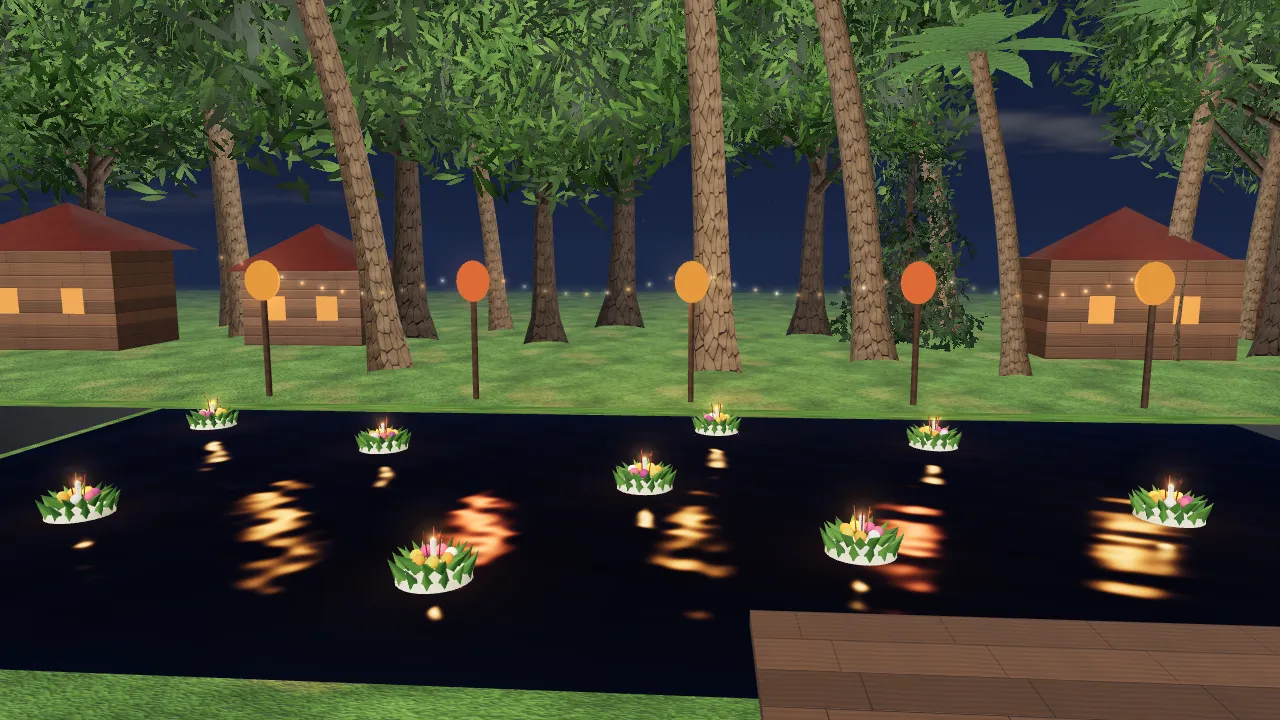
How to play
- Tap the river to float a krathong. It sets off ripples as it touches the water.
- Drag a krathong to guide it, then let the current carry it downstream.
- Look for the moon’s glittering path on the water, and guide a krathong into it.
- Open Lab to choose a banana-leaf or bread krathong, change the river’s current or trail a finger through the water.
Challenges
- Tap the river to float your own krathong
- Guide one of your krathongs into the moon’s glittering path
- Guide two of your krathongs so they drift side by side for 5 seconds
Try this
- Float several krathongs close together and watch their ripple rings overlap and drift downstream with the current.
- Look at the moon’s reflection. On rippled water a single moon becomes a long, glittering path pointing towards you.
- Set the current to zero, then turn it up. The ripples are carried along with the water, so each ring drifts as it grows.
Fun facts
- Loy Krathong takes place on the full-moon night of the twelfth month of the traditional Thai lunar calendar, which usually falls in November.
- In Thai, loi means to float, and a krathong is a small float traditionally made from a slice of banana trunk wrapped in folded banana leaves.
- In northern Thailand the festival coincides with Yi Peng, when many people release paper sky lanterns.
- Krathongs made of bread or banana trunk break down naturally, and fish may eat bread ones, so they are often recommended instead of foam.
Floating lights on moonlit water
Loy Krathong is one of Thailand’s best-loved festivals. On the night of the full moon in the twelfth month of the Thai lunar calendar, usually in November, people gather at rivers, canals and lakes to float krathongs: small floats traditionally made from a slice of banana trunk, wrapped in folded banana leaves and decorated with flowers, a candle and incense sticks. Many people make a wish as they let theirs go, give thanks to the water, or hope to float away bad luck. Customs vary from place to place, and stories link the festival to the old kingdom of Sukhothai, though its exact origins are uncertain. This scene is a calm, simple picture of a river on that night.
Why a krathong floats
Anything placed in water is pushed up by a force equal to the weight of the water it pushes aside. This is Archimedes’ principle. A slice of banana trunk is full of air spaces and is lighter than the same volume of water, so it only needs to sink a little way before the water pushes back hard enough to hold it up. That leaves room on top for flowers and a candle. The wide, flat base also makes the krathong stable: if it tips, the side that dips displaces more water and is pushed back up.
Ripples that drift with the river
Each krathong touching the water starts a ring of ripples. On a flowing river the ripples spread through the moving water, so the whole ring is carried downstream as it grows, while the krathongs themselves drift with the current. The scene shifts its ripples with the flow exactly, so you can watch rings slide along behind their floats.
Paths of light
On perfectly still water the moon would make a single round reflection. Ripples tilt tiny patches of the surface in every direction, and some of them always happen to be angled just right to reflect moonlight or candlelight into your eyes. Those glints line up into a long, shimmering path stretching from the light towards you. Every candle on the river makes its own small glitter path.
Celebrating gently
Huge numbers of krathongs are floated every year, and many towns now encourage natural materials such as banana trunk, leaves, flowers or bread, which break down in the water, instead of foam or plastic. Some families share a single krathong. The virtual ones here leave no trace at all.
Questions people ask
What is Loy Krathong?
A festival celebrated across Thailand on the full-moon night of the twelfth Thai lunar month, usually in November. People float small decorated floats called krathongs on rivers, canals and lakes, often making a wish as they let them go. Customs vary from place to place.
What is a krathong made of?
Traditionally a slice of banana tree trunk wrapped in folded banana leaves, decorated with flowers, a candle and incense sticks. Eco-friendly versions use bread, leaves and other natural materials that break down in the water.
When is Loy Krathong?
On the evening of the full moon in the twelfth month of the traditional Thai lunar calendar. Because it follows the moon, the date changes from year to year, but it usually falls in November.