Diwali Lights
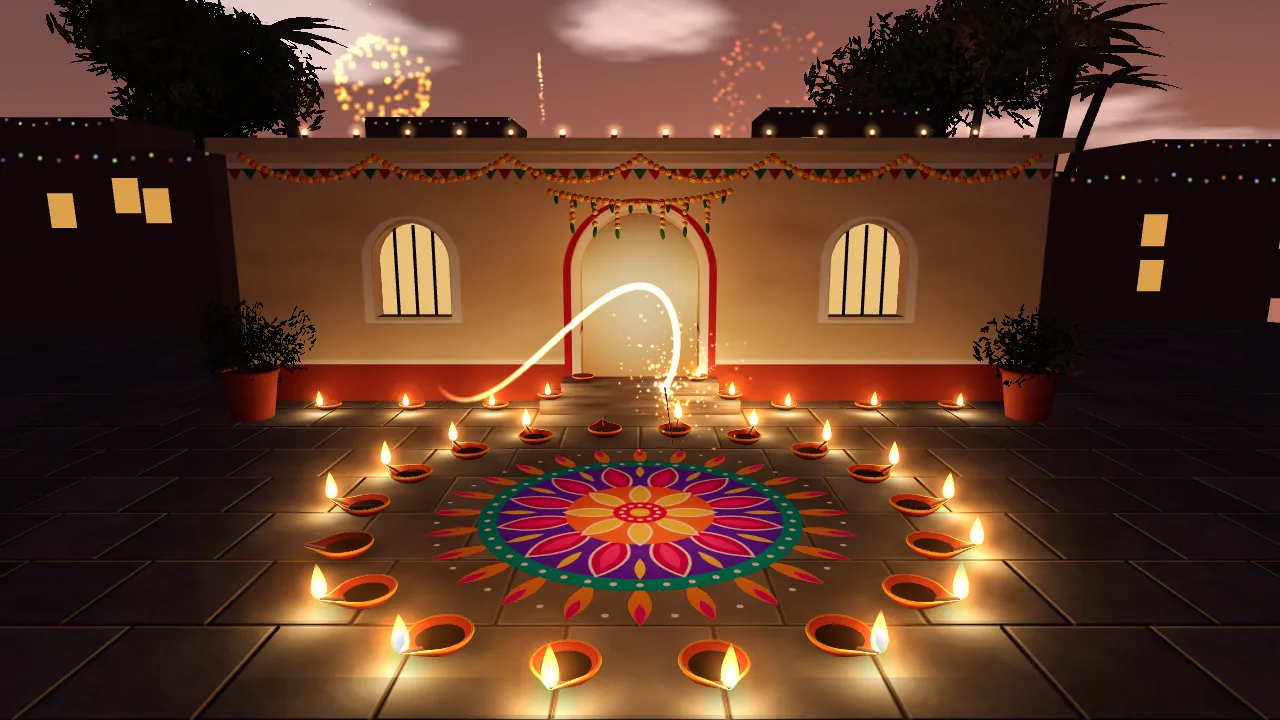
Light diyas around a rangoli, wave a sparkler and fill the sky.
How to play
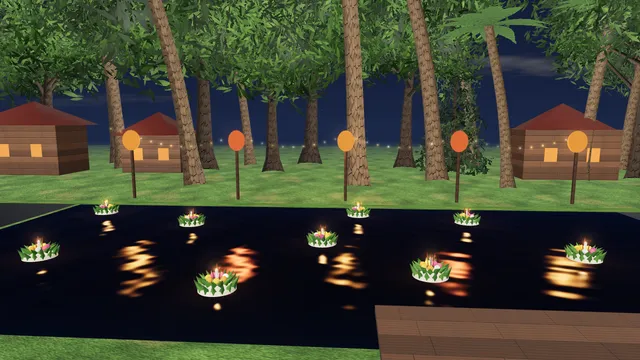
- Tap a clay diya to light it, or open Lab and press Light all to pass the flame from lamp to lamp.
- Press and drag in the air above the rangoli to wave a sparkler. Its glowing trail lets you write in the air.
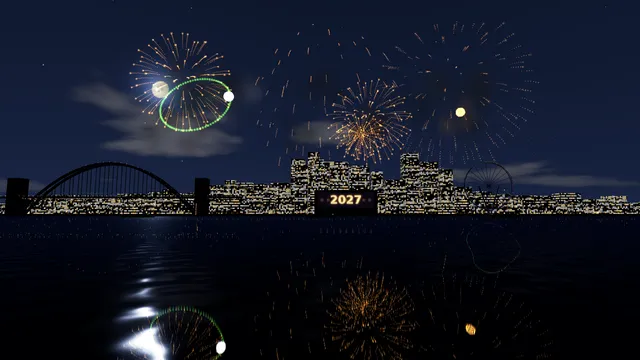
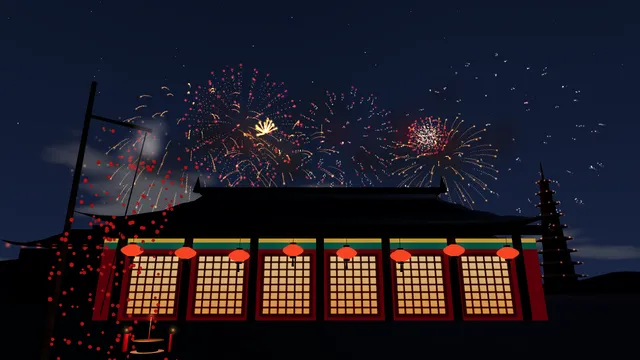
- Tap the sky above the house to launch a firework, and choose its metal salt in Lab.
- Prefer to look around? Switch the sparkler off in Lab, then drag to turn the view.
- Try the three Challenges: light the whole ring, draw a circle of light, and fill the sky with red, green and blue.
Challenges
- Light every diya in the ring around the rangoli
- Draw a full circle of light in the air with the sparkler
- Fill the sky with red, green and blue fireworks: strontium, barium and copper
Try this
- Write your name in the air with the sparkler. Your eyes hold each point of light for a moment, which is why a moving spark seems to leave a glowing line.
- Watch one spark closely: it leaves white-yellow and cools through orange to red before it fades, just like a cooling piece of hot metal.
- Launch a strontium firework, then a barium one, and compare the red and the green. Listen for the boom arriving just after each flash.
Fun facts
- The word Deepavali comes from Sanskrit and means “row of lamps”.
- Lakshmi Puja, the main evening of Diwali in much of India, falls on amavasya: the new moon, the darkest night of the lunar month. That’s why there is no moon in this sky.
- In space, with no “up” for hot gas to rise, a candle flame stops being a teardrop and becomes a dim blue sphere.
- Blue is the hardest firework colour to make, because copper compounds only give a good blue within a narrow range of temperatures.
The science of lamps, sparks and colour
Diwali, also called Deepavali, is the festival of lights. It is celebrated by Hindus, Sikhs, Jains and some Buddhists in India and around the world, and customs differ from region to region. Many families light rows of small clay lamps called diyas as a symbol of light overcoming darkness, and draw rangoli patterns in coloured powder at their doorways to welcome guests. This courtyard is a simple, joyful snapshot of the main evening.
How a diya burns
The cotton wick doesn’t burn the oil in the bowl directly. Oil climbs the wick by capillary action, the same effect that draws water up a paper towel. The flame’s heat turns oil at the tip into vapour, and it is this vapour that burns as it mixes with oxygen. Near the base, where fuel and air mix well, burning is clean and faintly blue. Higher up, tiny specks of unburnt carbon (soot) are heated to around 1,000 °C and glow yellow, which is where most of a diya’s light comes from. Hot gas rises and pulls fresh air in from below, stretching the flame into its teardrop shape.
Why sparkler sparks change colour
A sparkler, or phuljhari, is a wire coated with metal powder (usually iron or steel) mixed with an oxidiser and a binder. Every spark is a tiny burning droplet of metal thrown into the air, and its colour shows its temperature: hot things glow red, then orange, yellow and finally white as they get hotter. A fresh spark leaves white-yellow and cools through orange to red as it falls. Some sparks suddenly split into star-like bursts, because carbon in the steel turns to gas inside the molten droplet and breaks it apart.
Where firework colours come from
Firework colours come from metal salts. Heat excites electrons in the metal atoms, and as the electrons fall back they give off light at particular wavelengths, like a signature: strontium glows red, barium green, copper blue and sodium a rich yellow-gold. Strontium and copper together make purple. Choose the salt in the Lab and watch the bursts change.
Celebrating without smoke
Real crackers release smoke and fine dust, and they are a common cause of burns during festivals. These virtual diyas, sparklers and fireworks give you the glow, colour and crackle with zero smoke, which is kinder to lungs, pets and the air.
For the curious
The link between temperature and colour follows Wien’s law: λmax = b / T, with b ≈ 2.9 × 10⁻³ m·K. A spark at 2,000 K peaks near 1,450 nm, in the infrared, so our eyes see only the short-wavelength edge of its glow, which looks orange-yellow. In the scene each shell rises against gravity and linear air drag (dv/dt = g − kv) and bursts at the top of its climb. The stars droop as they slow down, and the boom arrives a moment after the flash because sound travels at about 343 m/s.
Questions people ask
What is Diwali, and why are diyas lit?
Diwali, or Deepavali, is a festival of lights celebrated by Hindus, Sikhs, Jains and some Buddhists. Lighting rows of diyas is a symbol of light overcoming darkness and good triumphing over evil, and homes are cleaned and decorated to welcome family, friends and good fortune.
Why are sparkler sparks gold, orange and red?
Each spark is a tiny burning droplet of iron or steel, and its colour shows its temperature. The hottest sparks glow white-yellow and cool to orange and then red as they fall, the same way a piece of hot metal changes colour as it cools.
Is a virtual sparkler better than a real one?
It’s certainly safer and cleaner. Real sparklers burn at around 1,000 °C or more and are a common cause of burns, and real crackers add smoke and fine dust to the air. A virtual sparkler gives you the glow and crackle with no smoke, burns or litter.