New Year Fireworks
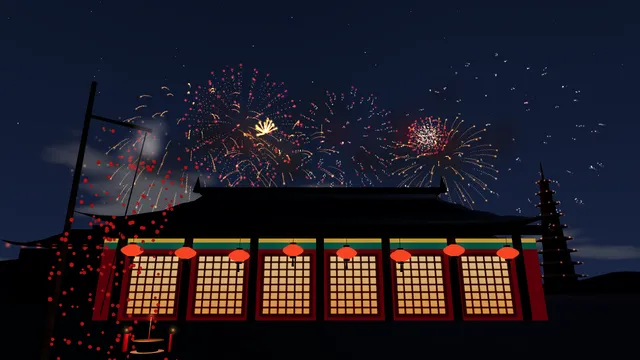
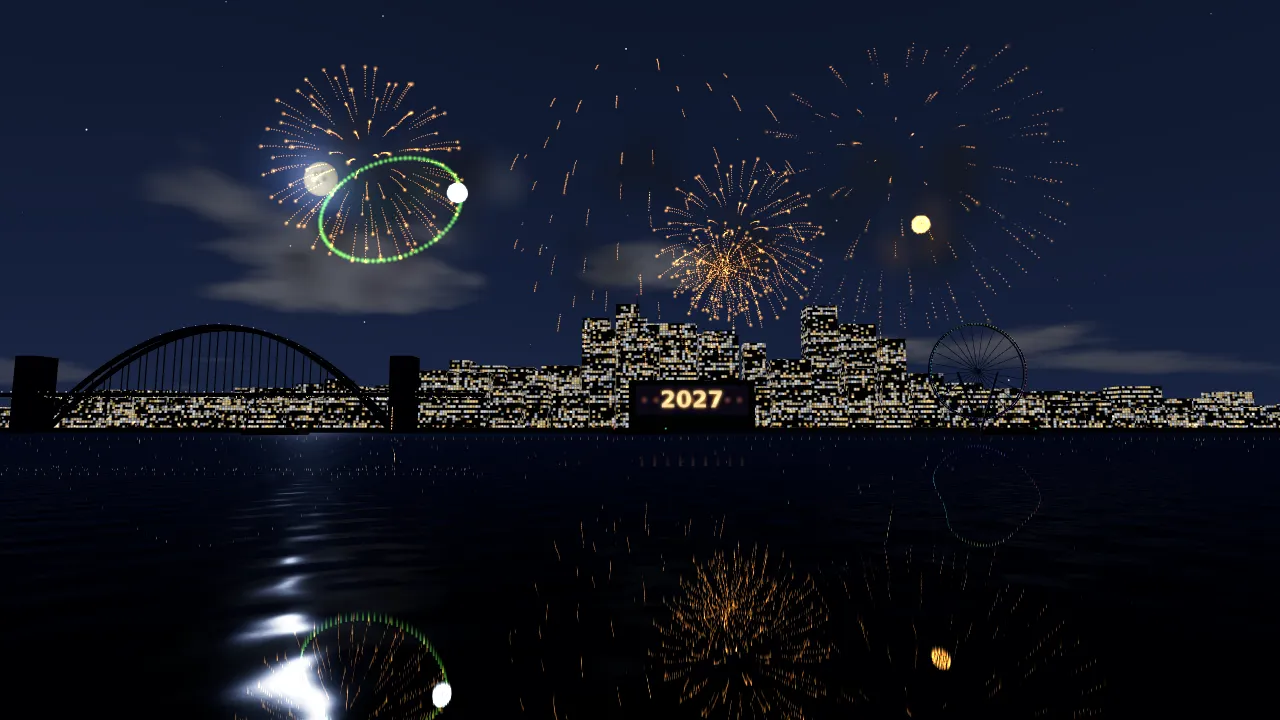
Count down to midnight and fill a harbour sky with fireworks.
How to play
- Press the sky to aim: a ring shows where the shell will burst and a dotted arc shows its flight. Let go to launch it.
- Drag while you aim to move the ring. Higher bursts need bigger shells, faster launches and longer fuses.
- Tap the clock on the far waterfront to start a countdown, then make one of your own shells burst right at midnight.
- Try the three Challenges, or open Lab to pick a metal salt, a star pattern or a shell size.
Challenges
- Fill the sky with five different colours, one shell at a time
- Burst a shell right above the arch of the bridge
- Tap the clock, then make one of your shells burst right at midnight
Try this
- Count the seconds between a flash and its boom, then multiply by 343 to estimate the distance in metres. Compare it with the Boom delay readout.
- Fire a 3-inch shell and then an 8-inch shell. The bigger one needs a faster launch and a longer fuse, but drag slows it less.
- Launch a heart, then turn the view to look at it from the side. Pattern shells are built flat, so they only look right from the front.
Fun facts
- Sound in air at about 20 °C travels at roughly 343 metres per second, so a burst 1 kilometre away is heard about three seconds after it is seen.
- Because of time zones, the new year arrives first in Kiribati’s Line Islands (UTC+14) and last in places such as American Samoa (UTC−11), about 25 hours later.
- Firework colours come from metal compounds: strontium for red, barium for green, copper for blue and sodium for yellow.
- Display shells are usually described by their diameter, and bigger shells are fired higher and burst wider.
Why the boom arrives after the flash
New Year’s Eve is celebrated with fireworks in cities all over the world, and many of the biggest displays are fired over water, where the bursts double in their reflections. This harbour is a made-up city, but its fireworks follow the same physics as the real thing.
Inside a firework shell
A display shell is a ball (or cylinder) packed with pellets called stars around a burst charge. It sits in a tube called a mortar on top of a lift charge of black powder. When the lift charge fires, it throws the shell out of the mortar at high speed and lights a time fuse. The fuse burns while the shell climbs, and it is cut to the right length so the burst charge goes off near the top of the flight, flinging the burning stars outwards.
Climbing against air drag
A shell doesn’t follow the neat parabola from school physics. Air drag grows with the square of the speed, so a shell loses speed fastest just after launch. In this simulation every shell feels gravity and quadratic drag, and its launch speed and mortar tilt are worked out so that it bursts right where you aimed. Bigger shells carry more mass for their size, so drag slows them less: an 8-inch shell needs a launch speed of roughly 95 m/s to reach about 240 m, and its fuse burns for over six seconds.
Flash first, boom later
Light from a burst reaches you almost instantly, but sound travels at only about 343 m/s in mild air. From a quay half a kilometre away, the boom arrives about one and a half seconds after the flash. The scene delays every boom by its true distance divided by the speed of sound, so you can measure distances with a stopwatch, just as people do with lightning.
A finale that lands on midnight
Display designers script a show by the moment each shell should burst, then fire it early by its own flight time. The midnight countdown here does the same thing: the finale shells leave their barges several seconds before twelve so the first bursts open on the stroke of midnight.
To keep the show comfortable to watch, there are never more than three bright bursts per second, and each one only lights its own patch of sky.
For the curious
With drag constant c = ρCdA / 2m, a shell launched straight up at speed v₀ climbs to h = ln(1 + c v₀² / g) / 2c, which gives the launch speed v₀ = √((g/c)(e2ch − 1)). It reaches the top after t = atan(v₀√(c/g)) / √(gc), and that is the fuse time. The speed of sound in air is about cs = 331.3 √(1 + T/273.15) m/s, where T is the temperature in °C.
Questions people ask
How high do New Year fireworks go?
Small display shells burst below about 100 metres and the largest several hundred metres up. In this simulation a 3-inch shell bursts at about 90 metres and an 8-inch shell at about 240 metres.
Why do you hear fireworks after you see them?
Light travels about a million times faster than sound. The flash reaches you almost instantly, but the boom travels at roughly 343 metres per second, so it arrives about three seconds later for every kilometre of distance.
Are virtual fireworks a good alternative to real ones?
They give you the colour and the countdown with no smoke, no litter, no risk of burns and no sudden bangs for pets. For the real thing, organised public displays are the safest way to watch.