Lunar New Year Fireworks
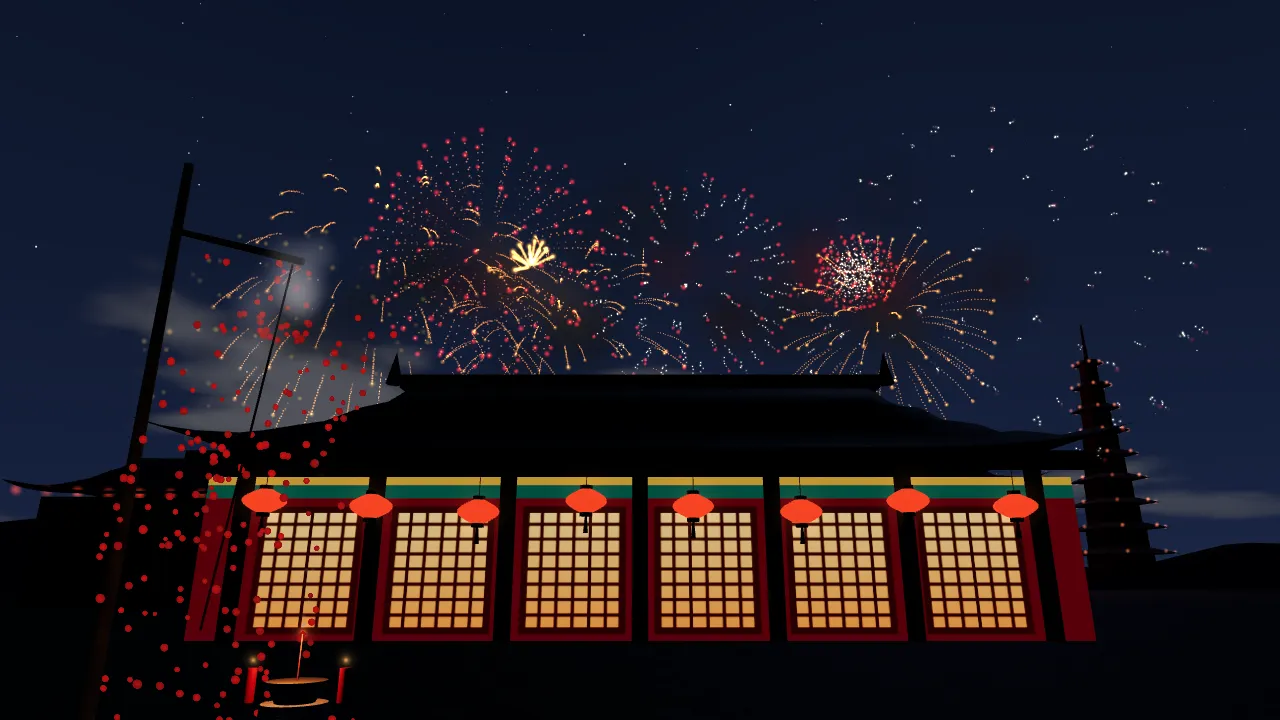
Light firecrackers and fill the sky with red and gold fireworks.
How to play
- Pick up the glowing incense stick from its bronze censer and touch it to the bottom of the firecracker string.
- The flame climbs the main fuse at a steady speed, and each bang kicks the string into a swing.
- Pull a red lantern under the eaves aside and let go, or press the sky to aim fireworks: they come red, then gold.
- Try the three Challenges, or open Lab to pick a metal salt, a star pattern or a shell size.
Challenges
- Light the firecrackers with the incense and let all 40 pop
- Pull a red lantern far aside and let it swing
- Burst a red and a gold firework side by side
Try this
- Light the firecrackers and time how long the flame takes to run up the string. The main fuse burns at a steady speed, so a longer string takes longer.
- Pick strontium for red and charcoal for gold, the two classic colours of the festival, and fire them one after the other.
- Watch the lanterns under the eaves: they are pendulums, and the shorter strings swing back and forth faster than the longer ones.
Fun facts
- Gunpowder was invented in China, and the oldest surviving written formulas for it appear in a Chinese military book compiled in 1044.
- Lunar New Year usually falls between 21 January and 20 February, on a new moon.
- Classic black powder is about 75 percent potassium nitrate, 15 percent charcoal and 10 percent sulfur by mass.
- Red is a traditional colour of good luck at the festival, which is why lanterns, envelopes and decorations are so often red.
Red, gold and a very old recipe
Lunar New Year, called the Spring Festival in China, is celebrated by many communities across East and Southeast Asia and around the world, including as Tết in Vietnam and Seollal in Korea. Customs differ from place to place and family to family, but reunions, special meals, red decorations and, in many places, fireworks and firecrackers are part of the welcome for the new year. A popular story tells of a beast called Nian that was frightened away by loud noises and the colour red.
The chemistry of black powder
Firecrackers and the lift charges that throw fireworks into the sky use black powder, the oldest explosive, first made in China. It is a mixture rather than a single chemical: potassium nitrate supplies oxygen, while charcoal and sulfur are the fuels. Because the oxygen is built into the mixture, it burns extremely fast even when packed tightly in paper. In a sealed firecracker the hot gases build up pressure until the paper tube bursts with a bang.
How a firecracker string works
The crackers on a string are braided onto a main fuse, and each cracker has a short fuse of its own tucked into the braid. When you light the bottom, the flame travels up the main fuse at a steady speed and lights the crackers one after another. Each bang gives the string a small kick, which is why real strings jump and swing as they go off. In the scene the flame speed is fixed, so a longer string takes proportionally longer, and every pop pushes the hanging string like a pendulum.
Where red and gold come from
Red fireworks get their colour from strontium compounds. In the flame they form molecules such as strontium monochloride, which give out light mostly in the red part of the spectrum. Gold comes from a different process: tiny pieces of charcoal or iron glow because they are hot, the way an ember glows, and as they cool their light shifts from yellow towards orange and red. The gold sparks that trail behind willow and palm stars in this scene are modelled that way.
Celebrating with care
Many cities now limit firecrackers because of air pollution, noise and injuries, and many families choose organised displays instead. Virtual crackers give you the crackle and the colour with none of the smoke.
For the curious
A simplified overall reaction for black powder is 2 KNO₃ + S + 3 C → K₂S + N₂ + 3 CO₂. The gas produced takes up thousands of times the volume of the powder, which is what bursts the paper casing.
Questions people ask
Why are firecrackers used at Lunar New Year?
Firecrackers are a long-standing tradition for welcoming the new year with noise and celebration, and a popular legend says their bangs and the colour red scared away a beast called Nian. Customs vary, and many cities now restrict them for safety and air quality.
What makes fireworks red?
Strontium compounds. In the heat of the burning star they form molecules such as strontium monochloride, which give out light mainly in the red part of the spectrum.
When is Lunar New Year?
It begins on a new moon, usually between 21 January and 20 February, so the date in the Western calendar changes from year to year.