Sky Lantern Festival
Hold a glowing paper lantern until it tugs, then let it rise.
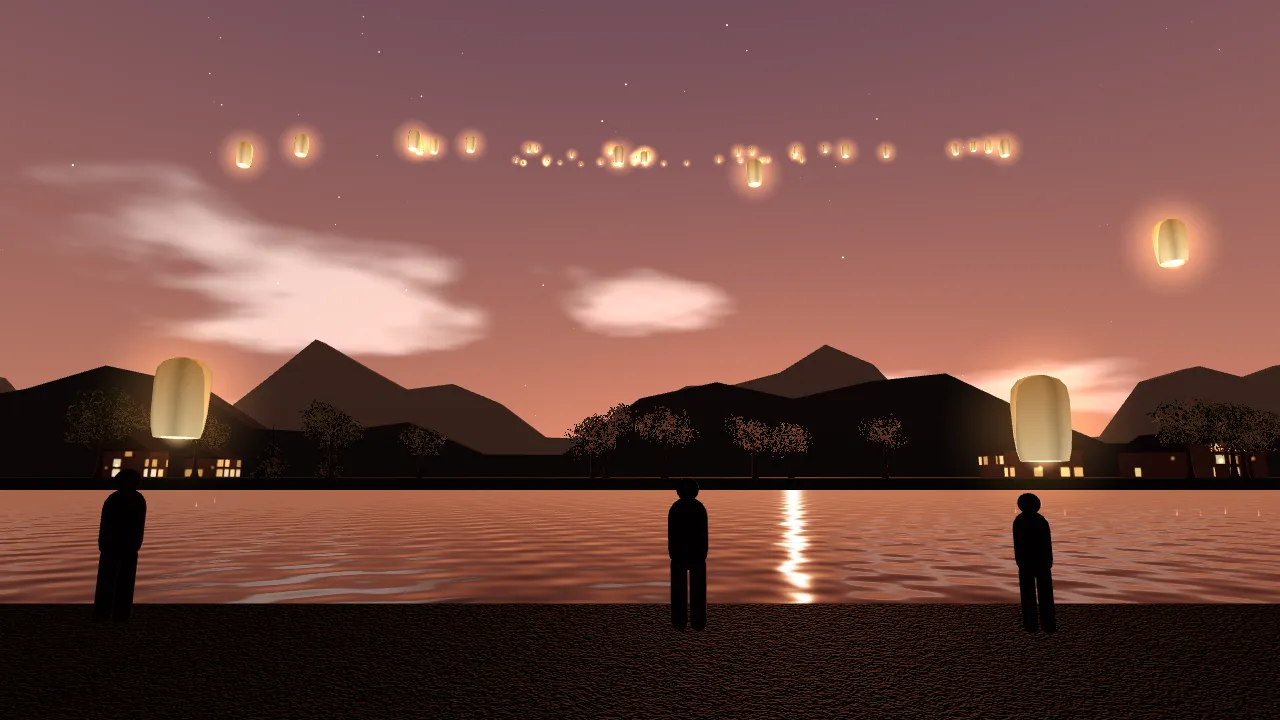
How to play
- Press and hold the riverbank near someone: they hold a lantern while its fuel cell warms the air inside.
- When the lantern starts to tug upwards, let go and it rises. Let go too soon and it sinks back into the hands.
- A quick tap instead lets the person release it themselves once it is warm. Release a wave of lanterns in Lab sends everyone’s up together.
- Try the three Challenges, or change the night air, the fuel cell’s power or its burn time in Lab.
Challenges
- Hold a lantern until it tugs at your hands, then let it go
- Let a lantern go before it’s warm and see it sink back
- Send ten lanterns up into the evening sky
Try this
- Lower the air temperature to −10 °C and release a lantern, then try 30 °C. On a cold night the same lantern climbs much more briskly.
- Turn the fuel cell power down until the lanterns barely leave the hands. The lift is the difference between two densities, so it shrinks fast as the flame weakens.
- Watch a lantern’s path as it climbs. It turns as it rises, because the wind higher up blows harder and from a different direction.
Fun facts
- Hot air is less dense than cold air because, at the same pressure, a gas’s density is inversely proportional to its absolute temperature.
- Sky lanterns are often called Kongming lanterns, after the Chinese strategist Zhuge Liang (Kongming), who is traditionally credited with inventing them.
- Sky lanterns are banned or restricted in many countries and regions, because they can start fires and harm farm animals and wildlife when they come down.
- A colder night gives a sky lantern more lift, because the air it pushes aside is denser.
A small hot-air balloon made of paper
Releasing lanterns into the night sky is part of several festivals, such as Yi Peng in northern Thailand and the Pingxi Sky Lantern Festival in Taiwan, and people often write a wish or a hope on their lantern before letting it go. Real paper lanterns, though, come down somewhere, sometimes still burning, which is why they are banned in many places. These virtual lanterns follow the same physics and then simply fade away.
Why a lantern floats
A sky lantern is a tiny hot-air balloon: a paper envelope with a fuel cell hanging in the open bottom. The flame heats the air inside, and hot air is less dense than the cool air around it. Like a cork in water, the lantern is pushed up by a buoyant force equal to the weight of the outside air it pushes aside, minus the weight of the hot air inside. In this scene each lantern holds about 0.28 m³ and weighs around 60 g with its fuel. With the air inside at roughly 120 °C, that gives a net lift of a few tens of grams, enough to rise at about one and a half metres per second.
Warming up and cooling down
Heating the air takes time, because the flame has to replace the heat that keeps leaking through the paper and out of the opening. People hold a real lantern for about a minute while it fills with hot air, and let go when they feel it tug upwards; here the warm-up is sped up, and each lantern lifts off at the moment its lift beats its weight. When the fuel runs out, the air inside cools, the lift fades and the lantern starts to sink.
Riding the wind
Once airborne, a lantern is carried by the wind, and air drag ties it closely to the air around it. Near the ground the breeze is weak and slowed by friction with the land; higher up it is usually stronger and can blow from a different direction. That is why lanterns released together spread into a long, curving river of light.
Why the virtual version is kinder
A lantern may drift for kilometres before landing in a field, a forest or on a roof, and the wire frames of some designs can injure animals. Enjoying them on screen keeps the beauty without the risk.
For the curious
Gas density is ρ = pM/(RT), so the lift is F = (ρair − ρhot)·V·g − m·g. The air inside warms as C·dT/dt = P − K(T − Tair), where P is the flame’s power and C = ρhotVcp its heat capacity, and the lantern feels a drag force ½ρCdA|v − w|(v − w) relative to the wind w.
Questions people ask
How do sky lanterns fly?
A small flame heats the air inside a paper envelope. Hot air is less dense than the surrounding air, so the lantern is pushed upwards by buoyancy, just like a hot-air balloon.
Why are sky lanterns banned in some places?
They come down wherever the wind takes them, sometimes still alight, and can start fires in fields, forests and buildings. Their frames and paper can also harm livestock and wildlife.
Is there a safe way to enjoy sky lanterns?
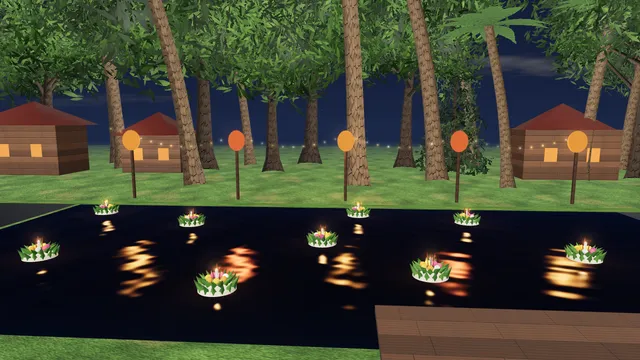
Virtual lanterns like these give the same glow and drift with no fire risk or litter. Some festivals also use alternatives such as floating lights on water or lantern displays.