Party Balloon Pop
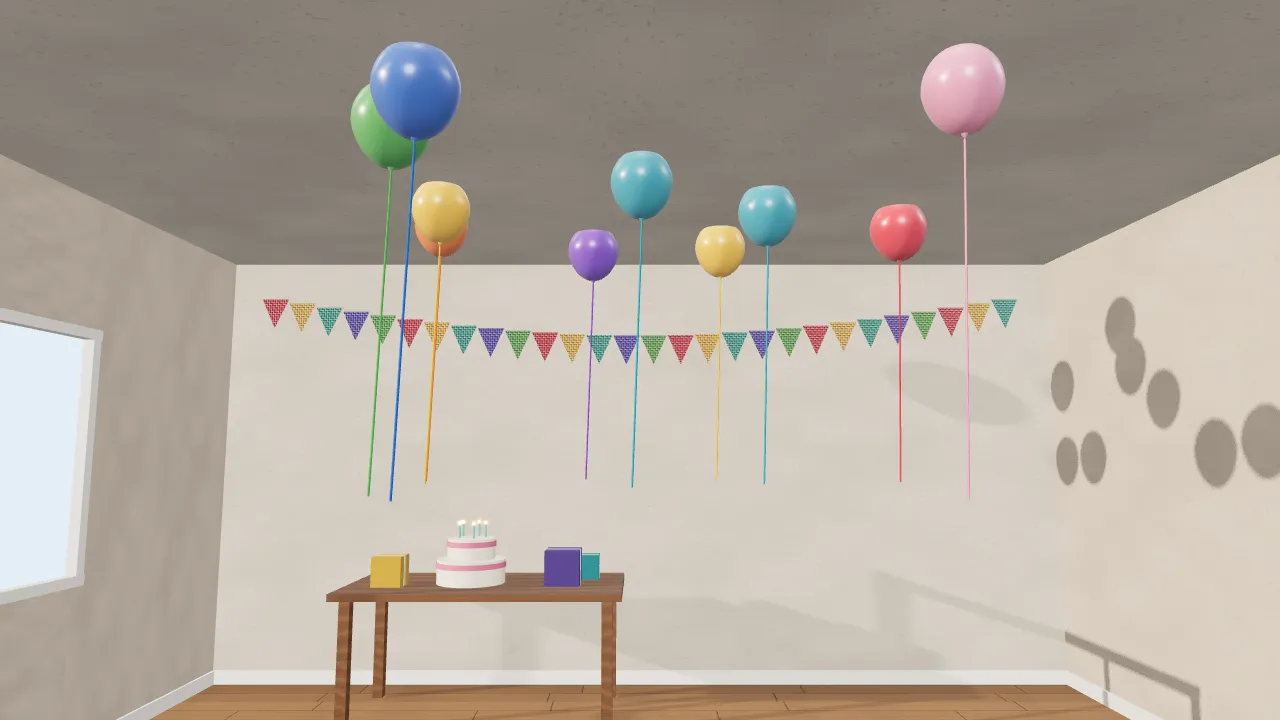
Squeeze floating helium balloons until they pop, round after round.
How to play
- Press and hold a balloon to squeeze it. Keep holding until it pops.
- Press a balloon and drag to pull it about by its ribbon; let go and it floats back up.
- Pop every balloon in the room and a new round floats up, sometimes full of confetti.
- Try the three Challenges, or open Lab to swap helium for air, change the room temperature or use a pin.
Challenges
- Squeeze a balloon until it pops
- Pull a balloon down to the floor and let it float back up
- Pop every balloon in the room to clear a round
Try this
- Squeeze a balloon slowly and watch the Pressure inside readout climb. A smaller volume means a higher pressure, which is Boyle’s law.
- Switch the gas to air from your lungs: the balloons sink to the floor, because air inside a balloon is no lighter than the air outside.
- Cool the room to 5 °C and look at the lift readout. Colder helium takes up less space, so each balloon lifts a little less.
Fun facts
- Helium is the second lightest element, and a litre of it weighs about one-seventh as much as a litre of air.
- Helium atoms are so small that they slowly escape through latex rubber, which is why a latex party balloon usually droops within a day or so.
- Squeezing a balloon to half its volume would double the pressure inside, if the temperature stayed the same: that is Boyle’s law.
- Never breathe in helium from a balloon: it pushes oxygen out of your lungs and can make people faint.
Why a squeezed balloon pops
Party balloons are a small daily miracle of physics: a few grams of rubber and a lungful of the right gas, and a balloon floats to the ceiling and bobs there. This room lets you pop them one round at a time, with no timer and no pressure, except the pressure inside the balloon, which is the point.
Why helium balloons float
A balloon is pushed upwards by the weight of the air it shoves aside, which is buoyancy. A typical 28 cm party balloon holds about 11 litres. That much air weighs about 14 grams, while the same volume of helium weighs about 2 grams. The difference, minus a few grams of rubber and ribbon, is the balloon’s lift: around 7 grams here. That is enough to rise steadily until the ceiling stops it, where the balloons jostle and settle.
Squeezing and Boyle’s law
When you squeeze a balloon, you make the space inside smaller, but the amount of gas stays the same. The gas molecules are squashed closer together and hit the rubber more often, so the pressure rises. If the temperature stays the same, pressure and volume are inversely proportional: halve the volume and the pressure doubles. This is Boyle’s law, discovered in the 1660s. The Pressure inside readout shows it rising as you squeeze.
The pop
The higher pressure stretches the rubber wherever it can bulge. Rubber can stretch a long way, but every balloon has a limit, and a small weak spot is enough for a tear to start. Once it does, the stretched rubber snaps back faster than the eye can follow, and the sudden release of squashed gas makes the bang. In this game each balloon has its own slightly different limit, just like real ones, so some give way sooner than others.
Air, temperature and slowly sinking balloons
Fill a balloon with air from your lungs and it has nothing to float on, so it sinks. Cool the room, and the helium contracts (Charles’s law), so the balloon shrinks a little and lifts less. Real latex balloons also leak: helium atoms are tiny enough to squeeze through the rubber, which is why they droop after a day.
For the curious
Boyle’s law is p₁V₁ = p₂V₂ at constant temperature, part of the ideal gas law pV = nRT. The lift is F = (ρair − ρHe)·V·g − m·g, with ρ = pM/(RT): about 1.2 kg/m³ for air and 0.17 kg/m³ for helium at room temperature.
Questions people ask
Why do helium balloons float?
Helium is much lighter than air. A balloon full of helium weighs less than the air it pushes aside, so buoyancy pushes it upwards until something, like the ceiling, stops it.
Why does squeezing a balloon make it pop?
Squeezing shrinks the space inside, so the trapped gas is pushed to a higher pressure (Boyle’s law). The extra pressure stretches the rubber past its limit somewhere, and a tear races across it.
Why do helium balloons go down after a day?
Helium atoms are small enough to slowly escape through latex rubber. As the balloon loses helium it shrinks and loses lift until it sinks.