Wax Motion Lamp
Drag glowing wax blobs, merge them and tune the bulb of a motion lamp.
How to play
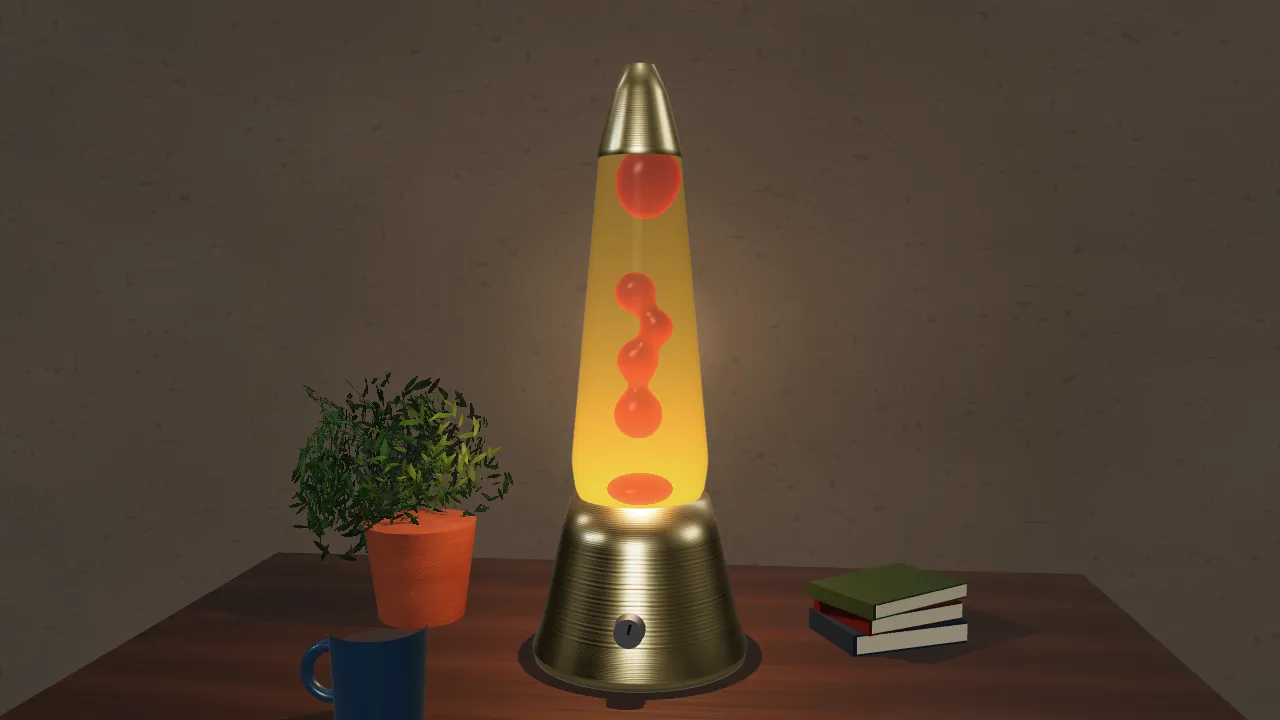
- Drag a wax blob with your finger. Push it into another blob and the two merge into one.
- Turn the dimmer knob on the base: drag it up for a hotter bulb, all the way down to switch off.
- Hold a finger on empty glass to cool that spot, or tap the glass to give the lamp a gentle knock.
- Try the three Challenges, or open Lab for the colours and a faster clock.
Challenges
- Push two wax blobs together until they merge
- Build a blob so big that it splits in two as it rises
- Get three blobs resting under the cap at once
Try this
- Lower the bulb to 15 W. The bottom never gets warm enough for the wax to become lighter than the liquid, so nothing rises.
- Turn the bulb up to 45 W. Now even the top of the liquid stays warm, so blobs rise and stay up, just as an overheated lamp misbehaves.
- Watch for a blob that hovers halfway up. It has reached almost exactly the density of the liquid around it.
Fun facts
- The wax motion lamp was invented by the British entrepreneur Edward Craven Walker, who launched it in 1963 as the Astro lamp.
- A wax motion lamp is a working model of convection, the same process that stirs a pan of soup, the air above a radiator and the hot rock deep inside the Earth.
- Most materials expand as they warm up, so the same mass fills more space and its density falls. The lamp works because the wax expands more than the liquid around it.
How a wax motion lamp works: heat, density and buoyancy
A wax motion lamp is a sealed glass bottle holding two substances that do not mix: a waxy blend and a watery liquid. A bulb in the base heats the bottom of the bottle, and that is all it takes to keep the wax drifting up and down for hours. It is a calm, glowing demonstration of convection, heat carried around by moving matter.
Density decides up or down
Whether something floats or sinks depends on its density, its mass per unit volume, compared with the liquid around it. By Archimedes’ principle the liquid pushes up with a force equal to the weight of the liquid that the blob pushes aside. If the blob is denser than the liquid, its weight wins and it sinks. If it is less dense, the push wins and it rises.
Cold wax is made slightly denser than the liquid, so it lies at the bottom. As the bulb warms it, the wax melts and expands. In this simulation the wax expands about one and a half times as much as the liquid per degree, so above about 53 °C it becomes the lighter of the two, and a blob buds off and rises.
A slow journey
The density difference is tiny, only a few tenths of a percent, so the upward push is gentle. Drag from the liquid soon balances it, and a blob rises at a steady few centimetres per second. Near the cap the liquid is cooler. The blob slowly loses heat, contracts, becomes denser than the liquid and sinks back down, where the bulb warms it again. Because a blob loses heat through its surface but stores it in its volume, big blobs take much longer to cool than small ones: the time grows with the square of the radius.
Too cold, just right, too hot
The lamp only flows when the bottom is warmer than the crossover temperature and the top is cooler. With a weak bulb the wax never gets light enough to leave the bottom. With too much heat, even the top stays above the crossover, so the wax rises and stays up. Try both in the Lab.
For the curious
Densities follow ρ(T) = ρ₀(1 − β(T − 25 °C)). For the wax ρ₀ = 1004.3 kg/m³ and β = 4.5 × 10⁻⁴ K⁻¹, and for the liquid ρ₀ = 1000 kg/m³ and β = 3.0 × 10⁻⁴ K⁻¹. Each blob feels a net buoyant force (ρliquid − ρwax)Vg and a drag of 6πμrv, corrected for larger speeds by the Schiller–Naumann factor 1 + 0.15Re0.687, with μ = 0.035 Pa·s. A blob’s temperature relaxes towards the liquid around it on a time r²/3α. The blobs are drawn by ray marching a smooth union of spheres, which is why touching blobs merge into one soft shape.
Questions people ask
How does a wax motion lamp work?
A bulb heats wax at the bottom of a bottle of liquid. Warm wax expands, becomes less dense than the liquid and rises. Near the cooler top it contracts, becomes denser again and sinks, so the cycle repeats as long as the lamp is on.
Why does a wax lamp take so long to warm up?
The wax starts as a solid lump. The bulb has to melt it and then warm it until it has expanded enough to be lighter than the liquid, and the liquid has to warm up too. That takes a long time because only a modest amount of heat flows in.
Why is all the wax stuck at the top of my lamp?
Usually the lamp is too warm, for example near a heater or in a hot room. If the liquid near the top never cools below the crossover temperature, the wax stays lighter than the liquid and has no reason to sink.