Yo-yo Tricks
Throw a yo-yo, make it sleep, walk the dog and swing it round.
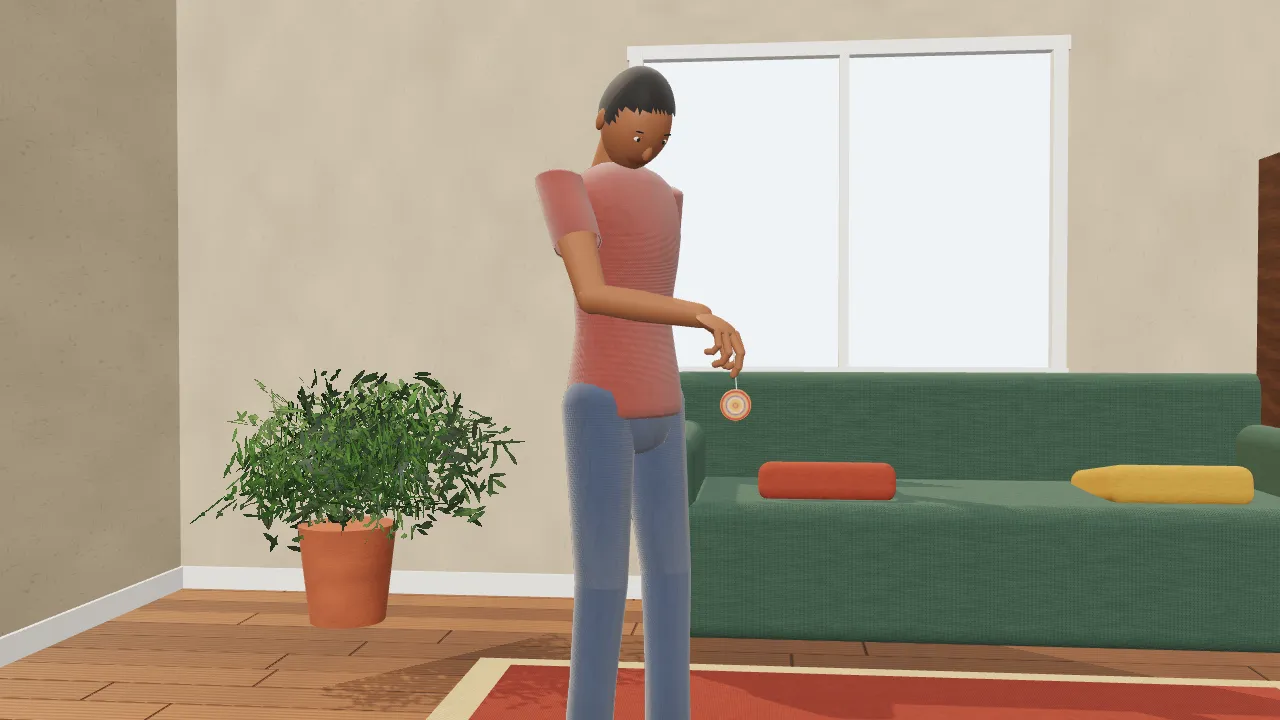
How to play
- Swipe down from the hand to throw the yo-yo. A quicker swipe spins it faster.
- At the end of the string it “sleeps”, spinning in the loop. Tap, or flick your finger up, to tug it back to your hand.
- While it sleeps, drag anywhere to move your hand. Lower it until the yo-yo touches the floor to walk the dog, or rock your hand from side to side, against the swing, to send it round the world.
- Try the three Challenges, or choose another yo-yo in Lab: the metal butterfly sleeps the longest.
Challenges
- Make the yo-yo sleep for 3 seconds, then tug it back to your hand
- Walk the dog: let a sleeping yo-yo roll along the floor
- Swing a sleeping yo-yo all the way round your hand
Try this
- Let the yo-yo go with the gentlest swipe you can. It creeps down slowly, because most of its energy goes into spinning, and the wooden one climbs straight back up without sleeping.
- Throw the beginner yo-yo and the metal butterfly with the same quick swipe and compare how long each one sleeps. Friction in the gap decides it.
- Throw hard, then lower your hand gently until the sleeping yo-yo just touches the floorboards. Watch its spin turn into rolling as friction grips the rim.
Fun facts
- Early yo-yos had the string tied fast to the axle, so they could only run down and back up. A string looped loosely round the axle lets the yo-yo spin freely at the bottom, and that is what makes sleeping and most tricks possible.
- Many modern trick yo-yos have a ball bearing at the axle, so the string rubs far less and a good throw can sleep for minutes.
- A yo-yo falling on its string is a Maxwell wheel: because the string unwinds from a thin axle, it falls with only a small fraction of the acceleration due to gravity.
- Walk the dog and around the world are among the best-known yo-yo tricks, and often among the first that beginners learn.
The physics of a yo-yo: falling, sleeping and climbing home
A yo-yo is two heavy discs joined by a thin axle, with a string wound round the axle. Let it go and it does not drop like a stone. It sinks slowly and starts spinning, because the string can only pay out as fast as the axle turns. Every centimetre it falls forces it to turn, and turning a heavy wheel takes energy.
Why it falls so slowly
Gravity gives the falling yo-yo energy, which it must share between moving down and spinning. With the string on a thin axle the spinning takes almost all of it. For the wooden yo-yo here, 52 g and 6 cm across, the moment of inertia I is about 25 times m·r², where m is its mass and r the 4 mm axle radius, so it falls with only about one twenty-sixth of the acceleration of a dropped stone. That is why a thrown yo-yo needs your flick: the faster it leaves your hand, the faster it is spinning when it reaches the end of the string.
Sleeping
The string is not tied to the axle. It ends in a loose loop, so at the bottom the yo-yo keeps spinning inside the loop instead of climbing back up. That is a sleeper. The loop rubs on the axle, and the friction torque, roughly μ·T·r with T the tension in the string, slowly brakes the spin. A wooden axle rubs hard and sleeps for a few seconds; a ball bearing barely rubs, so a metal butterfly yo-yo can sleep for minutes.
The tug and the climb
A quick upward jerk of your hand makes the string go slack for a moment, and the loop catches on the spinning axle. Now the string winds up as the axle turns. The catch is a sudden impulse that shares the yo-yo’s motion between spin and climbing, and as it climbs, the tension slows the spin while lifting it. If enough spin is left, it arrives back in your hand.
Walking the dog and going round the world
Touch a sleeping yo-yo to the floor and its rim slips across the boards. Friction pushes it forward and slows the spin until the rim rolls without slipping, so the “dog” trots off on its lead. Around the world is a pendulum trick: moving your hand against the swing does work on the string each time, and the swing grows until the yo-yo goes over the top.
For the curious
Falling on a taut string: a = g / (1 + I/(m·r²)). Speed at the end of a string of length L after a throw at v₀: v² = v₀² + 2·g·L / (1 + I/(m·r²)), and the spin is ω = v/r. Sleeping: I·dω/dt = −μ·T·r. When the string catches, the yo-yo keeps the fraction 1/(1 + m·r²/I) of its spin and starts climbing at v = r·ω. On the floor the rim slips at v − ω·R until friction makes v = ω·R, which happens at v = ω₀·R·I/(I + m·R²).
Questions people ask
Why does a yo-yo come back up?
When the string catches on the spinning axle, it starts winding up as the axle turns. The yo-yo then climbs its own string, using the energy stored in its spin. A yo-yo with a fixed axle catches by itself when its spin gets low; a ball-bearing yo-yo needs a tug.
What does it mean when a yo-yo sleeps?
It means the yo-yo is spinning at the end of the string without climbing back. The string ends in a loose loop round the axle, so the axle can turn inside it. Friction in the loop slowly takes the spin away.
How do you walk the dog with a yo-yo?
Throw a strong sleeper, then lower it gently until it touches the ground. Friction between the spinning rim and the floor makes it roll forward. Follow it with your hand, then give a little tug to bring it back up before it stops spinning.