Spinning Top Battle (Lattu)
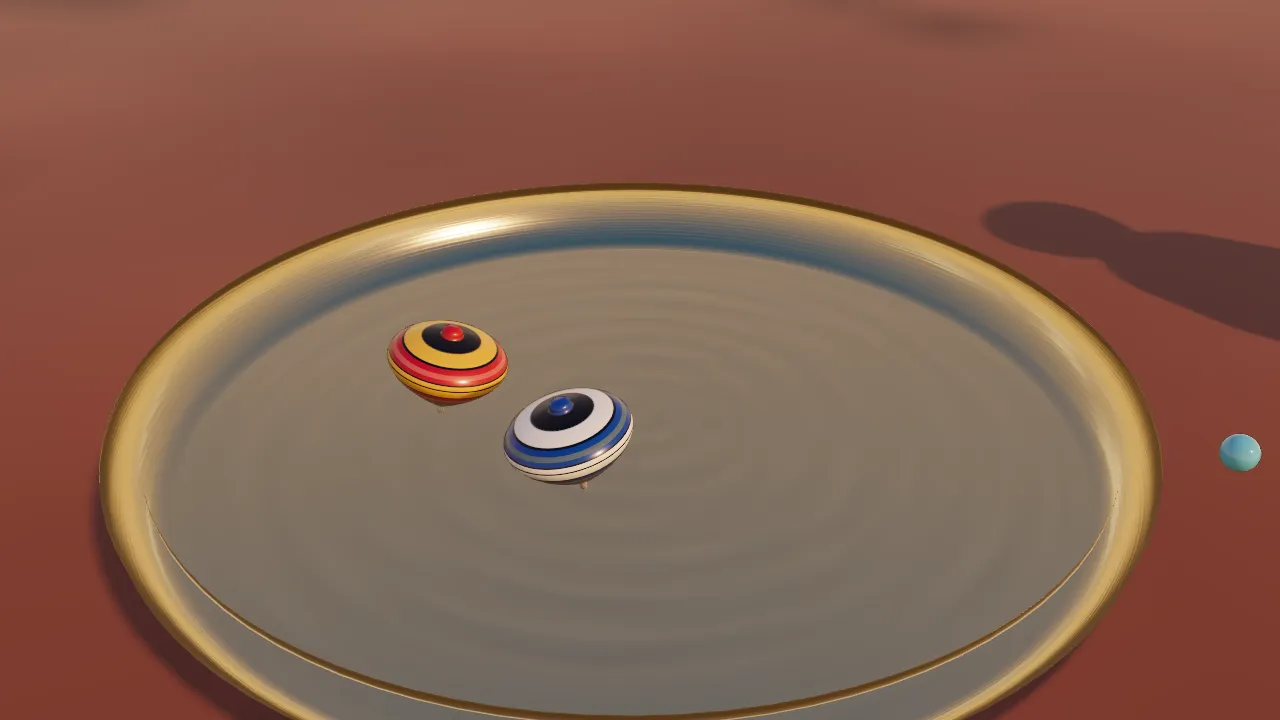
Throw a wooden lattu into a brass dish and outspin the computer.
On Amazon.in. As an Amazon Associate I earn from qualifying purchases.
How to play
- Put your finger on your red top, pull back and let go to throw it. The further you pull, the faster it spins.
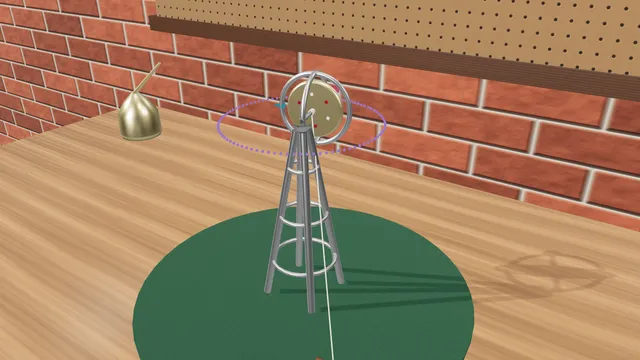
- Pull a little to the left or right to aim: the ring shows where your top will land, and the dots where it slides. Aim past the computer’s blue top and the ring jumps in front of it, so your top crashes into it.
- The computer throws too: the easy one while you are still winding, the strong one after you, at your top. The dish slopes toward the middle, so the tops meet and knock each other about. The last top still spinning wins.
- Try the three Challenges, or open Lab to set how strong the computer is, play two players on one phone or watch in slow motion.
Challenges
- Win a battle: be the last top still spinning
- Keep your top spinning for 30 seconds in one battle
- Knock the computer’s top out of the dish
Try this
- Throw a gentle spin of about 15 turns a second and watch closely. It lands leaning, wobbles in a growing circle and soon falls: below about 18 turns a second this top cannot hold itself up.
- Throw hard and land your top right beside the computer’s. Where they touch, their surfaces move in opposite directions, so friction kicks them apart sideways.
- Choose slow motion in Lab and watch a leaning top. Its axis swings round in a slow circle (precession) while it also nods in small, quick loops (nutation).
Fun facts
- Spinning tops are among the oldest toys in the world. They were played with thousands of years ago, long before anyone could explain why they stay up.
- In Hindi the wooden spinning top is called a lattu, and in Tamil a bambaram. It is wound with a cord and thrown so that it lands spinning on its metal tip.
- Channapatna in Karnataka is famous for wooden toys turned on a lathe and coloured with lacquer, and spinning tops are among them.
- The same physics that keeps a top upright keeps a gyroscope steady, which is why gyroscopes have long been used in instruments that show a ship’s or an aircraft’s heading and attitude.
The physics of a spinning top battle
A lattu battle looks like luck, but almost everything in it is decided by angular momentum: a spinning top carries it along its axis, equal to its moment of inertia about that axis times its rate of spin. Turning it takes a torque, and turning it far takes a big one for a long time, which is how a fast top can stand on a point no wider than a pin.
Why it does not fall, and why it wobbles
When a top leans, gravity pulls down on its centre of mass while the dish pushes up at the tip. Together they make a torque that would topple a still top. On a spinning top the torque instead turns the angular momentum sideways, so the leaning axis swings slowly round the vertical: this is precession. The faster the spin, the slower the precession. If the top lands with a jolt, its axis also nods in small quick loops, called nutation.
There is a limit. Below a critical spin the gyroscopic effect can no longer hold the axis up. For the lattu in this game that is about 18 turns a second. Thrown at 45 turns a second it keeps its lean small and steady; as friction slowly takes its spin, it creeps toward the limit, wobbles in ever wider circles and finally clatters onto its shoulder.
Friction: thief and steering hand
The steel tip rubs on the brass and the air drags on the body, so every top slowly loses spin. Friction also steers it. A leaning top’s rounded tip rolls round in little circles, so a tilted top wanders about the dish. A top that lands skidding feels friction pull back at its tip, below its centre of mass, which makes it lean as it slides: a gentle, accurate throw often beats a wild one.
The dish and the battle
The dish is a shallow brass bowl, 46 cm across. On its slope the dish’s push has a part pointing toward the middle, so tops drift inward until they meet. Both tops are wound the same way, so where they touch their surfaces move in opposite directions, and friction throws them apart sideways and knocks their tilt. A top with plenty of spin shrugs off the knock. A slower one leans further and, past what its spin can hold, falls. Hit hard near the rim, a top can be thrown right out of the dish.
For the curious
Angular momentum: L = I₃ω. Precession rate: Ω ≈ m·g·l / (I₃·ω), with m the mass and l the height of the centre of mass above the tip. A top on a fixed point stays upright above the critical spin ωc = √(4·m·g·l·I₁) / I₃, where I₁ is the moment of inertia about a horizontal axis through the tip. For this lattu m = 31 g, l = 27 mm, I₃ = 8.2 × 10⁻⁶ kg·m² and I₁ = 2.8 × 10⁻⁵ kg·m², so ωc ≈ 115 rad/s, about 18 turns a second. Spin is lost as I₃·dω/dt = −(μ·N·r + c·ω), tip friction plus air drag. In a bowl of radius R, the slope pulls a top toward the middle with a force of about m·g·r/R at a distance r from the centre.
Questions people ask
Why doesn’t a spinning top fall over?
Its spin gives it angular momentum along its axis. Gravity pulling on a leaning top makes a torque, but on a fast top that torque only turns the axis slowly round in a circle (precession) instead of tipping it over. Once friction has slowed it below a critical spin, it falls.
Why does a top wobble just before it falls?
As friction drains its spin, the gyroscopic effect that holds the axis up gets weaker. The lean grows and the precession gets faster, so the top wobbles in wider and wider circles until its side touches the ground.
How do you throw a lattu?
Wind the cord tightly round the cone, starting at the metal tip and working up. Hold the top with the tip pointing up and the end of the cord round a finger, then throw it down and forward while pulling the cord back. The top flips over in the air, unwinds and lands spinning on its tip.