Curling Stones
Slide granite stones down the ice, make them curl and sweep them home.
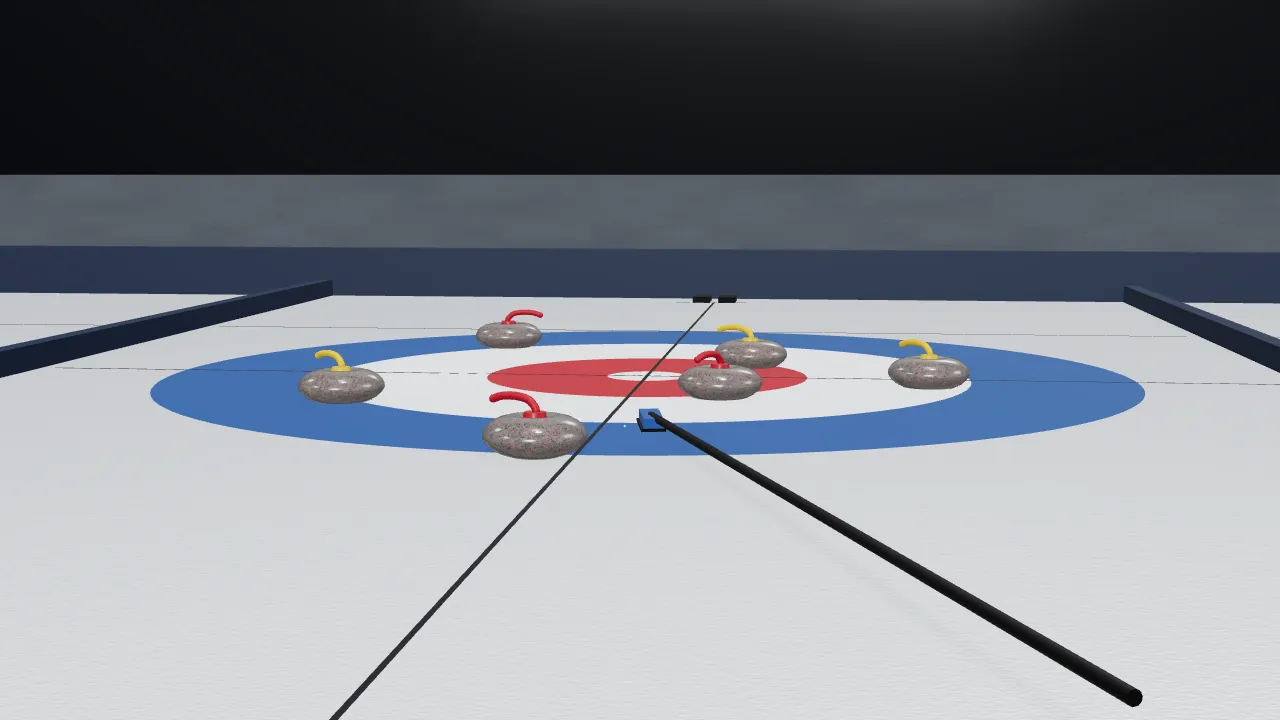
How to play
- Tap or drag on the far ice to place the skip’s broom. That is your aim: the stone sets off straight towards it.
- Pull the stone back towards you and let go to slide it. The further you pull, the harder it goes. The guide shows where it would stop.
- Tap the stone to switch the turn. Clockwise (in-turn) curls to the right, anticlockwise (out-turn) to the left.
- While it glides, scrub back and forth on the ice just in front of the stone to sweep: it travels further and curls less.
- Each end has eight stones, then the end is scored. Try the three Challenges, or open Lab for faster ice and a quicker clock.
Challenges
- Bring a stone to rest in the house, the big target of rings
- Draw a stone onto the button, the small circle in the very middle
- Knock one of the yellow stones out of the house
Try this
- Aim the broom about a metre to the left of the button with a clockwise turn, and pull for a draw weight. Watch the stone hold its line for most of the way, then bend in at the end as it slows down.
- Throw the same stone again, but sweep hard over the last third. It slides further and finishes on a straighter line than your first one.
- Pull right back for a takeout weight and aim straight at a yellow stone. On a full hit your stone stops almost dead and the yellow one shoots away, just like a stun shot in pool.
Fun facts
- Curling began on frozen ponds and lochs in Scotland about five hundred years ago.
- A curling stone may weigh no more than 19.96 kg (44 pounds), and many of the world’s stones are cut from granite quarried on Ailsa Craig, a small island off the west coast of Scotland.
- The ice is sprayed with fine water droplets that freeze into tiny bumps called pebble. The stone touches only the tops of the pebble, along a narrow ring on its base called the running band.
- Only one team scores in each end: one point for every stone that is closer to the centre than the other team’s closest stone.
Why curling stones curl: friction, spin and sweeping
Curling looks gentle, but every throw is a little physics experiment. A polished granite stone of almost 20 kilograms glides nearly 30 metres down a sheet of ice, bends sideways near the end and can be steered by two people with brushes. Three things decide where it stops: friction, spin and sweeping.
Gliding on pebble
Curling ice is not smooth. Before a game it is sprayed with droplets that freeze into a pebbled surface, and the stone rests only on the tops of those bumps, along a narrow ring on its base called the running band. Friction is tiny, about one hundredth of the stone’s weight, so it slows down by less than a tenth of a metre per second every second. A stone released at a little over 2 metres per second therefore glides for around half a minute before it comes to rest in the house. A firmer throw is used to knock other stones away.
The curl
Curlers always give the stone a slow turn, two or three rotations over the whole trip. A stone turning clockwise drifts to the right and one turning anticlockwise drifts to the left, and it bends most at the end, when it is moving slowly. Oddly, this is the opposite of what an upturned drinking glass does if you spin it and slide it across a table, and spinning the stone faster hardly changes how far it curls. Physicists are still testing explanations. One idea is that the rough running band scratches the pebble at the front of the stone and the back of the stone is then steered by those scratches. Another is that the stone pivots briefly around pebbles near its front edge. This simulation does not choose between them: it reproduces the measured behaviour with a small sideways force that points the way the stone turns.
Sweeping
Brushing hard just in front of a moving stone warms and polishes the top of the pebble very slightly, which lowers the friction where the stone is about to slide. The stone slows down less, so it travels further. Because it is moving faster at every point of its path, it also curls less there, so sweeping makes a stone go both further and straighter.
Collisions
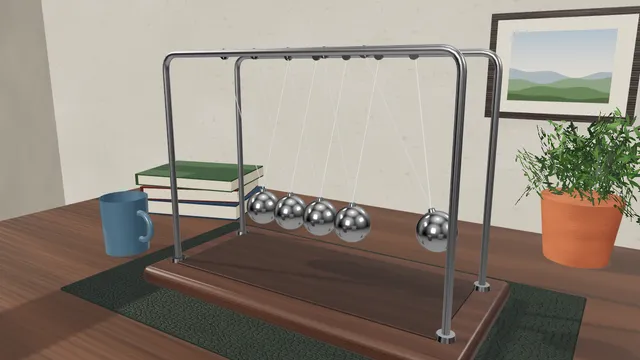
All stones have the same mass, so a head-on hit behaves like a Newton’s cradle: the moving stone hands most of its speed to the one it hits and almost stops. A glancing hit sends the two stones off at an angle to each other, which is how skilled teams remove one stone while their own rolls into a better spot.
For the curious
Here a stone slows at a = μg with μ ≈ 0.0085, so a stone starting at speed v stops after a distance d = v²/(2μg): 2.25 m/s carries it about 30 m. The sideways force is K·μmg with K ≈ 0.09, perpendicular to the motion, which gives about 1.3 m of curl on a draw and about 0.3 m on a fast takeout. Sweeping lowers μ by up to 16 % under the brush. Collisions use equal masses and a coefficient of restitution e = 0.82: after a head-on hit the shooter keeps (1 − e)/2 of its speed and the target leaves with (1 + e)/2.
Questions people ask
Why do curling stones curl?
Because the stone is turning slowly as it slides. A clockwise stone drifts right and an anticlockwise one drifts left, most of all near the end of its path when it is slow. The exact mechanism is still being researched; leading ideas involve the rough running band scratching the pebbled ice or pivoting around pebbles at the front of the stone.
Why do curlers sweep the ice?
Sweeping just in front of the stone warms and polishes the pebble slightly and lowers the friction. The stone slows down less, so it travels further, and because it stays faster for longer it also curls less. Sweepers use it to carry a stone the last metre or to hold it on a straighter line.
How is curling scored?
After both teams have thrown their eight stones, only the team with the stone closest to the centre of the house scores. They get one point for each of their stones that is closer to the centre than the other team’s best stone. Stones outside the outer ring do not count.