Pool Break
Pull back the cue, break the rack and pot balls on a real pool table.
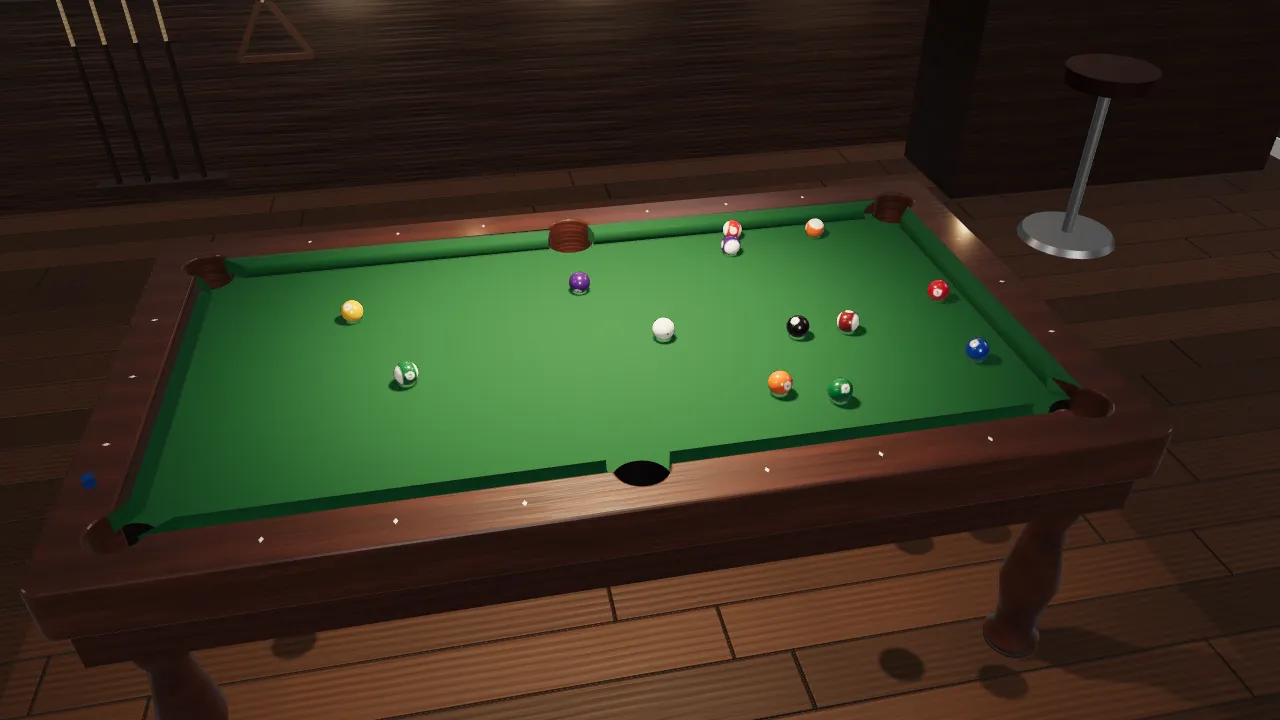
How to play
- Pull back on the cue and let go to strike: the further you pull, the harder the shot. Move sideways while you pull to fine-tune the aim.
- Tap the cloth to point the cue at that spot. The guide shows where the cue ball will meet the first ball and where that ball will go.
- Tap the cue ball to move the tip: centre for a stun, high for follow, low for draw, or either side for side spin. Drag the cue ball to place it anywhere.
- Tap the wooden triangle on the wall to re-rack, and try the three Challenges.
Challenges
- Pot any ball into a pocket
- Pot two balls with a single shot (a firm break is a good start)
- Play a stun shot: hit a ball full on and make the cue ball stop dead
Try this
- Put the cue ball about 20 cm behind another ball, keep the tip in the centre and hit firmly and straight. The cue ball stops dead and the other ball takes all its speed.
- Play the same shot gently from much further away. By the time it arrives the cue ball is rolling, so it follows the object ball forward.
- Set the tip low and hit firmly: the backspin survives the collision and pulls the cue ball back towards you.
Fun facts
- A regulation pool ball is 57.15 mm (2¼ inches) across and weighs between about 156 and 170 grams.
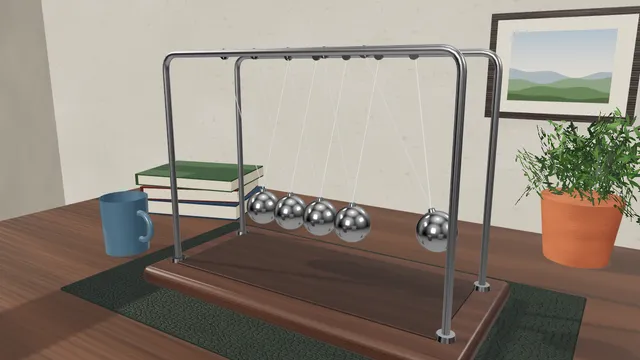
- When two balls of equal mass meet head-on they swap speeds, the same idea as a Newton’s cradle. That is why a cue ball without spin stops dead on a full hit.
- A ball struck in the centre slides at first, then friction sets it rolling. It settles into rolling at five sevenths of its starting speed.
- When a cue ball with no spin clips another ball at an angle, the two leave at close to right angles. Players call this the 90-degree rule.
The physics of pool: sliding, rolling and spin
A pool table looks like a game of angles, but much of the skill is about spin. Every ball on the cloth is either sliding, rolling or doing a bit of both, and that decides what happens when it meets another ball.
Sliding becomes rolling
Hit the cue ball dead in the centre and it leaves the tip with no spin. It skids across the cloth, and friction at the point of contact drags its bottom backwards. That friction slows the ball and, because it acts below the centre, sets it turning. Within a short distance the turning catches up with the motion and the ball rolls naturally, with no slip at all. For a solid ball this always happens at five sevenths of the starting speed. After that only a much smaller rolling resistance slows it down.
Stun, follow and draw
When two equal balls meet full on, the moving one hands over its forward speed and stops, just like the balls of a Newton’s cradle. A cue ball that is still sliding when it arrives therefore stops dead: the classic stun or stop shot. If it has already started rolling, its forward spin survives the collision, grips the cloth and drives it on after the object ball: a follow shot. Strike it low and the ball carries backspin. If some backspin is left at contact, it pulls the cue ball back towards you: a draw shot. Distance matters, because the cloth wears spin away, so a draw that works over a short distance can fade to nothing over a long one.
Angles and cushions
On a thinner hit the object ball always sets off along the line joining the two centres at the moment of contact, which is what the guide shows. A cue ball with no spin then leaves at close to right angles to it, while a rolling cue ball bends forward, ending up around 30 degrees from its original line for a wide range of cuts. Cushions give back most of a ball’s speed but not all, and friction at the rubber nose turns side spin into a change of rebound angle. That is how players steer the cue ball around the table.
The break
A good break sends the cue ball into the rack at several metres per second. The rack is tight, so the push passes through ball after ball in a tiny fraction of a second and spreads the pack across the table. A firm, square hit with little spin hands on the most energy.
For the curious
A ball of radius R slips at its contact point with velocity u = v + ω × r, where r points from the centre down to the cloth. Sliding friction μsg, with μs ≈ 0.2, acts against u. Because the moment of inertia is I = 2⁄5 mR², the slip shrinks at 7⁄2 μsg, so rolling begins after t = 2|u₀|/(7μsg). A cue hit with the tip a·R to the side and b·R above the centre gives speed V and spin ω = (5V/2R)(a ŷ + b ŷ × d̂), where d̂ is the aim; b = 2⁄5 is exactly natural roll. Here the balls collide with a restitution of 0.94 and the cushions with 0.78.
Questions people ask
Why does the cue ball stop dead on a stop shot?
Two balls of equal mass that meet head-on swap their speeds. If the cue ball is sliding with no spin at that moment, it hands all its forward speed to the object ball and stays put. If it is already rolling, the leftover spin makes it creep forward.
How do you make the cue ball come back?
Strike it below the centre so it leaves with backspin, and hit firmly enough that some of the backspin is still there when it reaches the object ball. After the collision the backspin grips the cloth and pulls the ball back.
What is the 90-degree rule in pool?
When a cue ball with no spin hits an object ball at an angle, the two balls leave at roughly right angles to each other. With forward roll the cue ball bends forward instead, and with backspin it bends back.