Ten-Pin Bowling
Set your line, swipe the ball and hook it into the pins for a strike.
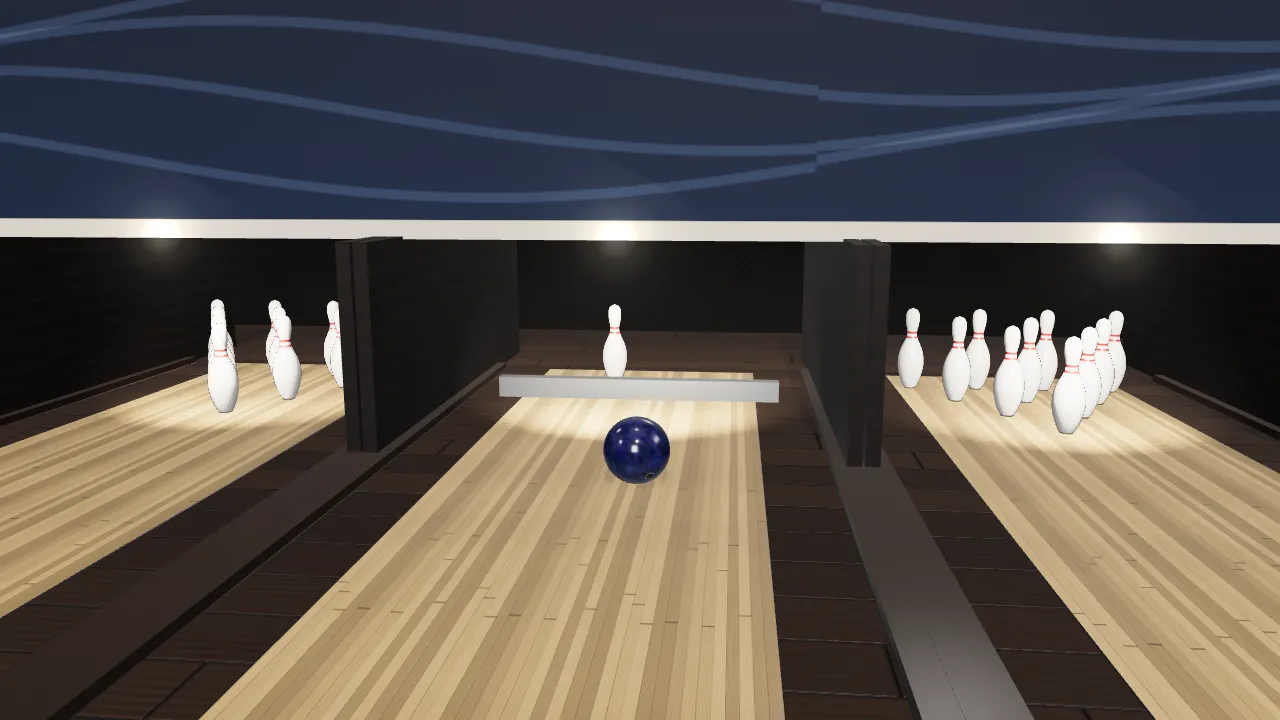
How to play
- Drag the glowing arrow on the lane to set your line. The ball sets off straight towards it.
- Drag the ball sideways along the foul line to choose the board you start from.
- Swipe the ball towards the pins to bowl: a faster swipe throws faster, and a swipe that curves to the left adds hook.
- Tap the ball to choose a straight ball, a hook or a big hook, and try the three Challenges.
Challenges
- Knock down at least five pins with one ball
- Pick up a spare: clear the pins left standing with your second ball
- Bowl a strike: all ten pins with the first ball of a frame
Try this
- Bowl a straight ball right at the head pin. Even a dead-centre hit often leaves pins standing, because the ball deflects and the pins fly out sideways.
- Keep the hook and aim out towards the arrows on the right-hand side, so the ball curls back into the pocket between the 1 and 3 pins.
- In the Lab, shorten the oil pattern: the ball grips sooner and hooks earlier. Lengthen it and the ball skids further before it turns.
Fun facts
- A regulation lane is 60 feet (18.29 m) from the foul line to the centre of the head pin and about 41.5 inches (1.05 m) wide, made of 39 boards.
- Bowling pins are 15 inches (38.1 cm) tall and weigh between about 1.53 and 1.64 kg.
- A bowling ball may weigh no more than 16 pounds (7.26 kg), and most adults use one between 12 and 15 pounds.
- For a right-handed bowler the strike pocket is between the 1 and 3 pins. For a left-hander it is between the 1 and 2.
Why a bowling ball hooks: oil, friction and spin
A good bowler does not roll the ball straight at the pins. The ball sets off down one side of the lane, slides for most of the way, then curves sharply into the gap beside the head pin. That curve, the hook, comes from spin meeting friction, and the lane oil decides where it happens.
Skid, hook, roll
When the ball leaves the hand it is moving fast but not spinning fast enough to roll, so its underside slides over the lane. Friction acts against that sliding. The first two thirds or so of a lane are coated with a thin film of oil, where friction is very low, so the ball skids and keeps nearly all its speed. Near the end the boards are dry. Friction there is several times stronger and grabs the spinning ball, which is when it hooks. Once the spin matches the motion, the sliding stops, the ball rolls and it travels straight again.
Why sideways
A bowler with a hook turns their hand at release so the ball spins about an axis that points partly along its direction of travel. The bottom of the ball then slides partly sideways over the lane, and friction always pushes against sliding, so it shoves the ball sideways. More side rotation, more revs or a drier lane give a bigger hook; a faster ball spends less time on the lane and hooks less.
The pocket and pin action
Pins stand on a triangle with 12 inches between neighbours. A strike rarely means the ball touches every pin. For a right-hander the ball enters the pocket between the 1 and 3 pins, and the pins knock each other down in chains: the 1 takes the 2, the 2 takes the 4 and the 4 takes the 7, while the 3 takes the 6 and the 6 takes the 10, and the ball itself drives through the 5 and on to the 9. Hitting the pocket at an angle helps the ball keep driving through instead of being deflected by the heavy head pin, which is why a hook strikes more often than a straight ball. Miss by a board or two and a lone corner pin, the 7 or the 10, is often left standing.
For the curious
This lane uses the sliding-ball model: the contact point slips with velocity u = v + ω × r, and friction μmg acts against u. The ball has a radius of 10.8 cm and a moment of inertia I = kmR² with k ≈ 0.36, typical for a ball with a dense inner core, so the slip shrinks at (1 + 1/k)μg. The friction coefficient is about 0.04 on the oil and about 0.2 on the dry back end, with the oil ending 12.2 m down the lane. On the pin deck, pins of 1.55 kg collide as rigid bodies with a restitution of 0.8.
Questions people ask
Why does a bowling ball hook?
The bowler gives the ball spin about an axis that points partly along its path. While the ball slides, friction pushes against the sideways part of that sliding and bends its path. On the oily front of the lane the push is tiny; on the dry back end it is strong, so the ball curves late and sharply.
What is the pocket in bowling?
It is the gap between the head pin and the pin just behind it on your hooking side: the 1 and 3 pins for a right-hander, the 1 and 2 for a left-hander. A ball that enters the pocket at an angle of a few degrees sets off chains of falling pins that clear the whole rack.
Why are bowling lanes oiled?
The oil protects the lane surface from thousands of heavy balls, and the pattern it is laid in shapes how balls move. Where the oil is thick the ball skids; where it thins out the ball grips and turns, so changing the pattern changes where a ball hooks.