Newton’s Cradle
Pull back steel balls, let go and feel momentum ripple down the row.
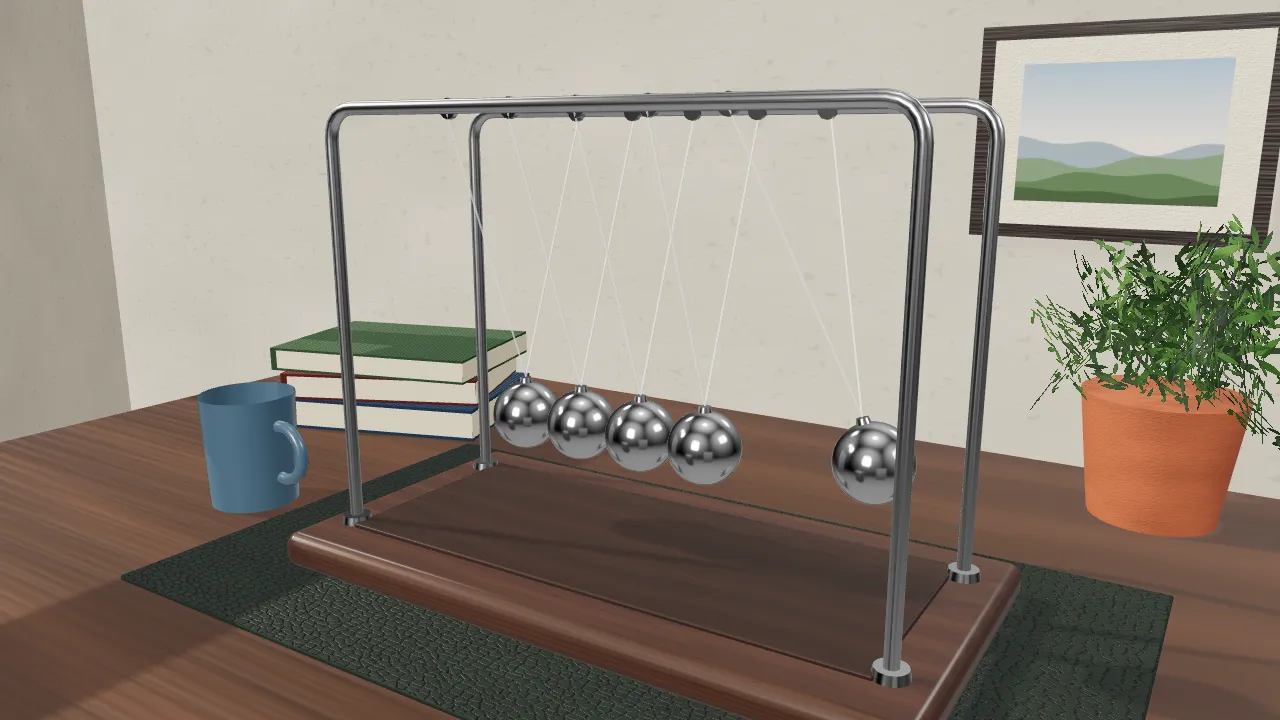
How to play
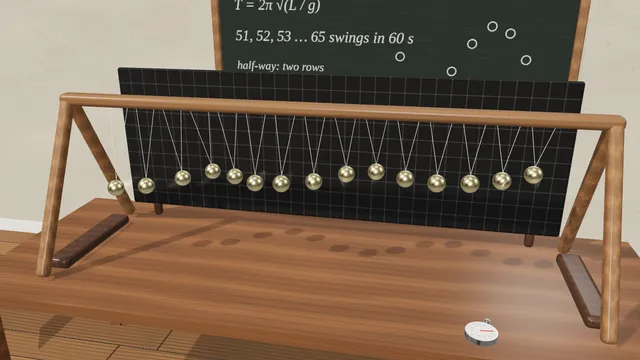
- Grab a steel ball, pull it out to the side and let go. One ball flies out on the far side.
- Grab the second or third ball instead: it pushes the end balls ahead of it, so you lift two or three at once.
- Try the three Challenges, or open Lab to change gravity, bounciness and the number of balls.
- Drag empty space to look around. Pinch or scroll to zoom.
Challenges
- Pull back one end ball and let go: exactly one ball flies out
- Pull back two balls together and see two fly out the far side
- Lift enough balls that the middle one swings out on both sides
Try this
- Lift three balls on the five-ball cradle. Three fly out the other side, so the middle ball swings in both directions.
- Lower the bounciness to 0.85 and count the swings before all the balls start moving together.
- Compare the swing period on Earth, the Moon and Jupiter. Does the number match the formula below?
Fun facts
- The name “Newton’s cradle” was coined in 1967 by the English actor Simon Prebble, who sold wooden versions of the toy.
- In the 1660s, Christiaan Huygens, Christopher Wren and Edme Mariotte were already using colliding pendulums to work out the rules of collisions.
- Your cradle’s swing period doesn’t depend on the mass of the balls, only on string length and gravity.
- On the Moon the same cradle would swing about 2.5 times more slowly, because gravity there is about one-sixth as strong.
Why exactly one ball flies out
When the moving ball strikes the row, two quantities have to balance. Momentum (mass × velocity) is always conserved in a collision. For hard steel balls, kinetic energy is nearly conserved too, because very little is lost as heat and sound.
Could two balls leave at half the speed instead? That would keep the momentum the same, since 2 × ½ = 1, but kinetic energy grows with the square of speed: two balls at half speed carry only half the energy (2 × ¼ = ½). Energy can’t simply vanish, so that outcome is ruled out. The only answer that satisfies both laws is one ball leaving with the speed that came in. Lift two and two must leave. Lift three and three leave, which is why the middle ball of five swings in both directions.
What happens inside the row
The impact doesn’t pass through the balls instantly. It travels as a tiny compression wave from ball to ball, much faster than the eye can follow. This simulation treats each touch as a separate, nearly perfectly elastic collision, resolved in sequence within a few thousandths of a second. That is the classic textbook model, and it reproduces “one in, one out” on its own, with no scripting.
Why real cradles slowly change their tune
No collision is perfectly elastic. Each clack loses a little energy to sound, heat and the slight squashing of steel, and air drag steals a little more on every swing. Physicists describe this with the coefficient of restitution: 1.0 is perfectly bouncy, 0 is a lump of clay. Hardened steel balls come close to 1, but small losses add up. Over time the middle balls start to move and the whole row ends up swinging together, exactly what you’ll see if you lower the bounciness in the Lab.
For the curious: the swing period
Each ball is a pendulum. For small swings its period is T = 2π√(L / g), where L is the distance from the pivot to the ball’s centre and g is the strength of gravity. Here L = 0.22 m, the size of a large desk cradle, so on Earth (g = 9.81 m/s²) one full swing takes about 0.94 seconds. The double V-shaped strings stop the balls twisting sideways, keeping every collision in a straight line.
Questions people ask
Why does only one ball swing out of a Newton’s cradle?
Because the collision has to conserve both momentum and kinetic energy. Several balls moving more slowly could match the momentum, but they would carry less energy. Only one ball leaving at the original speed satisfies both laws.
Does a Newton’s cradle keep going forever?
No. Every collision turns a little energy into sound and heat, and air resistance slows the swing, so it gradually stops. A machine that ran forever would break the law of conservation of energy.
Does the weight of the balls change how fast they swing?
Not for a pendulum. The time for one swing depends on the string length and on gravity, not on the mass. That is why the swing changes when you switch planets in the Lab.