Arcade Ramp Ball
Roll wooden balls up the lane, over the hump and into the rings.
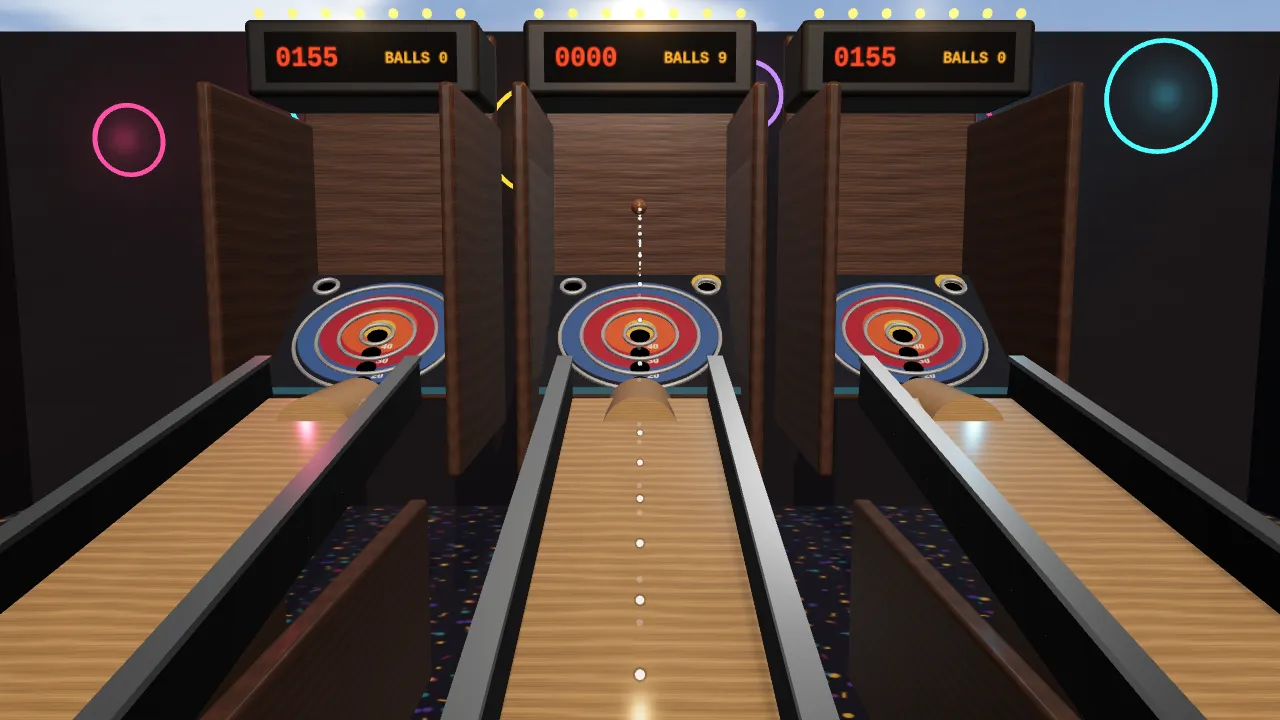
How to play
- Drag back from anywhere and let go to roll the ball. Pull further for a faster roll.
- Drag slightly left or right to aim for the corner 100 holes.
- The dots show where the ball will roll and fly. Each game has nine balls and the scoreboard keeps count.
- Try the three Challenges, or switch to the Moon’s gravity in Lab, where a gentle roll sails right over the rings.
Challenges
- Roll a ball into the 50 in the middle
- Sink a 100 in one of the top corner pockets
- Score 300 points in a single nine-ball game
Try this
- Find the slowest roll that still clears the hump. In this lane it is about 3 m/s.
- Roll a little faster each time and watch the ball land in each ring in turn: 10, 20, 30, 40, then 50.
- Switch to Moon gravity. The ball climbs the lane far more easily, so you need a much softer roll.
Fun facts
- A solid rolling ball carries 2/7 of its kinetic energy in its spin, so less is left for climbing.
- Rolling up a slope, a solid ball slows down at only 5/7 of the rate that a frictionless sliding block would.
- Ramp-ball lanes first appeared in the United States in the early 1900s under the name Skee-Ball, and arcade machines usually give you nine balls per game.
Rolling, climbing and the leap over the hump
A ramp-ball roll is a little physics lesson in three acts: the ball rolls uphill, flies off a ramp, then rolls down into a hole. Each act is governed by a different idea, and the simulation follows all three.
Act one: rolling uphill
When you roll the ball, friction with the lane makes it spin as it moves. That spin takes energy. For a solid ball, kinetic energy is ½mv² + ½Iω² with I = ⅖mr² and ω = v/r, which adds up to 0.7mv². So 2/7 of the energy is in the spin. As the ball climbs the 10° lane, both kinds of motion slow down together, at a = (5/7)·g·sin θ, about 1.2 m/s² here. Climbing the 0.45 m rise needs a starting speed of at least √(10gh/7) ≈ 2.5 m/s, and clearing the hump as well takes about 3 m/s. Slower rolls come back to you.
Act two: the hump
At the top of the lane the ball meets a curved hump. Following a curve takes a force towards its centre of mv²/R. On top of a bump, only gravity can supply it. Once the ball is fast enough that v²/R is more than g, gravity can’t hold it to the surface and it takes off along its direction of travel. So the hump turns your roll into a short flight, and the faster you roll, the higher and further it flies.
Act three: the rings
The target is a tilted board with raised rings. Each groove between two rings is a little wider than the ball, with a hole at its lowest point. Wherever the ball lands in a groove, gravity rolls it round to the bottom, where it drops through and scores. Balls that land below the rings roll down into the 10 slot. Because the landing spot depends on launch speed, the 50 in the middle takes a speed window of only about 0.1 m/s, about two percent.
Rolling on the Moon
With weaker gravity the ball loses speed far more slowly on the slope and is barely held to the hump, so it leaves early and flies high. You need much less speed, and small changes make a big difference.
For the curious
The 72 mm wooden ball is integrated 240 times a second. Every contact applies a bounce and Coulomb friction at the contact point, coupled to spin through I = ⅖mr², plus a little rolling resistance. Rolling isn’t scripted: it emerges because friction removes any slip between the spinning ball and the lane. The dotted preview runs the same physics ahead of time.
Questions people ask
What is the trick to scoring 50 in arcade ramp ball?
Consistency of speed. The ball’s landing spot depends mostly on how fast it leaves the hump, so the 50 needs the same firm, smooth roll every time. Aim straight up the middle and change only your speed until you find the 50.
Why does a rolling ball slow down going uphill?
Gravity pulls it back down the slope. A rolling ball also has some of its energy tied up in spinning, and the spin must slow down along with the forward motion, so a solid ball slows at five-sevenths of the rate a sliding object would.
How many balls do you get in an arcade ramp-ball game?
Most arcade machines give nine balls per game. This version also gives you nine balls, then starts a new game.