Dreidel Spin
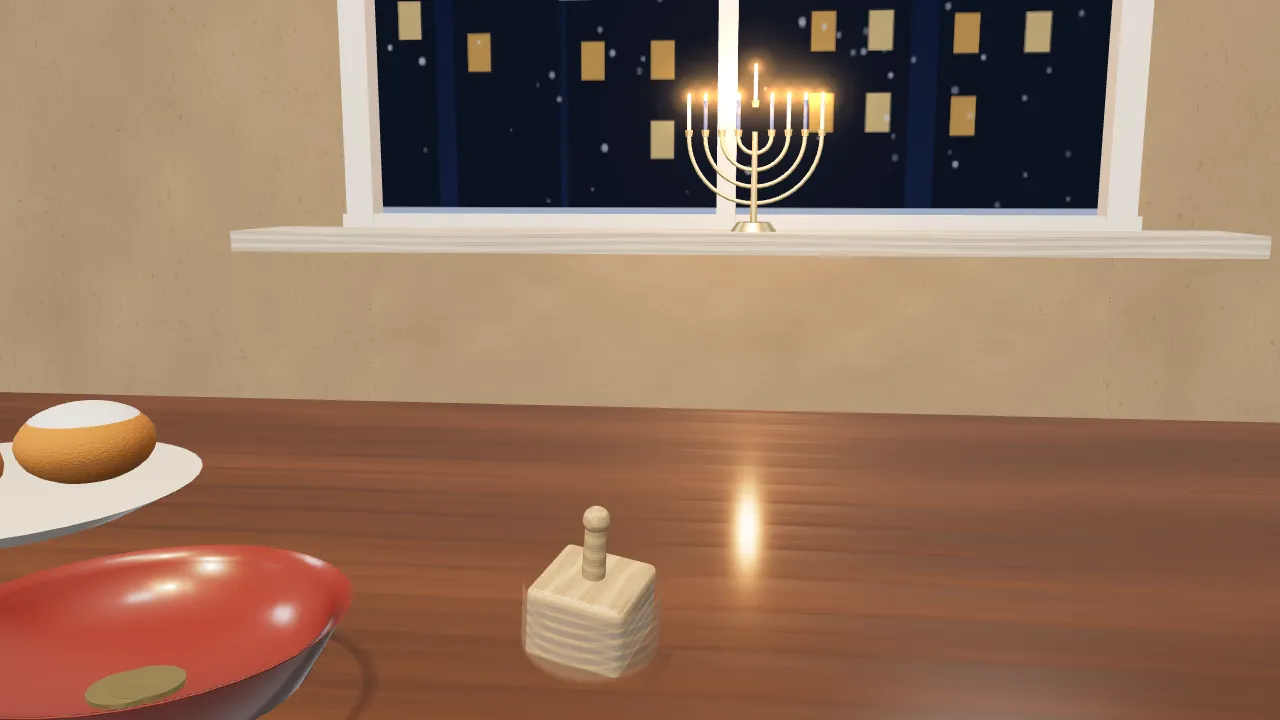
Flick a wooden dreidel, watch it precess and play for chocolate coins.
How to play
- Flick the dreidel sideways with your finger: the faster the flick, the faster it spins. Space or Spin it for me in Lab works too.
- While it spins, tap it to nudge it. Instead of toppling, its leaning axis circles round: that is precession.
- Friction slowly steals the spin, the wobble grows and the dreidel falls. The letter facing up decides your move, and the chocolate coins move between your pile and the pot in the bowl.
- Try the three Challenges, or open Lab for slow motion and dreidels made of clay or plastic.
Challenges
- Nudge the spinning dreidel and watch its axis precess in a full circle
- Flick hard enough to keep the dreidel spinning for 10 seconds
- Land on gimel (ג) and win the whole pot
Try this
- Spin it gently. Below its critical speed, about 20 turns a second for this shape, it can’t stand up straight and wobbles from the start.
- Switch on slow motion and nudge a fast spin. The axis moves at right angles to your push: the gyroscopic effect.
- Try the clay dreidel. It is heavier, so air drag slows it less and it spins for longer, yet its critical speed is the same, because that depends only on its shape.
Fun facts
- The four letters, nun, gimel, hei and shin, stand for “Nes gadol haya sham”, “a great miracle happened there”. Dreidels made in Israel carry pe instead of shin, for “po”, “here”.
- In Hebrew the dreidel is called a sevivon, from a root meaning “to turn”. The word dreidel comes from Yiddish.
- The game is usually played for chocolate coins (gelt), nuts or sweets, with everyone putting one into the pot to begin.
- A spinning top precesses more slowly the faster it spins: the precession rate is inversely proportional to the spin rate.
Why a spinning dreidel stays up, and why it finally falls
The dreidel is a four-sided spinning top that many Jewish families play with during Hanukkah, the eight-night festival of lights. Each side carries a Hebrew letter, and in the traditional game the letter facing up after a spin tells you what to do: nothing, take the whole pot, take half, or put one in. Players use chocolate coins, nuts or sweets, and rules vary a little from family to family. Behind the game is some of the most beautiful physics in mechanics.
Spin makes it stiff
A dreidel standing still on its point falls over at once: any small lean lets gravity pull it further. Spinning changes everything. A spinning body carries angular momentum, a quantity with a direction, along its axis. Gravity, pulling on the leaning dreidel, can only change that angular momentum gradually and only sideways, so instead of tipping the axis down it swings it round. A fast enough dreidel resists every small push and stands bolt upright, “sleeping”. Push its top sideways and it moves at right angles to your push: that is the gyroscopic effect.
Precession
When a spinning dreidel leans, its axis circles around the vertical instead of falling. This slow circling is precession. Its rate is the gravity torque divided by the spin’s angular momentum, so a fast spin precesses slowly and a slow spin precesses quickly. On top of the circling the axis also nods up and down a little: nutation. Nudge the dreidel in slow motion to see both.
Why it falls in the end
Friction at the point and the drag of the air slowly take away the spin. Below a critical speed the gyroscopic stiffness can no longer beat gravity: the wobble grows with every turn, the body hits the table and the dreidel rolls onto one of its four faces. Because the critical speed depends only on the shape, not the material, a heavy clay dreidel and a light plastic one start to wobble at the same spin; the clay one simply takes longer to slow down to it.
For the curious
The simulation is a rigid body with mass m, centre of mass a height l above its point and moments of inertia I₃ about its axis and I₁ about a sideways axis through the point, all computed from its shape. Each sub-step applies dL/dt = τ to the angular momentum and turns the body by its angular velocity ω = I⁻¹L. The fast-top precession rate is Ω ≈ m·g·l / (I₃·ω), and the dreidel can sleep upright only while ω² > 4·m·g·l·I₁ / I₃². Contacts at the point and the body corners push back with stiff springs and Coulomb friction, which also produces the slow rising of a nudged top back towards the vertical.
Questions people ask
What do the letters on a dreidel mean?
Nun, gimel, hei and shin are the first letters of “Nes gadol haya sham”, “a great miracle happened there”, recalling the Hanukkah story. In Israel the last letter is pe, for “po”, so the phrase means “a great miracle happened here”.
How do you play dreidel?
Everyone puts a coin or sweet into the pot and takes turns to spin. Nun means nothing happens, gimel means take the whole pot, hei means take half, and shin means put one in. When the pot is empty, everyone puts one in again. Families have their own variations.
Why doesn’t a spinning top fall over?
Its spin gives it angular momentum along its axis. Gravity’s pull on a leaning top changes that angular momentum sideways, so the axis circles round (precession) instead of tipping down. Once friction slows the spin below a critical speed, the wobble grows and it falls.