Gyroscope Precession
Pull the string of a toy gyroscope and see it circle instead of falling.
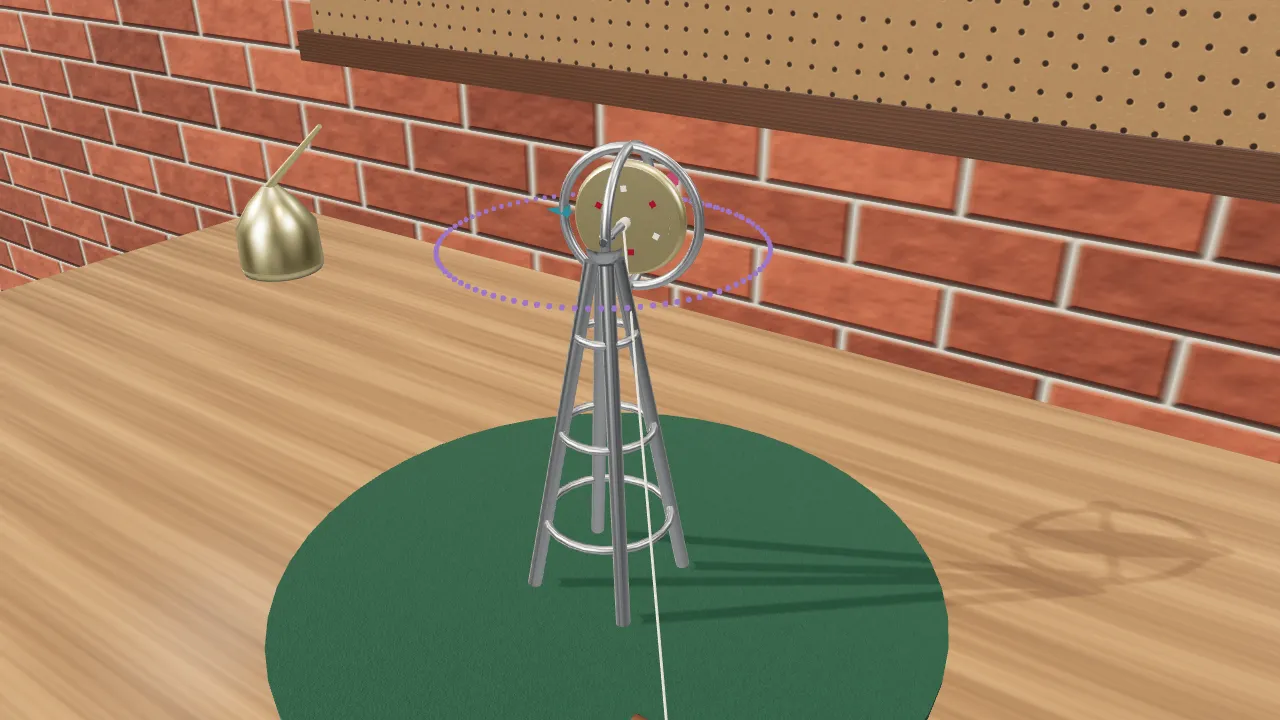
How to play
- Grab the wooden toggle on the string and pull it away from the gyroscope. The faster you pull, the faster the rotor spins.
- When the string comes free, the gyroscope circles the tower instead of falling. That slow turning is precession.
- Drag the pink knob on the cage up or down: instead of tipping over, the gyroscope swerves sideways.
- Open Lab to change the lever arm and gravity, show the spin and torque arrows, or add a motor.
Challenges
- Pull the string fast enough to spin the rotor above 3000 rpm
- Let the gyroscope precess all the way round the tower
- Pull so fast that one lap round the tower takes more than 8 seconds
Try this
- Halve the spin speed and compare the precession time. It halves too: slower spin, faster circling.
- Move the rotor further from the pivot. Gravity’s lever arm grows, and so does the precession speed.
- Push the cage down. Instead of dropping, it swings sideways: torque changes the direction of the spin.
Fun facts
- The word “gyroscope” was coined in 1852 by Léon Foucault, who used one to demonstrate the Earth’s rotation.
- A spinning gyroscope precesses more slowly the faster it spins: the precession rate is inversely proportional to its spin.
- A fast-spinning rotor keeps pointing the same way in space, which is why gyroscopes are used in compasses and guidance systems.
Why a spinning gyroscope circles instead of falling
Put a still gyroscope on its tower with only one end supported and it simply falls off. Spin it fast and something strange happens: it stays almost level and slowly swings round in a circle. The explanation is one of the most beautiful ideas in mechanics.
Spin is a vector
A spinning rotor has angular momentum L = Iω, pointing along its axle (I is its moment of inertia and ω its spin rate). Like ordinary momentum, it changes only when something pushes on it: a torque τ, and the rule is dL/dt = τ. The key is that this is a vector equation. The change in L points in the direction of the torque, not necessarily the way you expect the object to move.
Gravity’s twist
Gravity pulls down on the rotor, which is a distance r from the pivot. That makes a torque τ = mgr. But this torque points sideways, horizontal and at right angles to the axle. So each moment it adds a small sideways piece to L, and the axle swings sideways instead of down. The gyroscope circles the tower: that is precession. The precession rate is the torque divided by the angular momentum: Ω = mgr / (Iω).
Faster spin, slower circling
That formula holds a surprise. Spin faster and it precesses more slowly, because the same torque has to swing a bigger angular momentum. In this simulation the rotor starts at 3000 rpm and goes round about once every 3 seconds. Friction slowly drains the spin, so the circling gets faster and faster until, at low speed, the gyroscope droops and falls against the tower. The predicted readout uses Ω = mgr/(Iω) and you can watch the measured value follow it.
The nod
If you release or push the gyroscope, it bobs up and down slightly as it precesses. This fast nodding is called nutation. Friction calms it, leaving the smooth circle.
For the curious
The model is the full heavy symmetric top. With θ the tilt from vertical: I₁θ̈ = I₁φ̇² sin θ cos θ − I₃ω₃φ̇ sin θ + mgr sin θ, while pφ = I₁φ̇ sin²θ + I₃ω₃ cos θ stays constant apart from friction. It is integrated with fourth-order Runge–Kutta 4000 times a second, so precession and nutation emerge on their own.
Questions people ask
Why doesn’t a spinning gyroscope fall over?
Gravity’s pull produces a torque that points sideways, at right angles to the spin. That torque changes the direction of the spin rather than tipping the gyroscope over, so the axle swings round in a circle, called precession, instead of falling.
What is gyroscopic precession?
It is the slow circling of a spinning object’s axis when a torque acts on it. For a gyroscope supported at one end, the precession rate is Ω = mgr/(Iω): the weight times its distance from the pivot, divided by the spin angular momentum.
Why does a gyroscope precess faster as it slows down?
Because the precession rate is inversely proportional to the spin. As friction slows the rotor, its angular momentum shrinks, so the same gravity torque swings it round faster.