Pulley Lab: Mechanical Advantage
Haul a crate with a block and tackle: pulleys trade force for rope.
How to play
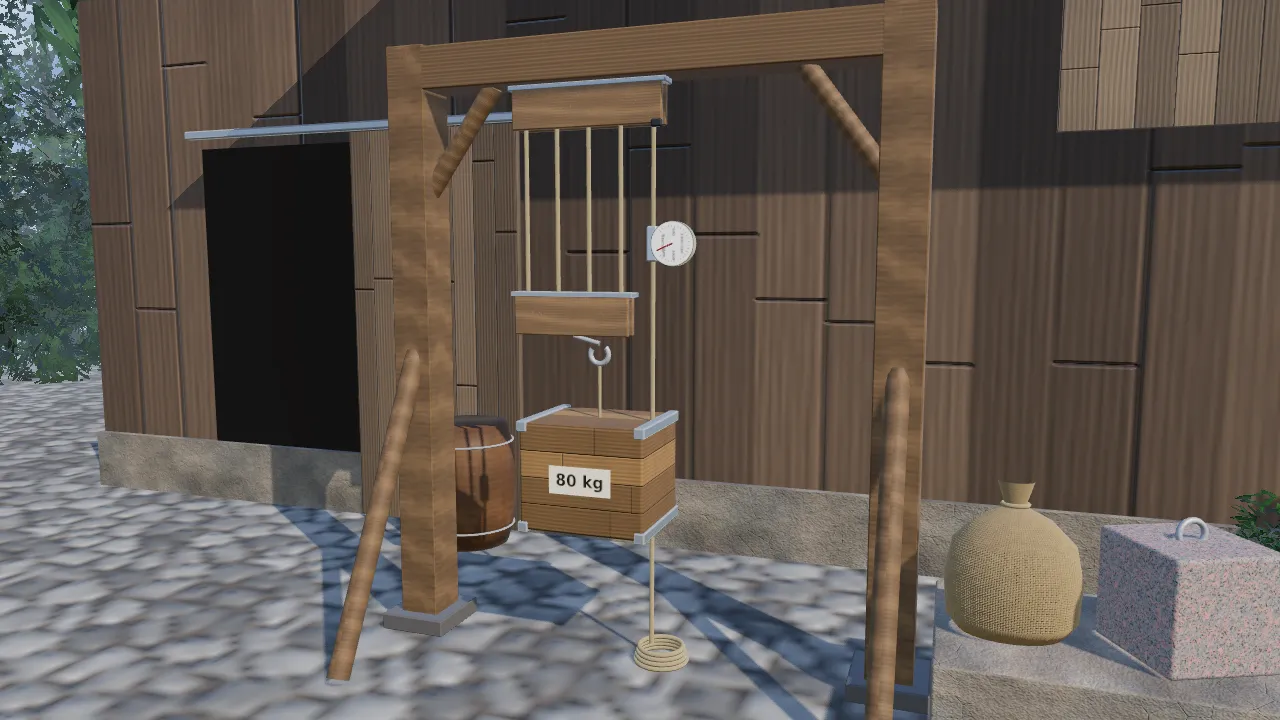
- Grab the hanging rope and pull it down to haul the load up. Push it up to lower the load. When you let go, the cam cleat on the top block holds the rope.
- Tap the top block to re-rig it with one more rope segment, from 1 up to 6, then back to a single pulley.
- Drag the flour sack or the granite block onto the hook to change the load. Swap loads while the one on the hook rests on the cobbles.
- Read the tension meter on the rope: the force you need drops as you add segments. Lab adds pulley friction and the Moon’s gravity.
Challenges
- Haul a load a whole metre up off the cobbles
- Re-rig the tackle so the 80 kg crate lifts with a pull under 200 N
- Hook on the 200 kg granite block and raise it half a metre, pulling under 500 N
Try this
- Lift the crate 0.5 m with 1 segment, then with 4. The rope readout shows how much more rope you pull.
- Turn friction on and compare the advantage with 2 segments and with 6. Each extra pulley gains a little less.
- Watch the pulleys: with several segments, the top ones spin much faster than the bottom ones.
Fun facts
- The mechanical advantage of an ideal block and tackle equals the number of rope segments supporting the moving block.
- A pulley system trades distance for force: with 4 supporting segments you pull 4 m of rope to lift the load 1 m.
- A single fixed pulley gives no mechanical advantage, but it lets you pull down to lift something up.
Why more rope means less effort
A block and tackle is a pair of pulley blocks with a rope wound back and forth between them. The top block is fixed and the bottom one carries the load. It is one of the oldest machines for lifting heavy things, and it shows one of the deepest ideas in physics: you can trade force for distance, but you can’t get work for free.
Counting the segments
Look at the rope between the two blocks. Every segment of rope that holds up the lower block carries the same tension T, because a free-turning pulley can’t make one side of the rope tighter than the other. With N supporting segments, together they hold up the weight W: N·T = W, so T = W/N. The rope you pull is the same rope, so your pull is also W/N. With four segments, an 80 kg crate (about 785 N) needs only about 196 N.
The catch
To raise the lower block by 1 m, each of the N segments must get 1 m shorter, so N metres of rope have to come out through your hands. The work you do, force times distance, is (W/N) × N = W × 1 m: exactly the work needed to lift the load. The pulleys don’t create energy. They let you spend it more slowly, with a smaller force over a longer pull.
Friction
Real pulleys waste a little effort in their bearings and in bending the rope. If each pulley passes on only a fraction η of the tension (95 % here), each segment towards your end carries a bit more than the last, and your pull grows. With friction on, 2 segments give an advantage of about 1.85, 4 give about 3.5 and 6 only about 5. Adding pulleys has diminishing returns, which is why sailors and riggers rarely use very long tackles.
For the curious
When lifting, the tensions grow from the fixed end of the rope: Tk+1 = Tk/η, with the supporting tensions adding up to W and your pull equal to TN/η. The rope also moves at different speeds in different segments. If the load rises at speed u, the rope near your hand moves at N·u, so each pulley spins at its own rate, which you can see in the simulation.
Questions people ask
How do you calculate the mechanical advantage of a pulley system?
For an ideal block and tackle, count the rope segments that hold up the moving block. That number is the mechanical advantage. Friction makes the real advantage a little smaller.
Do pulleys reduce the work needed to lift something?
No. They reduce the force, but you pull a longer length of rope by the same factor, so the work, force times distance, stays the same. Friction actually adds a little extra work.
What is the difference between a fixed and a movable pulley?
A fixed pulley only changes the direction of the pull, with no mechanical advantage. A movable pulley rides with the load and is held up by two rope segments, so it halves the force needed.