Wind Turbine and the Betz Limit
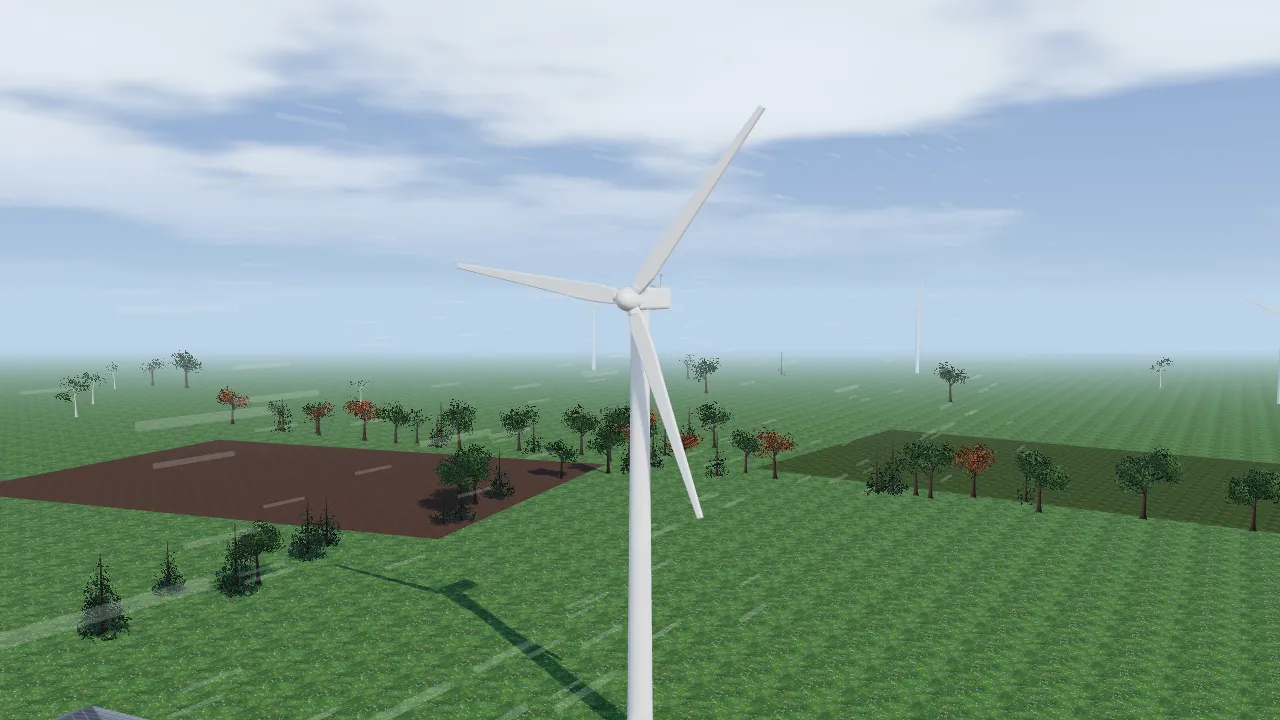
Make the wind, steer the rotor and pitch the blades of a turbine.
How to play
- Swipe across the sky to make the wind: a slow swipe is a gentle breeze, a fast one a gale.
- Drag the nacelle, the housing on top of the tower, sideways to turn the rotor out of the wind, or back into it.
- Grab the hub and twist it round to pitch all three blades by hand. Lab switches the automatic pitch back on.
- Watch the white air tracers slow down and spread out as they pass through the rotor, and read the power and efficiency.
Challenges
- Swipe up a wind strong enough for the turbine’s full 2 MW
- Turn the rotor out of the wind until it makes about half the power
- In a gale, twist the blades edge-on to the wind and bring the rotor to a stop
Try this
- Make a 5 m/s breeze, then a 10 m/s wind. The power rises about eight times, because it grows with the cube of the wind speed.
- Go above about 11.5 m/s. The power stops rising at 2 MW: the blades pitch to spill the extra wind and the rotor holds its speed.
- Twist the hub to pitch the blades to 20° in a moderate wind. The rotor slows and the efficiency drops far below its best.
Fun facts
- No wind turbine can capture more than 16/27, about 59.3 %, of the kinetic energy in the wind passing through it: the Betz limit.
- The power carried by the wind grows with the cube of its speed, so twice the wind speed carries eight times the power.
- Modern turbines turn their blades about their length, called pitching, to limit power in strong winds and to stop in storms.
How much energy can a turbine take from the wind?
Moving air carries kinetic energy. The wind flowing through a rotor disc of area A at speed v carries power P = ½ρAv³, where ρ is the density of air, about 1.2 kg/m³. For this turbine’s 80 m rotor in a 10 m/s wind, that is about 3 MW. A turbine can only turn part of it into electricity. The fraction is called the power coefficient, Cp.
Why not 100 %?
To take energy from the wind, a turbine has to slow it down. But it can’t stop the air completely, because stopped air would pile up behind the rotor and block the flow. Slow it too little and you take little energy; slow it too much and less air comes through. The best compromise was worked out by the German physicist Albert Betz around 1919. If the wind slows by a fraction a at the rotor, then Cp = 4a(1 − a)², which is largest when a = 1/3. The air then slows to two-thirds of its speed at the rotor and to one-third far behind it, and Cp = 16/27 ≈ 59.3 %. That is the Betz limit, and no turbine can beat it.
Watching the wake
The white tracers show this. Air that passes through the rotor slows down, and because the same amount of air has to keep flowing, the slower stream gets wider: the stream tube expands behind the turbine. The more power the rotor takes, the slower and wider the wake.
Tip speed and pitch
Real rotors fall short of Betz because of drag on the blades, swirl in the wake and losses at the tips. This model uses a widely used empirical rotor curve whose best value is about 48 %, reached when the blade tips move about eight times faster than the wind. Below rated power, the generator adjusts its resistance to keep that best tip-speed ratio, so Cp stays at its peak and power rises with v³. Above rated, the blades pitch to spill the extra energy and hold the output at 2 MW.
For the curious
The rotor obeys J·ω′ = Paero/ω − τgen, with τgen = kω² for best efficiency below rated and Paero = ½ρAvn³·Cp(λ, β), where λ = ωR/vn. Turned out of the wind by an angle γ, the rotor only feels the part of the wind along its axis, vn = v·cos γ, so in this simple model the power falls as cos³γ: to about half at 37°. Pitched fully edge-on, the blades stop driving the rotor and brake it instead. The tracers follow actuator-disc theory: the axial speed falls smoothly from v upstream to v(1 − a) at the rotor and v(1 − 2a) downstream, with a found from the turbine’s actual Cp.
Questions people ask
What is the Betz limit?
It is the maximum fraction of the wind’s kinetic energy that any turbine can capture: 16/27, or about 59.3 percent. It comes from the need to slow the wind down without stopping the flow through the rotor.
Why does wind power depend on the cube of wind speed?
Faster wind brings more air through the rotor each second, and each kilogram of that air carries more energy. One factor of speed comes from the flow and two from the kinetic energy, so the power grows as v cubed.
Why do wind turbines stop in very strong winds?
To protect themselves. Above their rated speed they pitch their blades to limit power, and in storms they turn the blades edge-on to the wind and stop, because the forces would otherwise become dangerous.