Tornado Vortex
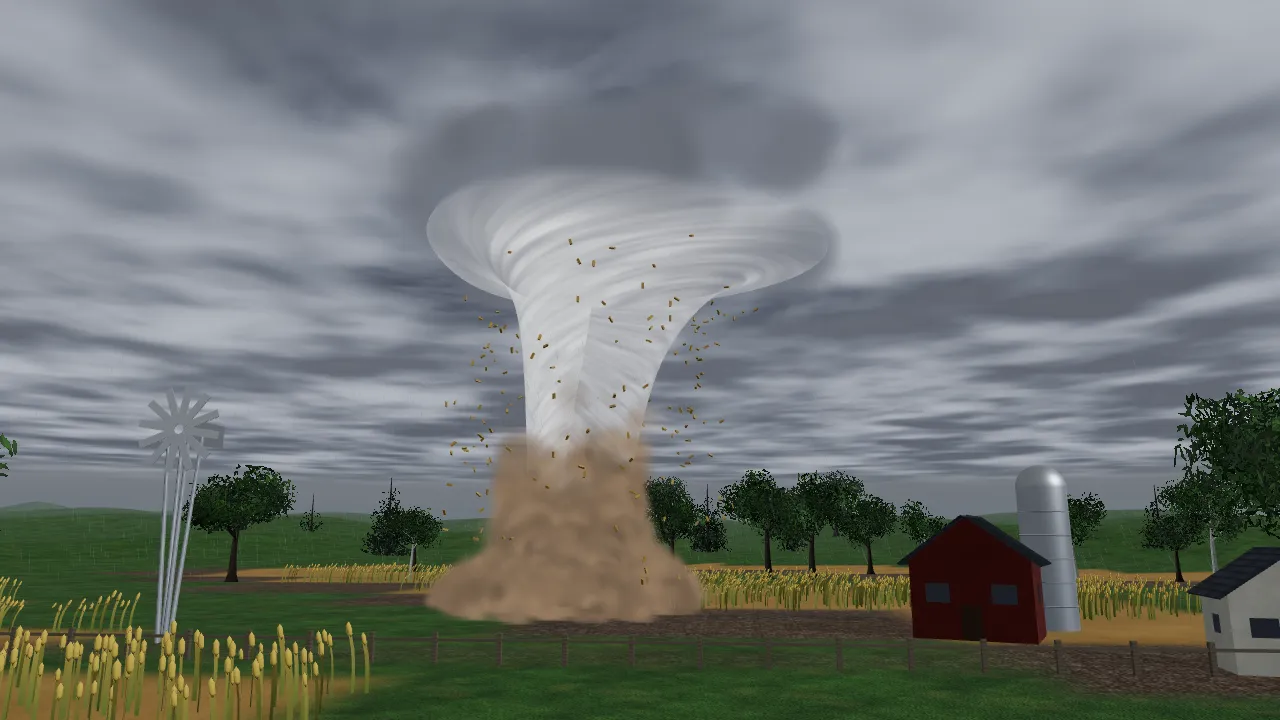
Steer a twister over farmland and lower its cloud base to touch down.
How to play
- Drag the funnel to steer the tornado across the fields. Dragging the fields works too.
- Drag the dark wall cloud above it down or up. A lower cloud base means moister air, so the funnel reaches further down.
- Look at the wheat and the windmill: every stalk and every blade answers the wind at its own spot.
- Try the three Challenges, or open Lab for the peak wind, the core size and Spin up or Rope out.
Challenges
- Drag the wall cloud down until the funnel touches the ground
- Steer a touching-down tornado through the wheat fields
- Bring the tornado close enough to blow 40 m/s winds through the windmill
Try this
- Lower the peak wind speed a little at a time. The funnel lifts off the ground, but the dust whirl underneath keeps spinning, because the tornado is the moving air, not the cloud.
- Raise the humidity. The cloud base drops lower and the funnel reaches the ground at a gentler wind speed.
- Make the core wider without changing the peak speed and watch how much more of the field lies flat.
Fun facts
- A tornado is a rotating column of air in contact with the ground. The visible funnel is cloud, and it does not always reach the ground even when the wind does.
- The Enhanced Fujita (EF) scale rates tornadoes from EF0 to EF5 from the damage they leave behind; the wind speeds it lists are estimates made from that damage.
- In the Northern Hemisphere most tornadoes turn anticlockwise when seen from above, but a small share turn the other way.
- The United States records more tornadoes each year than any other country.
How a spinning column of air makes its own cloud
Meteorologists often describe a tornado with a simple model called a Rankine vortex. In the core, the air turns like a solid wheel: the farther you are from the centre, the faster it moves. Outside the core the speed falls away again, in proportion to one over the distance, the way a spinning skater slows when she stretches her arms out. The fastest wind of all blows at the edge of the core. That is the shape you can see in the wheat field: the stalks lie flattest in a ring, not at the very centre.
Why the middle has low pressure
Air moving in a circle needs a push towards the middle, just as a ball on a string needs the pull of the string. In a tornado that push comes from pressure: the air at the centre is at lower pressure than the air around it. For a Rankine vortex the pressure at the centre is lower by about ρV², where ρ is the density of air and V is the peak wind. With V = 70 m/s that is a drop of roughly 60 hectopascals, about six percent of normal air pressure, which the Lab readout shows as you change the wind.
The funnel is cloud
When air flows into that low pressure it expands, and expanding air cools. If it cools all the way to its dew point, the water vapour in it condenses into droplets and you see a funnel. Air higher up is already closer to saturation, which is why the cloud base sits where it does: roughly 125 metres up for every degree Celsius between the temperature and the dew point. So the funnel is widest where it joins the cloud and narrows towards the ground, and in drier air it may never get there. In this simulation the funnel touches down when V² is larger than g times the height of the cloud base.
Why it lifts things up
Near the ground, friction slows the spinning air. With less spin there is less outward pull to balance the low pressure, so air near the surface rushes inwards and then upwards in the core. It is the same effect that gathers tea leaves in the middle of a stirred cup. Dust and loose straw ride that inflow, spiral upwards and are thrown outwards near the cloud base.
For the curious
Inside the core (r ≤ R) the wind is v = V·r/R; outside it is v = V·R/r. Balancing pressure against the turning of the air, dp/dr = ρv²/r, gives a pressure deficit of ρV²(1 − r²/2R²) inside the core and ρV²R²/2r² outside. Cloud forms wherever that deficit exceeds ρg(zbase − z), the pressure change the air would feel if it were lifted to the cloud base. Each straw and dust grain is pushed towards the local wind with a short drag time and pulled down by its own settling speed.
Questions people ask
Why is a tornado shaped like a funnel?
The funnel is cloud that forms where the pressure inside the vortex is low enough for the air to cool to its dew point. The pressure is lowest near the centre and the air higher up is already closer to saturation, so the cloud is widest at the top and narrows towards the ground.
How fast are the winds in a tornado?
Most tornadoes are weak, with winds below about 50 m/s (180 km/h). The rare tornadoes rated EF5 are estimated to have winds above about 90 m/s, more than 320 km/h.
What is a Rankine vortex?
It is a simple model of a whirl in which the core spins like a solid wheel and the wind outside the core weakens in proportion to one over the distance from the centre. It captures the main features of tornadoes, dust devils and even hurricanes.