Aurora Borealis
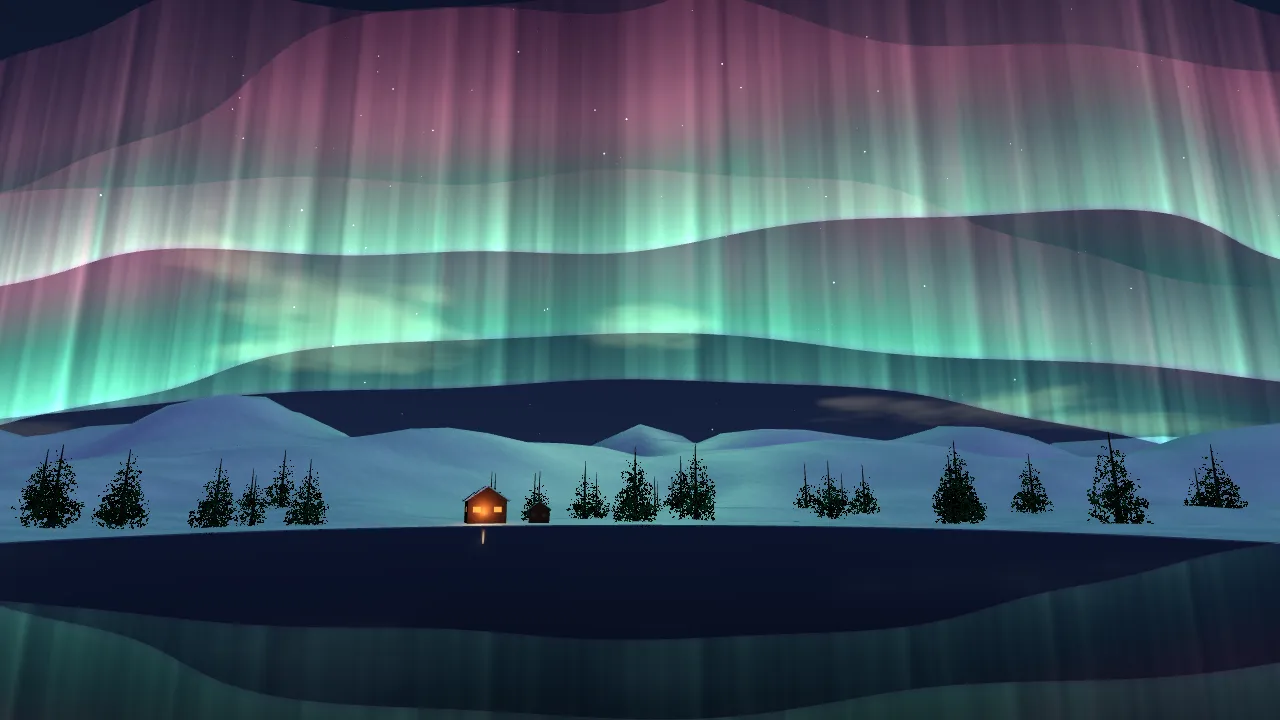
Stir up the northern lights over a frozen lake and set off substorms.
How to play
- Drag the sky upwards to strengthen the geomagnetic storm. The auroral oval spreads towards you and the curtains climb higher.
- Tap the curtains to set off a substorm: they brighten, speed up and ripple.
- Turn on the altitude labels in Lab to see how high each colour shines.
- Try the three Challenges, or use the Kp slider in Lab.
Challenges
- Tap the aurora to set off a substorm
- Drag the storm up to Kp 7, when red oxygen glows high above the green
- At Kp 9, set off another substorm to bring out the violet nitrogen fringe
Try this
- Raise the Kp index to 7 or more. Red appears at the tops of the curtains and a violet fringe along their lower edge.
- Turn on the altitude labels: the green glow sits around 100 to 200 km up and the red light higher still.
- Tap the sky for a substorm and watch the curtains brighten and fold faster before they settle again.
Fun facts
- The green of most auroras is light at 557.7 nanometres given off by oxygen atoms, mostly between about 100 and 200 km above the ground.
- The deep red at the tops of strong auroras is oxygen light at 630.0 nanometres, emitted higher up where the air is thinner.
- Auroras around the South Pole are called the aurora australis, or southern lights.
- The Kp index runs from 0 to 9 and measures how disturbed the Earth’s magnetic field is. The higher it goes, the farther from the poles auroras can be seen.
Why oxygen glows green, and sometimes red
The Sun constantly blows a thin wind of charged particles into space. The Earth’s magnetic field shields us from most of it, but energy from that solar wind is stored in the field and released in bursts. Electrons are accelerated down the magnetic field lines into the upper atmosphere, in a ring around each magnetic pole called the auroral oval. When they hit atoms and molecules of air, they knock them into excited states, and each excited atom gives the energy back as light of a particular colour.
Green and red: one atom, two colours
Most of the light comes from oxygen. An excited oxygen atom can emit green light at 557.7 nanometres, or red light at 630.0 nanometres. The red state is unusually long-lived: an atom waits around 110 seconds on average before it emits, compared with less than a second for the green. Lower down, the air is dense enough that the atom usually bumps into another molecule first and loses its energy without glowing. Only high up, roughly above 200 km, is the air thin enough for the red light to survive. That is why red crowns the tops of strong displays, while green dominates below.
The violet edge
During strong activity, faster electrons dive deeper, to around 100 km, where they also excite nitrogen. Ionised nitrogen molecules emit violet and blue light at 391.4 and 427.8 nanometres, painting a purplish fringe along the bottom of the curtains. Raise the Kp index in the Lab to see it.
Curtains, rays and substorms
Aurora curtains are thin sheets of light hanging along the magnetic field lines, which is why they look like folded drapes with fine vertical rays. A substorm is a sudden release of energy stored in the Earth’s magnetic tail. The curtains brighten, fold and race across the sky for several minutes before settling down. Tap the sky to trigger one here.
For the curious
The energy of each photon is E = hc/λ: about 2.22 electronvolts for the green line and 1.97 eV for the red. In this simulation each curtain’s brightness depends on altitude: a sharp lower edge near 100 km, a green peak just above it, a red layer above about 200 km, and a violet fringe at the bottom that grows with activity. The folds drift as a sum of slow waves, and a substorm speeds them up and brightens a patch of the curtain.
Questions people ask
What causes the northern lights?
Energetic electrons, ultimately powered by the solar wind, stream down the Earth’s magnetic field lines into the upper atmosphere. They collide with oxygen and nitrogen, which then give off light of particular colours.
Why are most auroras green?
Green is the strongest colour that oxygen atoms emit at the heights where most aurora electrons stop, roughly 100 to 200 km up. Our eyes are also very sensitive to green light.
Where can you see the northern lights?
Most often under the auroral oval, a ring around the north magnetic pole that typically passes over places such as northern Scandinavia, Iceland, northern Canada and Alaska. During strong geomagnetic storms the oval spreads towards the equator and auroras can be seen much farther south.