Weather Balloon to the Edge of Space
Fill a weather balloon, let it go and see it swell until it bursts.
How to play
- Drag the valve wheel on the helium cylinder to fill the balloon. The free lift readout shows how much it could lift beyond itself and its load.
- When the free lift is above zero, drag the balloon upwards to let it go.
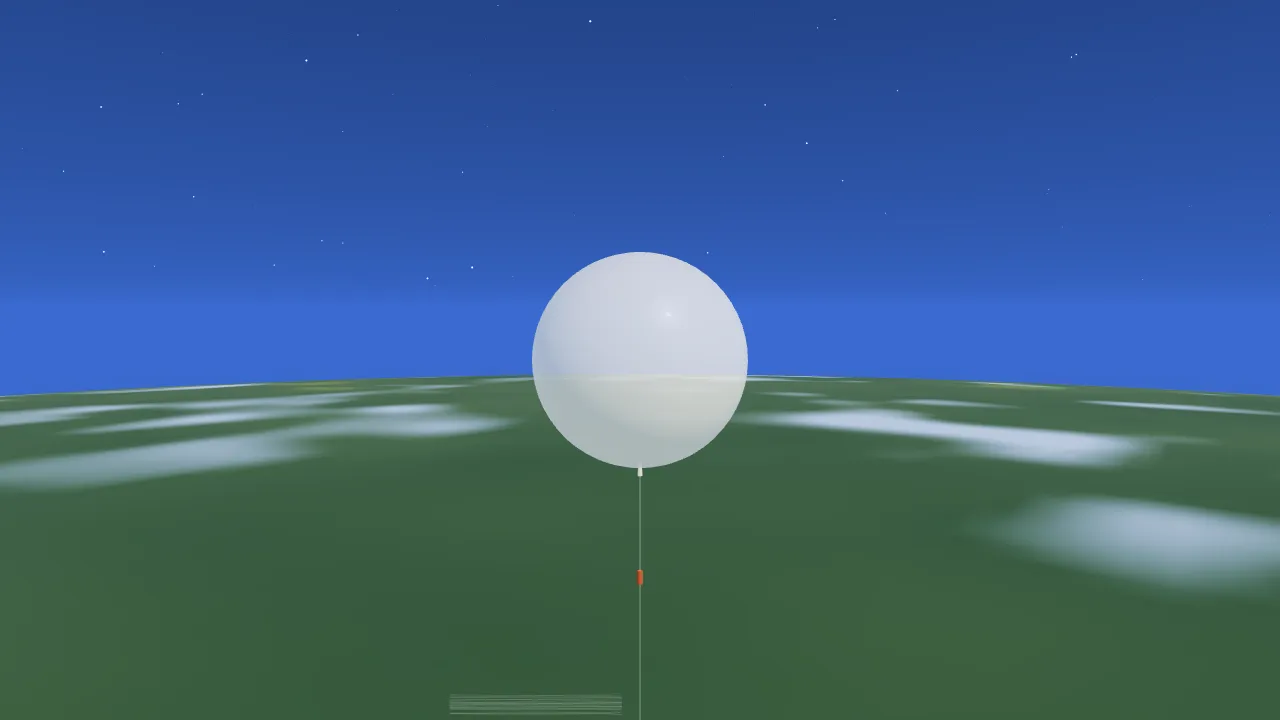
- Follow the readouts as it climbs: pressure and temperature fall while the balloon grows wider. Drag to look down at the curving Earth.
- Try the three Challenges, or open Lab for a bigger balloon or a faster time-lapse.
Challenges
- Fill the balloon with the valve until it can lift, then let it go
- Climb past the tropopause, where the air stops getting colder
- Fill a balloon gently enough that it bursts above 30 km
Try this
- Note the balloon’s width at launch and again at 20 km. The pressure up there is under a tenth of that at the ground, so the balloon’s volume has grown more than ten times.
- Watch the temperature readout: it falls steadily for the first 11 km or so, then stops falling, and starts to rise again above about 20 km.
- Launch the 2000 g balloon with the same extra helium as the 600 g one. The bigger balloon can stretch further, so it climbs higher before it bursts.
Fun facts
- Weather services launch balloon-borne instruments called radiosondes from hundreds of sites around the world, usually twice a day at 00:00 and 12:00 UTC.
- At about 30 kilometres up, the air pressure is roughly one percent of the pressure at sea level.
- In the troposphere, the lowest layer of the atmosphere, the air cools by about 6.5 °C for every kilometre you climb, on average.
- The sky looks darker the higher you go, because there is less air above you to scatter sunlight.
A balloon that grows as the air thins
Every day, weather services around the world release balloons carrying small instrument packs called radiosondes. As they rise, these measure temperature, humidity and pressure and track the wind, radioing their readings to the ground. The measurements feed the computer models behind weather forecasts. This scene follows one flight from a grassy launch site to the dark sky of the stratosphere, sped up as a time-lapse.
Why the balloon swells
A weather balloon is filled with a fixed amount of helium (some services use hydrogen) and tied off. The rubber is thin and stretchy, so the gas inside stays at about the same pressure as the air outside. As the balloon climbs, the outside pressure falls, roughly halving every five or six kilometres, and the gas expands to match. By the ideal gas law, its volume grows as the pressure drops, and so does the balloon: a balloon launched about one and a half metres wide can reach several metres across before it bursts.
A steady climb
Surprisingly, the balloon’s lift hardly changes as it rises. The air gets thinner, but the balloon gets bigger in exactly the right proportion, so it always pushes aside the same mass of air. The thinner air also drags less, so the balloon rises at a fairly steady speed of around five metres per second, climbing 30 kilometres in under two hours. In the scene the extra helium you add sets this lift and the climb rate.
Burst and parachute
Eventually the rubber stretches past its limit and the balloon bursts, typically somewhere around 25 to 35 kilometres up. A small parachute then opens. At first it falls fast, because there is very little air to push against; as it drops into thicker air, it slows to a gentle few metres per second before landing, often tens of kilometres from where it started, carried by the winds on the way.
Layers of the atmosphere
The readouts follow the International Standard Atmosphere, an average model used in aviation and science. Temperature falls through the troposphere to about −56 °C near 11 km, stays almost constant for a while, then rises slowly in the stratosphere, where ozone absorbs sunlight.
For the curious
With a fixed mass of helium m, the volume is V = m·RHe·T/p, so the displaced air mass ρairV stays constant and the free lift L = (ρairV − mtotal)·g is the same at all heights. The ascent speed is v = √(2L/(ρCdA)), and the parachute’s terminal speed is v = √(2mg/(ρCdA)), which falls as the air density ρ rises.
Questions people ask
How high do weather balloons go?
Most burst somewhere around 25 to 35 kilometres up, in the stratosphere, after swelling to several times their launch width as the air pressure falls.
Why do weather balloons expand as they rise?
The gas inside stays at about the same pressure as the air around it. Air pressure falls with height, so the gas spreads out and the balloon grows, just as the ideal gas law predicts.
What happens to a weather balloon after it bursts?
A small parachute opens and the instrument pack drifts back to the ground. It falls quickly in the thin upper air and slows down as the air gets thicker lower down.