Lightning Storm
Call down lightning and count the seconds until the thunder arrives.
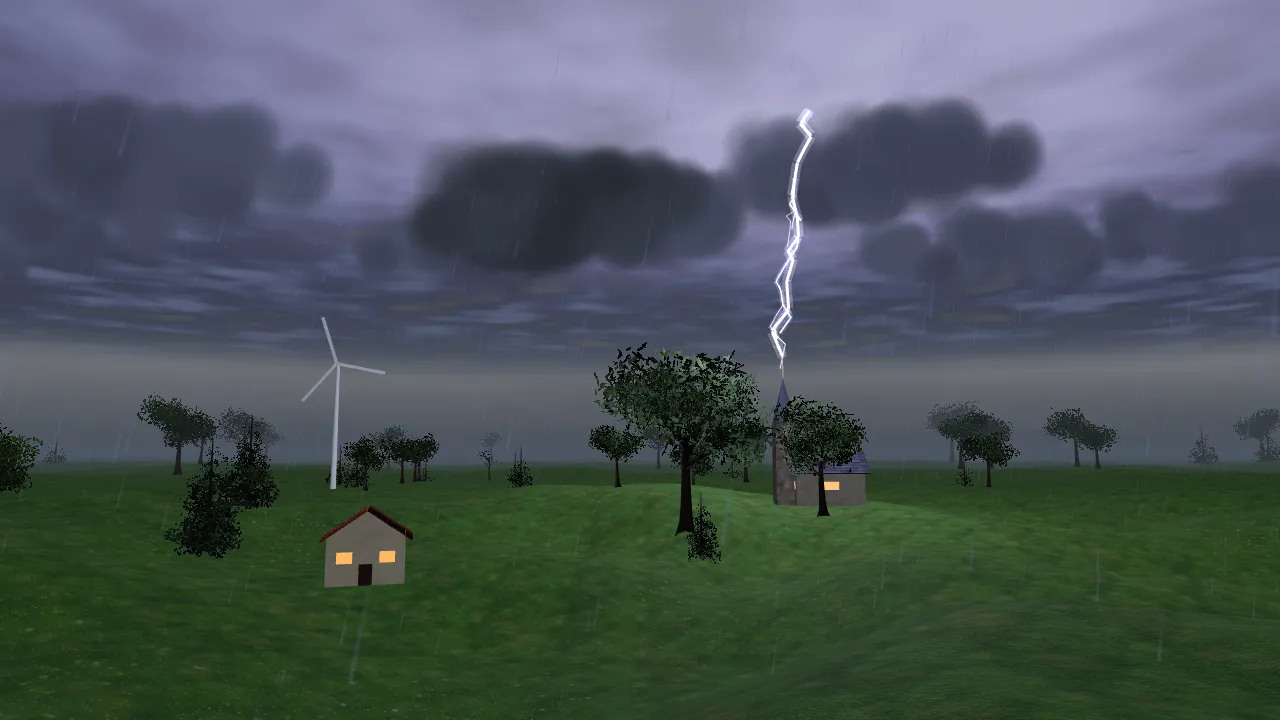
How to play
- Tap the landscape to start a lightning strike there.
- Drag the dark storm cell across the sky. It charges up, flickers and strikes the tallest thing beneath it.
- Count the seconds until the thunder arrives: every three seconds is about a kilometre. The readout counts with you.
- Try the three Challenges, or open Lab to change the peak current or switch off the slow motion.
Challenges
- Call down a strike close enough that its thunder comes in under 3 seconds
- Make the lightning hit the church’s lightning rod
- Strike so far away that the thunder takes more than 10 seconds
Try this
- Tap near the church. The strike jumps to the lightning rod when the leader comes within striking distance of it.
- Raise the peak current. The striking distance grows, so tall objects catch strikes from farther away.
- Tap close by, then far away. Divide each thunder delay by three to get the distance in kilometres.
Fun facts
- Sound travels about 343 metres per second in air at 20 °C, so thunder takes roughly three seconds to cover each kilometre.
- A lightning channel can heat the air to around 30,000 °C, hotter than the surface of the Sun.
- A lightning rod does not pull in strikes from far away. It gives a strike that would hit the building anyway a safe path to the ground.
- Most of the brilliant flash you see is the return stroke, which races up the path that the stepped leader opened.
From stepped leader to thunderclap
Inside a thundercloud, ice crystals and soft hail collide in strong updrafts. The collisions move electric charge around, and the cloud ends up with layers of opposite charge, usually with negative charge in its lower part. When the electric field becomes strong enough, the air begins to break down.
The stepped leader
A typical cloud-to-ground strike starts with a faint channel of ionised air called the stepped leader. It does not shoot straight down. It advances in short jumps, each tens of metres long, pausing between steps and forking into branches that wander as they grope towards the ground. In this simulation the leader is slowed right down so you can watch it. In reality it covers the distance in a few hundredths of a second.
Attachment and the return stroke
As the leader nears the ground, the electric field at tall, pointed objects becomes intense, and they send up short upward streamers. When one meets the leader, the circuit is complete and a huge current surges up the channel: the return stroke. Peak currents of tens of thousands of amperes are typical. Engineers estimate the reach of that final jump with the electrogeometric model, which says the striking distance grows with the peak current. That is why the strike here sometimes jumps to the church’s lightning rod, the wind turbine or the old oak.
Thunder
The return stroke heats the channel so fast that the air expands explosively, sending out a shock wave that becomes the sound of thunder. Light reaches you almost instantly, but sound travels at only about 343 metres per second. Count the seconds from flash to bang and divide by three: that is roughly the distance in kilometres. Thunder rumbles because the channel is long. Sound from its nearest point arrives first and sound from its far end arrives seconds later, so the simulation plays a crack followed by a rolling rumble.
For the curious
Thunder delay is t = d / 343 m/s. The electrogeometric model used in lightning-protection design gives the striking distance as r = 10·I0.65 metres, with the peak current I in kiloamperes: about 90 m at 30 kA. The leader here is a random walk biased towards the ground, with branches that spawn with a fixed probability at each step and die out after a few jumps. Bright flashes are limited to three per second to keep the scene comfortable to watch.
Stay safe: if you can hear thunder, you are close enough to be struck. Go indoors and wait until the storm has passed.
Questions people ask
How do you work out how far away lightning is?
Count the seconds between the flash and the thunder. Sound covers about a kilometre every three seconds, or a mile in about five, so a nine-second gap means the strike was roughly three kilometres away.
Why does thunder rumble?
The lightning channel is kilometres long. Sound from the nearest part reaches you first and sound from the farthest parts arrives seconds later, so one crack is smeared into a long roll. Echoes from hills and clouds add to it.
Does lightning always strike the tallest thing?
Often, but not always. Tall, pointed objects send up streamers that can meet the descending leader, so they tend to be hit when a strike would land nearby anyway. Lightning can still strike open ground right beside a tall tree.