Wind Chimes
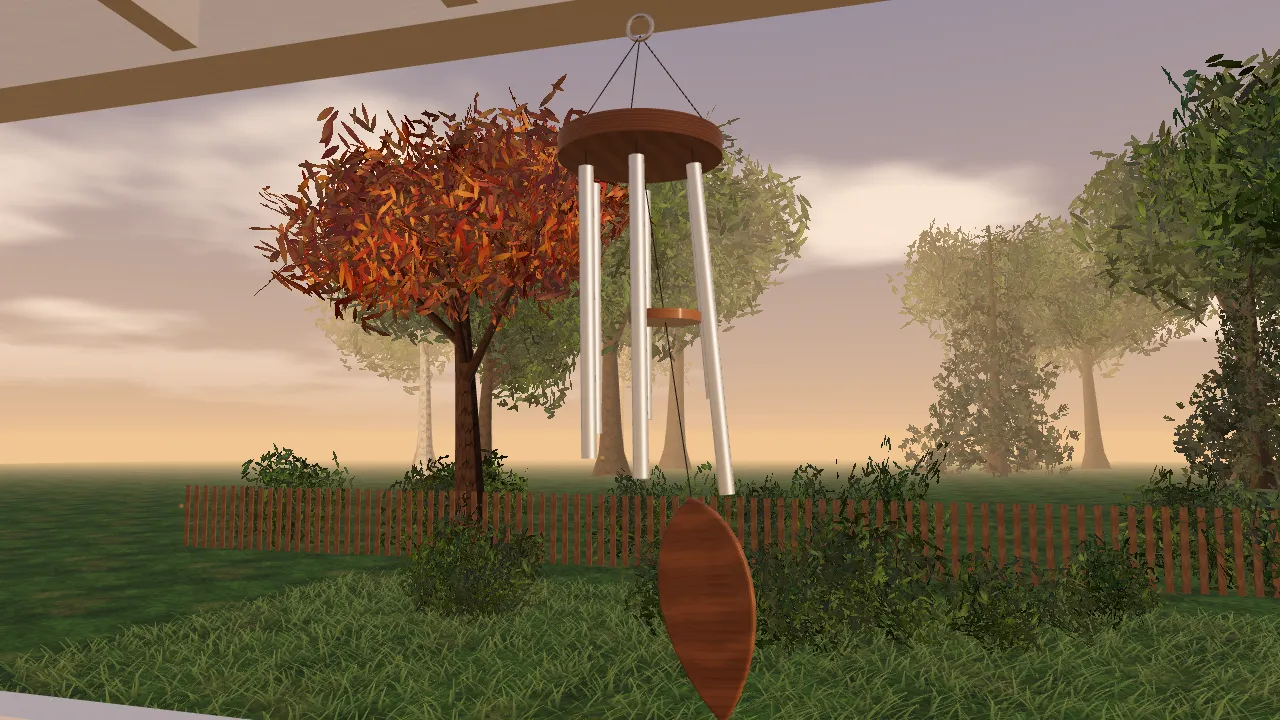
Swipe a breeze through porch wind chimes, or tap the tubes yourself.
How to play
- Swipe across the chime to send a gust of wind that way. A quicker flick blows harder.
- Tap a tube to ring it. Tap near the middle, then near an end, and listen to the difference.
- Grab the wooden sail, pull it aside and let go to swing the striker into the tubes.
- Try the three Challenges, or open Lab to change the breeze, the tuning and the metal.
Challenges
- Ring every one of the six tubes yourself
- Tap the six tubes in order, from the lowest note to the highest
- Send one gust that rings four different tubes
Try this
- Compare the tube lengths with the notes. One octave higher needs a tube only about 71% as long, because pitch rises as one over the length squared.
- Switch from aluminium to copper. The tubes keep their lengths but every note drops by more than a quarter, because bending waves travel more slowly in copper. Steel sounds almost the same as aluminium. Can you see why from the formula below?
- Tap a tube right at its end, then exactly in the middle. The end brings out the higher, clangy overtones, while the middle gives a purer note.
Fun facts
- Chime tubes are often hung from a point 22.4% of the way along their length. That is a node of the main vibration, where the tube hardly moves, so the string barely damps the ring.
- The overtones of a ringing tube are not whole-number multiples of its main note. The first two sit about 2.76 and 5.40 times higher, which gives chimes their shimmering, bell-like sound.
- In Japan, small glass or metal wind bells called fūrin are a classic sign of summer.
- Sound travels along an aluminium rod at about 5,000 metres per second, roughly fifteen times faster than through air.
Why longer tubes ring lower
Wind chimes turn a breeze into music. A light sail catches the wind and swings a striker, the striker knocks against hanging tubes, and each tube rings with its own note. Because the notes are chosen from a pentatonic scale, any order the wind picks still sounds pleasant. This simulation follows each piece as a real pendulum and works out every note from the size and material of the tubes.
A tube is a bending bar
When the striker hits, the tube does not stretch or squash much. Instead it bends, flexing back and forth like a skipping rope frozen in shape. Because both of its ends are free, physicists call it a free–free bar. Its main vibration has two still points, or nodes, each 22.4% of the length in from an end. Hanging the tube from a node lets it ring for a long time.
The pitch of a bending bar depends on how stiff it is compared with how heavy it is, and above all on its length. The frequency is proportional to 1/L². Double the length and the note falls by two octaves. To go up one octave you need a tube about 71% as long, since 1/√2 ≈ 0.71. That is how chime makers tune a set: they cut each tube to a carefully calculated length.
Bell-like overtones
A guitar string’s overtones are neat multiples of its note: 2×, 3×, 4× and so on. A bending bar is different. Its next vibrations come at about 2.76 and 5.40 times the main frequency. These unrelated overtones are what make chimes and bells sound shimmering rather than plain. Where you strike matters too. At the middle of a tube the second vibration has a node, so it is not excited at all and the note sounds pure. At an end every vibration moves, so all the overtones ring out together.
The wind’s part
The sail feels a drag force of ½ρCdAv², so doubling the wind speed pushes four times harder. Gusts come and go at random, which is why chimes play in bursts. The heavy tubes barely notice the wind themselves; it is the light sail that swings and drives the striker.
For the curious
For a tube with outer and inner radii ro and ri, the frequencies are fn = (βn²/2πL²)·√(E/ρ)·√((ro² + ri²)/4), with βnL = 4.730, 7.853 and 10.996. Here E is the stiffness (Young’s modulus) and ρ the density of the metal. The ratio E/ρ is almost the same for steel and aluminium but much smaller for copper, which is why copper chimes of the same size sound lower. With aluminium tubes 25 mm across, a C5 at 523 Hz needs a tube about 54 cm long.
Questions people ask
How are wind chimes tuned?
By cutting each tube to a precise length. A tube’s pitch is proportional to one over its length squared, so makers calculate the length for each note of the scale, then fine-tune by trimming. The tubes are hung from the node of their main vibration so they ring freely.
Why do longer wind chimes sound lower?
A longer tube is easier to bend and has more mass to move, so it vibrates more slowly. For a bending tube the frequency falls with the square of the length, so a tube twice as long sounds two octaves lower.
Why do wind chimes sound so pleasant together?
Many sets are tuned to a pentatonic scale, which has no notes a semitone apart, so no pair of notes clashes harshly. On top of that, each tube has bell-like overtones that give a soft, shimmering tone.