Humpback Whale Bubble-Net Feeding
Swim a humpback round a herring school and trap it in bubbles.
How to play
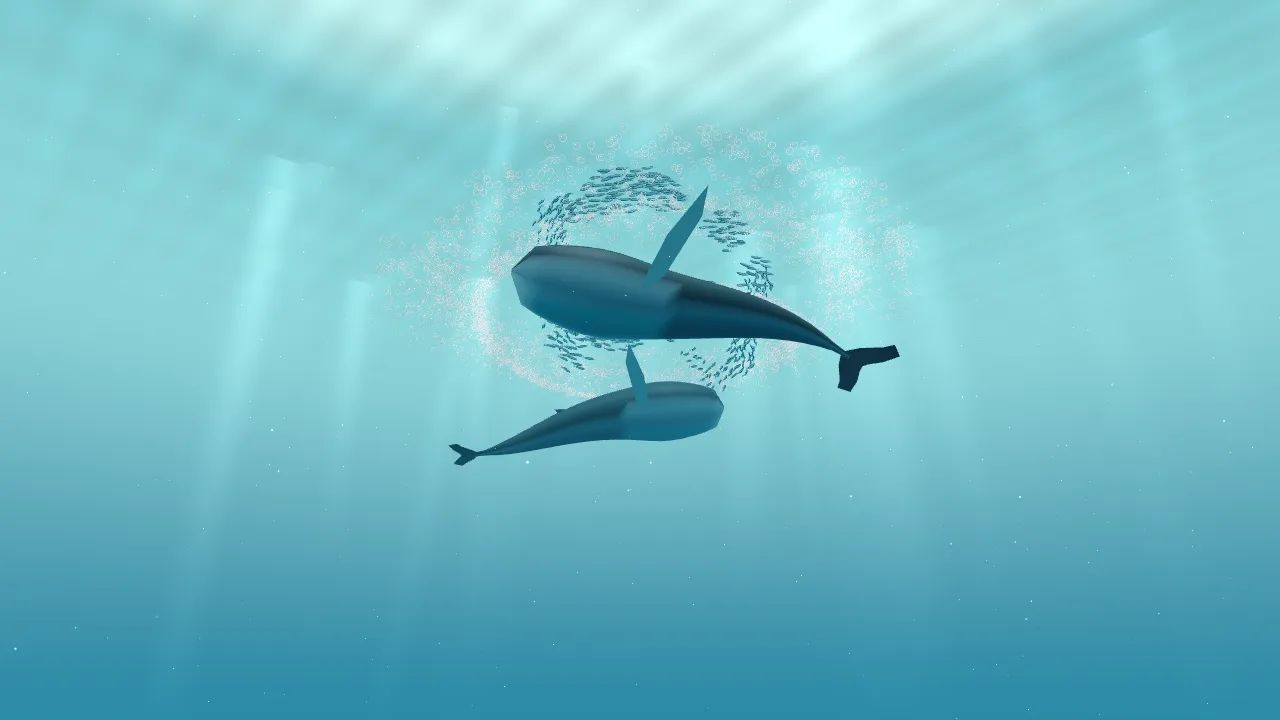
- Press and drag to swim the lead whale. It breathes out a stream of bubbles as it goes, and the rising curtain stays behind it.
- Swim all the way round the herring: they won’t cross the bubbles, so they pack into the middle.
- Tap the school to lunge straight up through it, mouth wide open.
- Open Lab to change how many whales work together, the size of the net or the size of the bubbles.
Challenges
- Swim a full circle of bubbles around the herring
- Tighten your net until the school is under 6.5 m across
- Lunge up through a squeezed school and gulp a third of it
Try this
- Set the bubble size to 2 mm, then 40 mm, and watch the “Bubbles rise at” readout. Bigger bubbles rise faster, so the curtain reaches the school sooner.
- Make the starting net wider. The herring have more room, and fewer end up in the whales’ path when they lunge.
- Try one whale, then three. With more whales spiralling together, the curtain closes faster and more evenly.
Fun facts
- The humpback whale’s scientific name, Megaptera, means “big wing”, after its very long flippers, which can reach about a third of its body length.
- Researchers who attached suction-cup sensor tags to humpbacks found that whales build bubble nets in more than one way, including upward spirals and double loops.
- A humpback feeds by engulfing a huge mouthful of water and prey, its pleated throat expanding like a balloon, then pushing the water out through its baleen plates.
- Pressure in seawater rises by roughly one atmosphere for every 10 metres of depth.
How a curtain of bubbles becomes a net
Humpback whales in some parts of the world have a remarkable way of catching schooling fish. One or more whales dive beneath a school, then swim upward in a spiral while releasing bubbles from their blowholes. The bubbles rise in a circular curtain around the fish. The fish seem to treat the curtain as a wall, perhaps because it looks and sounds like a barrier, so they crowd together in the middle. Then the whales lunge up through the centre with their mouths wide open.
Why bubbles grow as they rise
Water pressure increases with depth, by roughly one atmosphere every 10 metres. A bubble released at 20 metres is squeezed by about three atmospheres. As it rises the pressure falls, and by Boyle’s law the volume of a fixed amount of gas at the same temperature is inversely proportional to its pressure, PV = constant. So that bubble has about three times its starting volume by the time it reaches the surface, and its diameter grows by about 44%. The bubbles here grow in exactly this way.
How fast bubbles rise
A bubble rises when buoyancy beats drag. Small bubbles a few millimetres across rise at roughly 20 to 30 centimetres per second. Bigger bubbles flatten into wobbly caps and rise faster, at a speed close to 0.71√(g × d), where d is the bubble’s diameter, a relationship found by Davies and Taylor in 1950. The whale has to time its spiral so the curtain reaches the fish before they slip away, and bubble size helps set that timing.
Teamwork and learning
Some humpbacks bubble-net feed alone, while others work in groups, with different whales seeming to take different roles. Not all humpback populations use bubble nets, and some feeding techniques appear to spread from whale to whale by social learning.
For the curious
Each whale follows a rising helix: its angle advances one and a half turns while its radius shrinks from the starting width to 5 m and it climbs from 18 m to 9 m deep, then it dives slightly and lunges upward. Each bubble starts with diameter d₀ at depth z₀ and has diameter d = d₀ × ((Patm + ρg z₀) / (Patm + ρgz))1/3 at depth z, with ρ = 1025 kg/m³. It rises at max(0.23, 0.71√(gd)) m/s. Herring follow schooling rules, and every few steps each fish checks a grid of bubble columns around it and steers away from any that span its depth. Whales and herring are drawn to scale with each other, except that the herring are twice life size so you can see them.
Questions people ask
What is bubble-net feeding?
It is a hunting technique used by some humpback whales. Whales swim in a rising spiral or circle beneath schooling fish or krill while blowing bubbles. The bubbles form a curtain that the prey avoid crossing, and the whales then lunge up through the concentrated school.
Why do bubbles get bigger as they rise?
Because the water pressure on them falls. By Boyle’s law, the volume of a gas bubble is inversely proportional to the pressure around it, so a bubble rising from 20 metres to the surface ends up with about three times its starting volume.
Do all humpback whales use bubble nets?
No. Bubble-net feeding is seen in some humpback populations, notably in the North Pacific, and different groups use different techniques. Studies suggest that some feeding methods spread between whales through social learning.