Synchronous Fireflies
Flash your light at hundreds of fireflies and pull them into step.
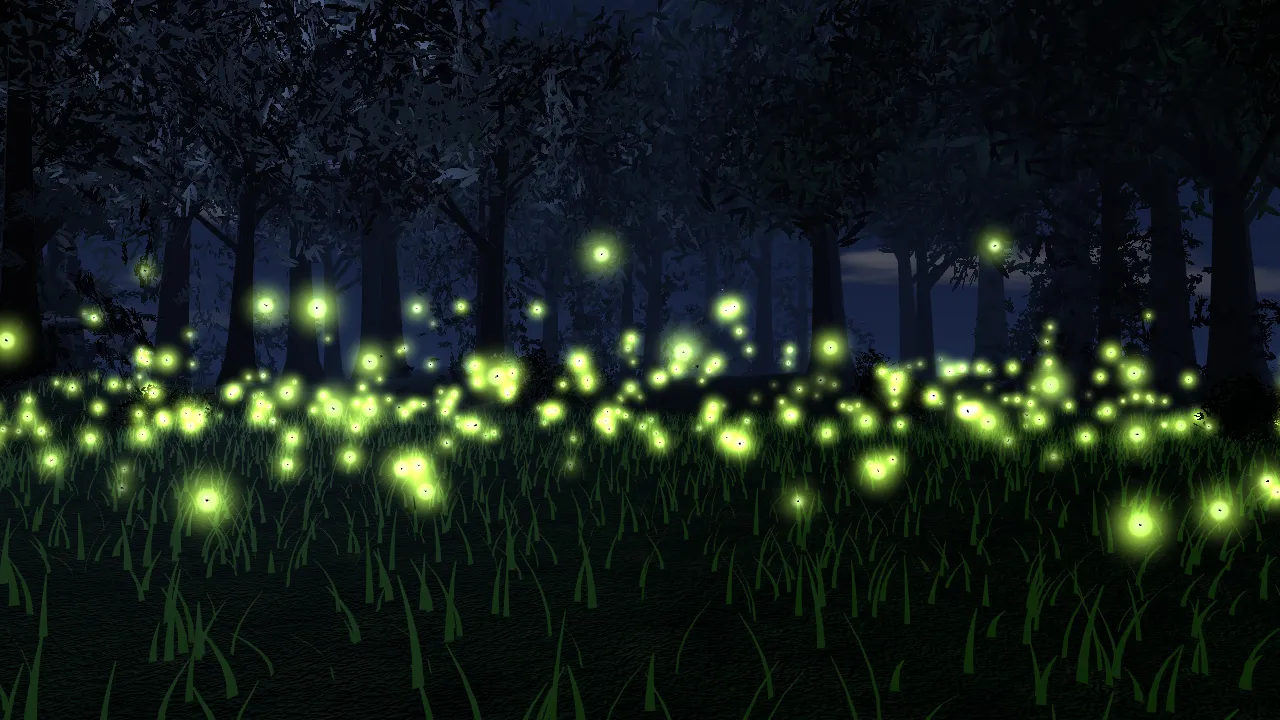
How to play
- Tap the meadow to flash your own light. Fireflies nearby answer with a burst, and their bursts set off their neighbours.
- Keep flashing every so often: scattered flashes gather into waves, then into bursts the whole clearing shares.
- Try the three Challenges, or open Lab to change how strongly each burst pulls on the others, or how far a firefly can see.
- Drag to look around the clearing. Pinch or scroll to zoom in on a firefly.
Challenges
- Flash your light and get a firefly to flash back
- Time a flash well enough to set off a chain of a hundred fireflies
- Help the swarm into step: get nine in ten flashing together
Try this
- Set the coupling to 0 and scramble their rhythms. With no pull between them, they never sync.
- Lower “How far a firefly can see” to 3 m. Small patches fall into step separately, and bursts roll across the clearing as waves.
- Turn on “Colour each firefly by its clock”. Matching colours show fireflies whose clocks already agree, even between flashes.
Fun facts
- Fireflies are not flies but beetles, and their light is made by a chemical reaction in which the enzyme luciferase makes the molecule luciferin glow.
- In the Great Smoky Mountains, the firefly Photinus carolinus flashes in synchrony for a few weeks around early June, and the national park runs a lottery for viewing passes.
- Synchronous fireflies are also found in parts of Southeast Asia, where Pteroptyx fireflies gather in mangrove trees and flash together night after night.
- Firefly light produces very little heat, which is why it is often called cold light.
How fireflies fall into step
Each male firefly carries an internal clock that tells him when to flash. On its own, every clock runs at a slightly different pace, so a group of fireflies starts out flashing at random. Yet in a few places, such as the forests of the Great Smoky Mountains, thousands of Photinus carolinus males end up flashing together: a burst of several quick flashes, then a few seconds of darkness, all in step.
Nudged by a neighbour’s flash
The trick is that seeing a flash resets a firefly’s clock a little. If a male is close to flashing when a neighbour flashes, he is pushed over the edge and fires at once. If he has only just flashed, he hardly reacts. Mathematicians call this a system of pulse-coupled oscillators. In 1990, Renato Mirollo and Steven Strogatz proved that if every oscillator can see every other and the clocks build up toward a flash along a concave curve, a group almost always ends up perfectly synchronised. Once two fireflies fire together, they stay together for good, and the cluster grows until it takes in everyone.
Waves across the forest
Real fireflies can’t see the whole forest, because leaves, trunks and distance block their view. In this clearing each firefly only reacts to bursts within a set range. With a long range the whole swarm locks together. With a short one, neighbourhoods sync separately and you see waves of light roll across the clearing as one patch triggers the next, something researchers have filmed in real swarms.
Why flash together?
The flashes are courtship signals. Males flash while flying and females answer from the ground. One idea, supported by experiments with flashing LEDs, is that synchrony helps a female pick out her own species’ pattern in a forest full of flickering lights. Fireflies need darkness to see each other, so light pollution and habitat loss are among the threats to their displays.
For the curious
Each firefly has a phase φ that rises from 0 to 1 over its cycle, about 8 seconds here, with each individual’s period varying by a few percent. Its readiness to flash is x = f(φ) = ln(1 + (eb − 1)φ) / b with b = 3, a concave curve. When a neighbour within range begins a burst, x jumps by the coupling ε: x → x + ε. If x reaches 1 the firefly bursts immediately; otherwise its phase becomes φ = f−1(x). Just after bursting, a firefly ignores flashes for half a cycle. The “In step” readout is the order parameter r = |Σ e2πiφ| / N, which is 0% for random clocks and 100% for perfect synchrony.
Questions people ask
How do fireflies synchronise their flashes?
Each firefly has an internal rhythm, and seeing a neighbour flash nudges its own clock forward. A firefly close to flashing is pushed into flashing at once, so groups that flash together keep growing until the whole swarm is in step.
Where can you see synchronous fireflies?
The best known display in North America is Photinus carolinus in Great Smoky Mountains National Park, for a few weeks around early June. Synchronous fireflies are also found in parts of Southeast Asia, where Pteroptyx fireflies gather in mangrove trees.
Why do fireflies flash?
Most fireflies flash to find a mate. Males of each species flash in their own pattern while flying, and females answer from the vegetation. The light comes from a chemical reaction between luciferin, the enzyme luciferase, oxygen and the cell’s energy molecule ATP.