Starling Murmuration
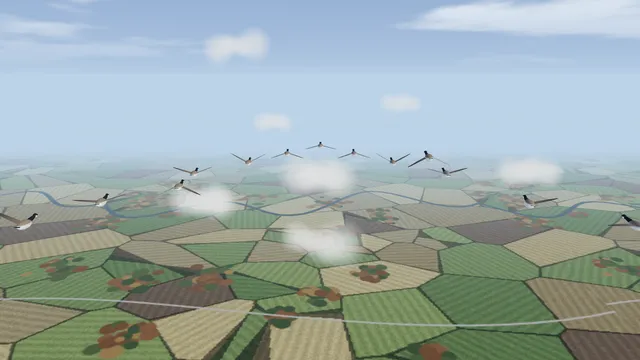
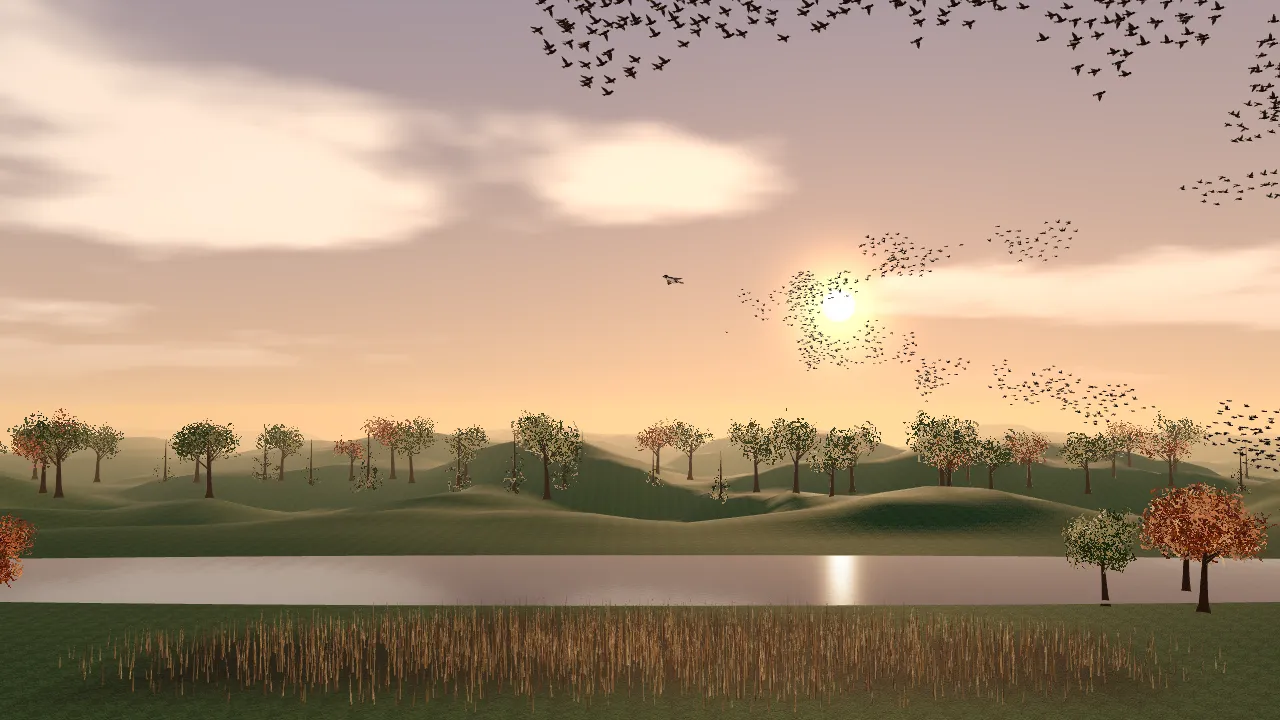
Fly a falcon at a swirling flock of starlings over a sunset roost.
How to play
- Drag in the sky to fly the falcon at the flock. Let go and it peels away.
- Drag the low sun down past the horizon: dusk falls and the starlings pour into the reed bed. Drag it back up to wake them.
- Try the three Challenges, or open Lab to change how many neighbours each starling follows, or switch to a fixed-distance rule.
- Right-drag, or turn off falcon dragging in the Lab, to look around. Pinch or scroll to zoom.
Challenges
- Fly the falcon right through the middle of the flock
- Send a wave of alarm through the flock: make a tenth of it swerve at once
- Drag the sun below the horizon and watch the flock pour into the reeds
Try this
- Set the neighbours slider to 1 and send the falcon in. Does the flock still hold together, or does it shatter into small groups?
- Switch on the metric rule, where each bird follows everyone within 2 metres, then attack again. Watch the flock tear apart where it thins out.
- Turn on “Show one starling’s neighbours” during an attack. The seven birds it follows keep changing, but there are always seven.
Fun facts
- Murmurations are made by common starlings, mostly on autumn and winter evenings just before the birds settle into a shared roost for the night.
- Researchers who filmed starling flocks over Rome in 3D found that each bird keeps track of about six or seven nearest neighbours, however near or far they are.
- The same research group found that changes in flight direction are correlated right across a flock, whatever its size, so a turn can sweep through thousands of birds.
- Peregrine falcons and sparrowhawks hunt starlings at their roosts, and a dense, swirling flock makes it hard for a predator to single out one bird.
How thousands of starlings fly as one
A murmuration has no leader and no plan. Every starling is simply reacting to the birds around it, many times a second, and the great shifting shapes in the sky emerge from those small decisions. Computer scientist Craig Reynolds showed in 1987 that three rules are enough to make a convincing flock: keep a little space, match your neighbours’ direction and stay close to them. Each bird in this simulation follows those rules, plus a pull back over the reed bed where it will sleep and a preferred cruising speed of 10 metres per second.
Seven neighbours, not seven metres
Which neighbours does a starling watch? In 2008 a team in Rome filmed flocks with several synchronised cameras and rebuilt the position of every bird in 3D. They found that each starling responds to a fixed number of nearest neighbours, about six or seven, rather than to every bird within a fixed distance. This is called a topological rule. Its great advantage is robustness: when a falcon punches a hole in the flock and the birds spread out, each one still has its seven neighbours, so the flock stretches instead of breaking. Try the metric rule in the Lab to see the difference.
Waves of alarm
When a falcon dives, the birds nearest to it swerve away and speed up. Their neighbours copy them, and the reaction runs across the flock as a wave, while the hole closes behind the predator. Observers often see dark bands ripple through a murmuration during an attack. Researchers call these agitation waves, and computer models suggest that birds banking in turn may help explain how the bands look so dark.
Why gather at all?
Safety in numbers is the leading explanation. A predator finds it hard to pick one target out of thousands of identical, fast-turning birds, and many eyes spot danger sooner. Gathering also brings birds together at a sheltered roost on cold nights, where they may pick up information from one another.
For the curious
Each bird’s acceleration is a sum: separation, which pushes it away from neighbours closer than 1.2 m; alignment, k(v̄ − v), toward the mean velocity of its neighbours; cohesion toward their centre; speed control, (v₀ − |v|)/τ, along its heading; and escape from the falcon. Velocity and position are updated 60 times a second. Each bird banks into turns at the angle given by tan φ = v·ω / g, where ω is its turning rate, the same rule a pilot uses for a coordinated turn. A spatial hash grid finds the nearest neighbours quickly, so a thousand birds cost very little. The birds are drawn a little over twice life size so you can see them flap.
Questions people ask
Why do starlings form murmurations?
The main explanation is safety. A dense, fast-turning flock confuses predators such as peregrine falcons and sparrowhawks, and many eyes spot danger early. Murmurations also gather birds together just before they settle into a shared roost for the night.
How do starlings in a murmuration avoid crashing into each other?
Each bird watches a handful of nearest neighbours, about six or seven, keeps a little space from them and matches their direction and speed. Reactions pass quickly from bird to bird, so the whole flock can turn without collisions.
When and where can you see a starling murmuration?
Murmurations are most often seen on autumn and winter evenings around sunset, near large roosts in reed beds, woods, piers or city buildings. In Britain, well-known sites include the reed beds of the Somerset Levels and Brighton’s seafront piers.