Geese in V Formation
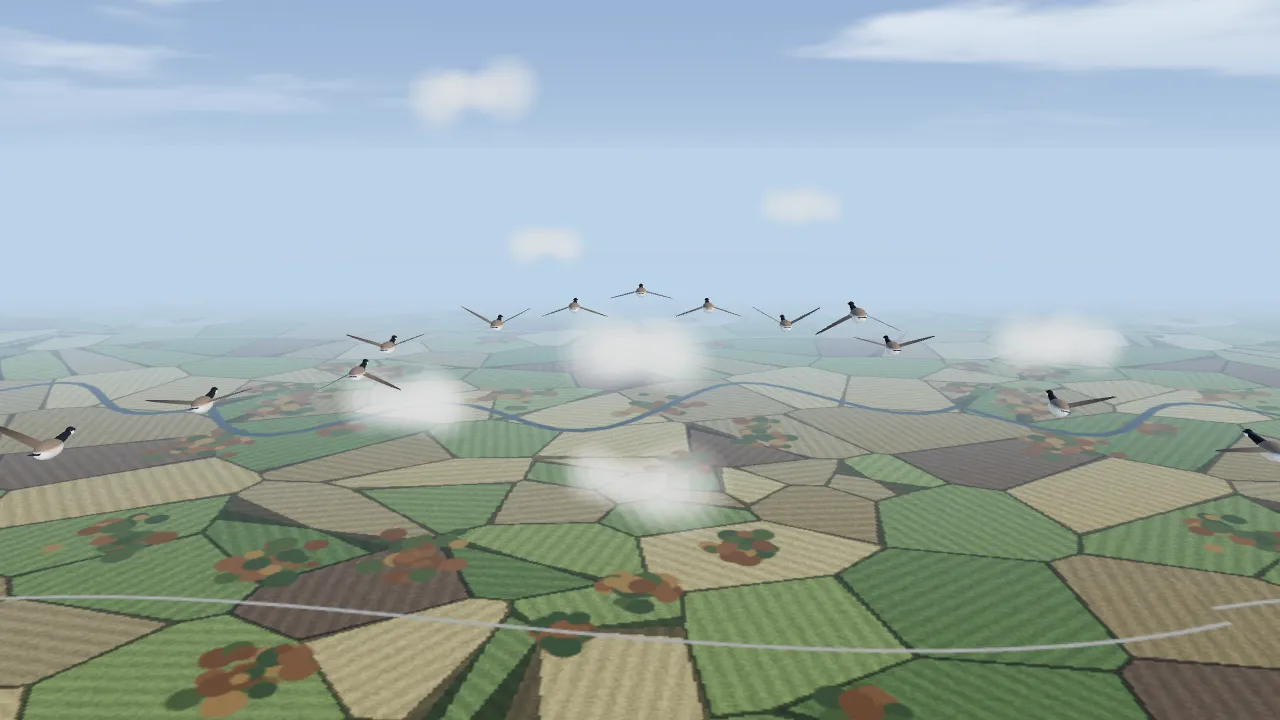
Slide geese into each other’s upwash and send them to the front.
How to play
- Drag a goose to slide it about in the formation. While you hold it, green ribbons show rising air and red ones sinking air, and you see what it saves.
- Tap a goose to send it to the front. The leader works hardest, and tired leaders drop back to rest.
- Try the three Challenges, or open Lab to keep the upwash showing, or to switch upwash-seeking off.
- Drag the sky around the flock to look about. Pinch or scroll to zoom.
Challenges
- Tap a goose and see it take the lead of the V
- Hold a goose in a wingtip’s upwash until it saves 30 % of its lifting power
- See three different geese take a turn at the front
Try this
- Switch off “Geese seek the upwash” and scatter the flock. With no rising air to chase, the geese drift into a loose bunch and the saving readout falls.
- Turn on the upwash view and follow one goose: its wingtip sits just inside the green band trailing from the goose ahead.
- Colour geese by tiredness and wait. The leader turns red first, drops back to rest, and another goose takes a turn at the front.
Fun facts
- Many large birds fly in V or slanting-line formations, including geese, cranes, pelicans and ibises.
- In 2014, researchers fitted northern bald ibises with tiny data loggers and found that the birds placed themselves in the rising air behind the bird ahead and timed their wingbeats to match it.
- Ibises on those flights took turns at the front, with each bird spending a similar amount of time leading and following.
- In another study, great white pelicans had lower heart rates when flying in formation than when flying alone.
Riding the air off a neighbour’s wingtip
A wing makes lift by pushing air downward. That downwash doesn’t stay behind the wing as a flat sheet. Within a short distance it rolls up into two spinning tubes of air, the wingtip vortices, one trailing from each wingtip. Between the two vortices air is moving down. Just outside them, it is moving up. A bird flying in that rising air, the upwash, gets some of its lift for free, the way a glider gains height in a rising air current.
Why a V?
The best seat is diagonally behind the bird in front, with your inner wingtip just outboard of its wingtip vortex. Each goose in this simulation measures the vertical air speed across its own wings, created by every goose ahead of it, and steers sideways and up or down toward stronger upwash. Nobody plans the formation. Because the best spot is always beside and behind someone, the flock assembles into a slanting line, or into two lines meeting at a point: a V.
Field studies support this. Northern bald ibises carrying data loggers placed themselves where theory predicts the upwash should be, and even timed their wingbeats so their wingtips followed the path of the bird ahead. The geese here do the same, adjusting their wingbeat phase to the goose in front.
Taking turns
The leader flies in undisturbed air and works hardest. In this simulation, every goose builds up tiredness at a rate that depends on how much upwash it is getting. When the leader is worn out, it drops back to the end of the line to recover, and the next bird finds itself in front. Ibises have been seen sharing the lead in a similar way.
For the curious
For a wing with an elliptical lift distribution, the two tip vortices end up a distance b′ = πb/4 apart, where b is the wingspan. Lift must equal weight, so each vortex has circulation Γ = mg / (ρ U b′), where ρ is air density and U is airspeed. A straight vortex induces a swirl of speed Γ / (2π r) at distance r, with a small core so the speed stays finite. The model goose has a mass of 4 kg, a 1.6 m wingspan and flies at 17 m/s. Its saving is the upwash w averaged across its span, multiplied by its weight, as a share of the induced power a lone goose would need, (mg)² / (2ρU · πb²/4). Induced power, the cost of making lift, is only part of a bird’s total flight effort, so total energy savings are smaller than the readout shows.
Questions people ask
Why do geese fly in a V formation?
Mainly to save energy. Each wing leaves rising air just outside its wingtips, and a bird flying diagonally behind its neighbour gets some free lift from it. A V or slanting line gives most birds that position, and it may also help the flock keep visual contact.
Which bird leads a V formation?
The front position is the hardest because the leader has no upwash to ride. In ibises, which have been studied closely with data loggers, birds take turns at the front, swapping between leading and following during a flight.
How much energy does flying in a V save?
It depends on the spacing and on how much of a bird’s flight effort goes into making lift. Pelicans have been measured with lower heart rates in formation, and aerodynamic theory predicts the biggest savings for birds that sit precisely in the upwash, which is what the geese in this simulation try to do.