Koi Pond
Feed koi in a Japanese garden: tap the water and they rise to gulp.
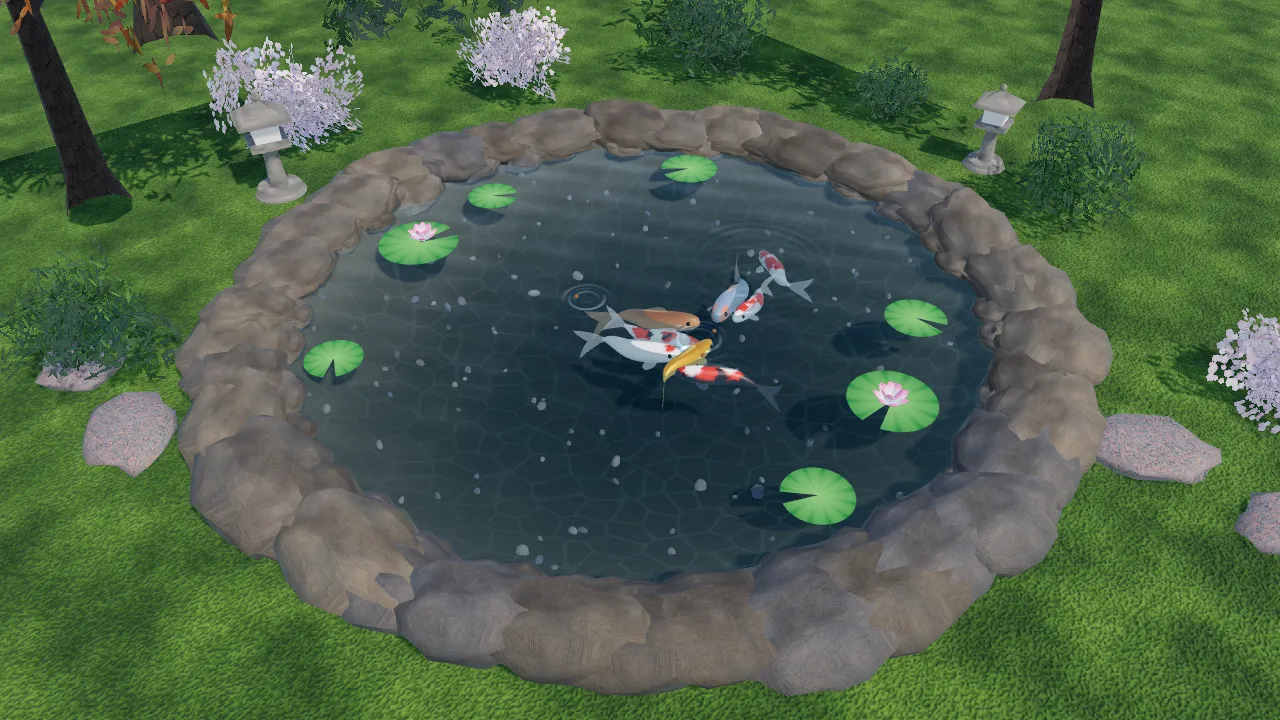
How to play
- Tap the water to drop a few floating pellets. Koi sense the plop and rise to gulp them.
- Tap right beside a koi to startle it, then see it come back for food.
- Try the three Challenges, or open Lab to change the number of koi, switch to golden hour or dusk, or show how far each koi can sense food.
- Drag the garden to look around the pond. Pinch or scroll to zoom in on a fish.
Challenges
- Feed the koi ten pellets
- Feed a kohaku, a sanke and an ogon: red and white, three colours, and gold
- Gather five koi around one handful of food at the same time
Try this
- Turn on “Show what each koi senses”, then drop one pellet just outside every circle. Does any koi notice it?
- Feed one side of the pond with 3 koi, then again with 14. Which crowd reaches the food first, and why do they jostle more?
- Zoom in on a koi as it speeds toward food. Its tail beats faster as it goes faster, just as the Strouhal number predicts.
Fun facts
- Koi are a colourful domesticated form of the common carp, bred in the Niigata region of Japan since the early 1800s.
- “Koi” simply means carp in Japanese. The fancy coloured varieties are called nishikigoi, roughly “brocaded carp”.
- Koi have no true stomach. Food passes almost straight from the mouth into the intestine, which is why small, frequent meals suit them.
- Koi can live for decades. A famous scarlet koi named Hanako was reportedly 226 years old when she died in 1977, judged by the growth rings on her scales.
How koi swim, sense and steer
These koi aren’t recorded animations. Each makes small decisions many times a second, and its body bends like a real fish’s.
Swimming with a travelling wave
Like other carp, koi swim in a subcarangiform style. A wave of bending runs from the head toward the tail and grows as it travels, so the head stays fairly steady while the back half of the body and the tail sweep from side to side. Each sweep pushes water backward, and by Newton’s third law the water pushes the fish forward.
How fast should the tail beat? Biologists compare swimmers using the Strouhal number, St = f × A / U, where f is the tail-beat frequency, A is how far the tail tip sweeps from side to side, and U is the swimming speed. Fish, dolphins, birds and bats all cruise with St between about 0.2 and 0.4, where thrust is produced most efficiently. Every koi here keeps St at 0.3, so a 60 cm koi cruising at 15 cm per second beats its tail roughly once every two and a half seconds, while one dashing away at almost a metre per second beats it nearly twice a second.
Senses: eyes, taste and the lateral line
Koi find food by sight, by taste (their whisker-like barbels carry taste buds) and with the lateral line, a row of pressure-sensing pores along each side that feels movements in the water. That is why the plop of a pellet brings fish from across the pond. Here, each koi notices food within a fixed distance, shown by the Lab overlay.
Steering by simple rules
Each koi blends a few desires, an idea known as steering behaviours that the computer scientist Craig Reynolds introduced in the late 1980s to animate flocks and schools. Every koi wanders a little, keeps some personal space, turns back before reaching the stones, and heads for the nearest food it can sense, slowing as it arrives. None of the fish knows the overall plan. The gentle circling, the crowd that gathers around a meal and the jostling at the surface all emerge from these rules.
The escape reflex
Tap right beside a koi and it bolts. Real fish have a pair of giant nerve cells, the Mauthner cells, which can trigger a C-start within a few thousandths of a second: the body bends into a C, then one powerful tail stroke launches the fish away. Pond koi soon get used to people, so the startled fish comes back for dinner.
For the curious
The swimming wave here bends the body by A(s)·sin(2πs/λ − ωt), where s runs from the nose (0) to the tail (1), the amplitude grows as s², the wavelength λ is about one body length, and ω comes from the Strouhal relation above. Steering adds weighted direction vectors, and each koi turns toward their sum at a limited rate, so koi can’t spin on the spot unless startled.
Questions people ask
Why do koi come to the surface when you feed them?
Most koi pellets float, and koi quickly learn that a splash at the surface means food. They feel the plop with their lateral line, find the pellet by sight and taste, then rise and gulp it from the surface.
How fast do koi swim?
Calm koi cruise slowly, often well under half a metre per second, and can burst several times faster for a moment when startled. The koi here cruise at 11 to 18 centimetres per second and dash at up to about a metre per second.
Do koi really get scared when something splashes beside them?
Yes. A sudden disturbance can trigger the C-start escape reflex, run by giant Mauthner nerve cells, which bends the fish into a C and launches it away in a fraction of a second. Koi kept in ponds soon get used to people and come back for food.